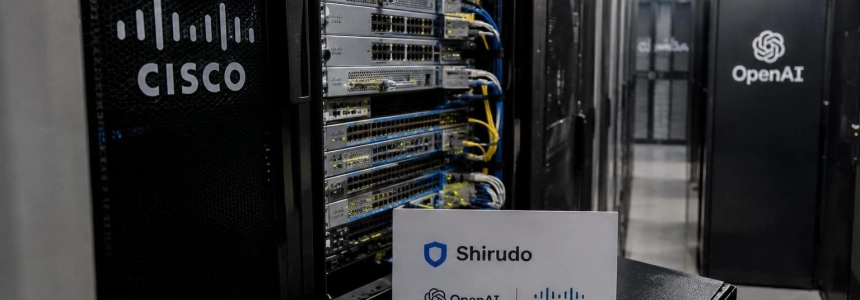
A shield generated with Codex blocked an attempt to exploit Java4Shell against an Elasticsearch instance that kept running, without restarting the system. That is the demonstration OpenAI and Cisco are using to introduce Shirudo, an open project for Linux that aims to contain attacks while teams prepare and deploy the definitive patch.
The tool generates small mitigations—called “shields”—to block the behavior that makes it possible to exploit a vulnerability, without completely shutting down the affected operation. The difference matters when that same operation also handles legitimate requests: simply disabling it could take an application offline. With Shirudo, teams can test the protection and review its effect before authorizing it.
An ever-shorter window for defense
The project addresses a problem Cisco describes as a race between discovering flaws and installing permanent fixes. Jeetu Patel, Cisco’s president and chief product officer, argues that attacks and vulnerability detection now unfold in minutes or hours, while developing, testing, and distributing a patch still takes time. According to Cisco, campaigns related to PHP2Shell and Java4Shell began within a day of the flaws being disclosed, or even earlier.
The company also notes that AI agents can operate on both sides: they help find vulnerabilities, but attackers can also use them to exploit discovered flaws. Cisco credits startup Calif with finding a PHP flaw and a major Java issue using OpenAI’s Cyber model. According to Patel, the speed of these tools reduces the response time available to teams tasked with protecting systems that have not yet been patched.
In its announcement, Greg Brockman, president and co-founder of OpenAI, summed up the gap between finding a bug and fixing it across all affected systems: “Finding a bug today doesn’t mean you can patch every system tomorrow”. Shirudo’s proposal is to buy time with a temporary, targeted defense, not to replace the fix that must come later.
“Finding a bug today doesn’t mean you can patch every system tomorrow.”
— Greg Brockman, president and co-founder of OpenAI
OpenAI explains that a risky function may be necessary both for an attacker and for legitimate users. For that reason, a shield should intervene in the specific path exploited by the exploit and let the rest of the requests continue. The tool gives operators the option to observe how a protection would behave before switching it to active blocking; approval remains in the hands of the security team.
eBPF makes it possible to intervene without restarting
Shirudo relies on eBPF, a Linux technology that allows small, verified programs to run at specific points in the operating system. In this case, those programs can observe activity and apply controls to a running system without changing the application’s source code or restarting the system. OpenAI and Cisco present it as the foundation for placing a mitigation alongside the vulnerable operation.
The planned cycle combines vulnerability analysis, shield generation, and testing to determine whether it stops the exploit without harming the service. Agents can work with available vulnerability information and disclosures, reproduce the exploit, and validate the mitigation against the attack and real workloads. The operator decides which protection is activated; the system can also monitor false positives, performance, and the application’s overall health.
Before it is loaded, each shield carries a cryptographic signature that must be verified. The kernel’s eBPF verifier checks that the programs comply with its security rules, while kernel controls seek to prevent unauthorized changes. Shirudo also uses a Trusted Platform Module (TPM), a hardware security component, to maintain a verifiable record of protections that have been added or removed.
SecurityWeek reports that the mechanisms are designed to make it difficult for even an attacker with root privileges to disable the application of controls in the kernel. OpenAI’s proposal also includes preserving evidence about controls throughout the system, from their creation to the machine where they run. This traceability is intended to let operators review which protection was active.
The Java4Shell test and its limitations
In the test described by OpenAI, Codex generated a shield to validate the input received by Java’s Base64 decoder. The mitigation was attached to an Elasticsearch process that was already running; when an attempt was made to exploit Java4Shell, it rejected the malicious input and blocked the attempt. The service remained online during the test, without restarting the system.
Infosecurity Magazine clarifies that this was a single controlled test, designed and carried out by the project’s developers, not an independent evaluation. It also reports that Isovalent described the mitigation as apparently effective and said it would protect affected applications until OpenJDK was patched. The published results therefore show a specific demonstration, but not an external validation of how it works across different environments.
The software’s status is another practical limitation. SecurityWeek reports that Shirudo is in early development and is not ready for production: it requires specific Linux kernel capabilities, additional kernel patches, and TPM 2.0. Repository documentation cited by Infosecurity Magazine also makes production use conditional on a kernel that includes Shirudo’s patches and a TPM 2.0 chip.
The project has its roots in Tetragon, the eBPF-based runtime security platform that Isovalent made public in 2022. Cisco acquired Isovalent in 2024, and Tetragon already serves as the foundation for Live Protect, Cisco’s vulnerability mitigation feature. Shirudo is a rewrite designed for agents: instead of making them work through consoles, configuration files, and policy languages intended for people, it lets them work directly with code and technical context.
From prototype to shared shields
Thomas Graf, Isovalent co-founder, and Liz Rice, the company’s head of open source, describe agents as particularly capable of generating code, processing large amounts of context, and examining low-level code. In the proposed architecture, an agent can search for flaws on its own initiative or respond to an external disclosure, build a mitigation, check that it works, and repeat the process until it finds an effective approach. Once the permanent patch is installed, the temporary shield is removed.
Isovalent also describes a counter for active exploitation attempts, which would make it possible to investigate attacks when they are detected. The process can be configured with different levels of autonomy, but OpenAI and Cisco leave deployment control in the hands of security teams. Cisco also proposes that agents monitor false positives, performance, and service health, and incorporate red-team test results and production signals to review defenses.
OpenAI and Cisco want tested shields to be distributed alongside vulnerability disclosures, so organizations have a temporary mitigation while preparing to install the permanent fix. This is a future goal, not a capability already presented as available at scale. OpenAI also sets out as long-term goals quickly identifying affected systems and automatically generating least-privilege policies.
Shirudo is released under the BSD 2-Clause license; its BPF programs are dual-licensed under BSD and GPL. OpenAI and Cisco invite developers, security researchers, and infrastructure operators to review the code, test the protections, and contribute. OpenAI proposes a quick-start guide in a virtual machine and an Isovalent self-guided lab; both companies also announced a technical webinar for December 15, 2026.
Caution around dynamically generated sensitive code
The idea has also drawn concerns about the risk of creating and deploying sensitive kernel code during a response to an attack. Amiram Shachar, CEO and co-founder of Upwind, told SecurityWeek: “I love the idea, but doing it with open source is very risky”. His objection focuses on the complexity of testing the tool against the many versions and distributions of Linux before trusting it with production systems.
Shachar added that Shirudo would need to be tested, packaged, and automated before anyone could trust it in production. That warning is consistent with the early-stage status SecurityWeek attributes to the project and with the kernel and TPM requirements detailed in the launch materials. For now, the Java4Shell case serves as a demonstration of a targeted mitigation; making shared shields available alongside future disclosures remains a goal for OpenAI and Cisco.
Sources: InfoWorld, SecurityWeek, Infosecurity Magazine, OpenAI, Cisco Blogs, SiliconANGLE