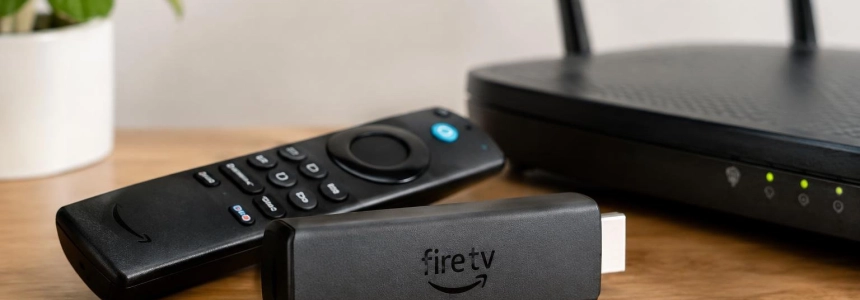
App Cloner may share your Fire TV connection with proxy services that route third-party traffic through your IP address. AFTVnews confirmed connections to Traffic Monetizer, Massive, and Pawns.app; if the application is still installed, the recommendation is to uninstall it.
This affects anyone who installed App Cloner on a Fire TV device, whether from Amazon’s store or through sideloading. Amazon removed the application from its Appstore, but that does not remove a copy you already have installed; AFTVnews reports that it is still distributed on its developer’s website.
How to check whether it’s on your Fire TV
Look for the exact name, App Cloner, in the list of installed applications. Netzwelt gives these steps to remove it: open the gear icon in the Fire TV menu, go to “Apps,” then “Manage Installed Applications.” Select App Cloner and choose “Uninstall”; complete any prompts that appear on screen.
Network activity may provide another clue, but you don’t need to investigate it to take action. AFTVnews observed connections from the main application to Traffic Monetizer, Massive, and Pawns.app. These names can serve as clues if you’re already reviewing your network traffic; they are not required to identify or uninstall the app.
What to do, step by step
Check your installed applications. On Fire TV, select the gear icon in the menu, open “Apps,” then “Manage Installed Applications,” following Netzwelt’s instructions. Browse the list and look for App Cloner. If it isn’t listed, don’t uninstall anything: the sources do not identify any other affected applications.
Uninstall App Cloner if it appears. Select it, choose “Uninstall,” and follow the on-screen instructions. PCWorld recommends removing it as a precaution. AFTVnews also notes that uninstalling the main application stops network sharing on that device.
Don’t look for a switch inside the app. AFTVnews says App Cloner does not let you disable the connection-sharing feature separately. Its terms describe the feature as part of the free service. If you don’t want it to remain active, the recommended step is to remove the application.
Keep cloned copies in mind. AFTVnews found no evidence that cloned applications establish the proxy connections made by the main application. If you rely on a copy, the outlet suggests uninstalling App Cloner after creating it and continuing to use the cloned app. This is not the same as leaving App Cloner installed: the observed activity was associated with the main application.
Check anyway if you installed it from outside the store. Removing it from the Amazon Appstore does not remove previous manual installations. AFTVnews says the application was still available on its developer’s website; that’s why checking the installed-apps list is more useful than looking only to see whether it appears in the store.
If you receive an inquiry about traffic associated with your connection, save the communication and contact your connection provider if you need to clarify its origin. App Cloner’s terms state that websites or services may direct inquiries to the connection holder, and that the company says it will try to refer the matter to the relevant network partner if asked. They do not promise to resolve every case.
What sharing your connection means
When it operates as a residential proxy, the device acts as an intermediary: third-party requests reach online services using the user’s connection and public IP address. AFTVnews explains that malicious activity could be associated with that connection, although it does not claim that all uses are illegal. It also notes that these services have legitimate uses and that some have been used to facilitate crimes.
App Cloner’s published terms describe the mechanism as a feature that becomes active after accepting the agreement: some bandwidth is made available to network partners, and activity may continue while the application runs in the background. The document states that traffic from these clients is kept separate from the user’s own activity and that the device’s files, messages, and credentials are not accessed. This does not change the practical advice: the feature cannot be turned off without uninstalling the app.
PCWorld also reports a noticeable effect on the Fire TV it examined: App Cloner consistently used between 60 and 120 MB of RAM on a device with 2 GB, and caused delays and freezes. Those figures apply to the case described, not to a measurement of all Fire TV devices. AFTVnews confirms proxy connections but does not provide the same memory measurement.
Mistakes to avoid
Don’t assume removing it from the store is enough. Amazon removed App Cloner from its Appstore, but installed copies remain on devices until someone removes them. Check the Fire TV’s application list.
Don’t mistake a risk for proof of a crime. Using a proxy connection can make third-party traffic appear to come from the user’s IP address, and some services of this kind have been used for illegal purposes. That does not prove that every request routed through App Cloner is criminal or that the user has committed an offense.
Don’t rely solely on the terms of use. AFTVnews found that App Cloner described using some of the available connectivity to route third-party traffic, but also concluded that there were no controls to disable this feature. Reading the explanation is no substitute for removing the app if you don’t want to share your connection.
Don’t delete a cloned copy based on an assumption. In AFTVnews’s tests, a cloned application did not establish the proxy connections observed with App Cloner. The outlet suggests keeping the cloned app and removing the main application if you need the copy; its tests do not justify claiming that all copies work the same way on every device.
The specific action is to check your installed applications and remove App Cloner if it appears. Amazon removed it from the store, but the local installation does not disappear on its own.
Sources: PCWorld, AFTVnews, Netzwelt, Futurezone, App Cloner