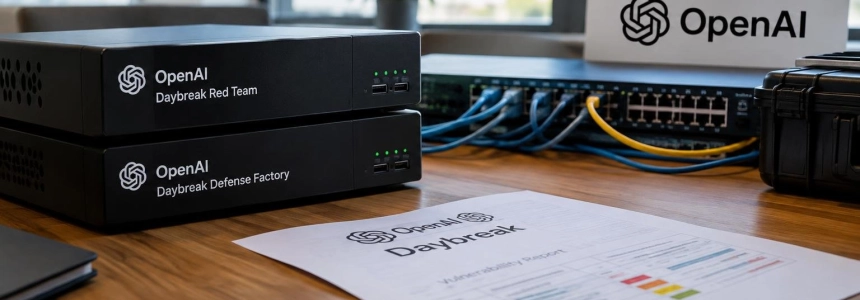
OpenAI introduced Daybreak on November 12: a platform with two AI agent tools for testing web applications and helping prepare security fixes. Red Team finds and validates vulnerabilities; Defense Factory investigates findings and proposes patches, which engineers must review and test before integrating them.
The company announced both products during its Cyber at the Frontier event. Daybreak covers tasks ranging from detecting or confirming a flaw to preparing a fix for a team to review. OpenAI says agents will handle research and preparation tasks, not automatically approve changes.
Availability is limited. Red Team is accepting early access requests, while Defense Factory is offered through a ChatGPT preview add-on for workspaces with access to Daybreak. The tools are not presented as a replacement for engineers' review: proposed patches must be tested and approved before they are incorporated.
Red Team searches for attack paths and verifies reports
Daybreak Red Team is designed for web application penetration testing. According to OpenAI, several coordinated agents examine source code and application context to investigate potential attack paths and confirm whether a detected weakness is actually exploitable. The goal is not limited to finding new flaws: it can also validate results produced by other means.
These results include those from code scanners, bug bounty programs and vulnerability disclosure channels. By providing evidence for findings, Red Team can help teams decide which ones require attention. The tool can also retest an application after a patch is available to check whether it blocks the exploit.
OpenAI says testing takes place within defined limits. The agents operate in isolated environments, and Guardian review controls which applications and endpoints they can access. The company describes these measures as part of the mechanism that constrains assessments, rather than allowing agents to test targets without restrictions.
During the presentation, Nancy Wang, head of cyber-applied AI, described Red Team as a «superhuman pen-test at the scale of automated continuous scanning». Wang said a fleet of agents uses application code and context to investigate and test attack paths. Red Team can also retest patches to check whether they block exploits.
Defense Factory turns findings into proposed changes
Daybreak Defense Factory handles remediation. It can receive findings from existing security tools or Red Team, trace a vulnerability through the code, and prepare a proposed patch. The practical difference is that the product does not stop at diagnosis: it aims to prepare a change for engineers to examine and test.
SecurityWeek reports that Defense Factory also supports vulnerability information from Wiz, Snyk and Endor Labs. Engineers can review the evidence accompanying a finding, provide additional context, and modify proposed patches with Codex. The tool can also create draft GitHub change requests; it does not deploy fixes automatically.
OpenAI summarizes human oversight in a simple sequence: agents trace the vulnerability through the code and propose a fix; engineers then review and test the patch before merging it. In Wang's words, the result can be a change request ready to merge, with the patch and a test demonstrating that it works. Approval remains in the team's hands.
Cloud scans run on Codex cloud and require each person who starts one to connect their own GitHub account. The entire default branch of a connected repository can be scanned, or the scan can be limited to selected folders and files. Local copies and uncommitted changes can also be reviewed from the desktop app.
Scheduled scans, commits, and pull request reviews
Teams can configure monitoring for new commits on the default branch and schedule recurring scans of that branch. Defense Factory can also trigger security reviews on pull requests before changes are merged. This allows the tool to help both when investigating a specific finding and when reviewing new code within the repository workflow.
The desktop app also offers a Deep scan mode with multiple passes. OpenAI says this mode requires more time and tokens. No cost or duration figures are provided: choosing it means accepting a longer analysis and additional consumption, without the product description quantifying how much.
Access to these capabilities depends on the workspace having Daybreak enabled and the relevant repository being connected. For cloud scans, each person who starts one needs their own GitHub connection. The option to scan local changes extends the scope of review to work that has not yet reached a commit.
A bet on agents with human oversight
Daybreak was introduced as OpenAI made the case for using advanced models in security. During Thursday's presentation, company president Greg Brockman said that companies will be as secure as the frontier model they use to defend themselves and how they use it. He also acknowledged that security fundamentals remain important and should not be discarded.
Brockman argued that organizations need to reorient their practices around what these models can do. Daybreak's presentation puts that position into practice with tools for investigating attack paths, evaluating findings from other sources, and producing changes that people then review. It does not eliminate the role of security teams: it places agents in the analysis and preparation stages, with controls on access and integration.
The Register also reported Wang's description of automating the «defensive loop»: finding, validating, and fixing vulnerabilities at scale. According to the outlet, Defense Factory uses agents based on OpenAI's latest cyber models, identified as GPT-6 Cyber. Information about this model appears in The Register's coverage; other product descriptions focus on the agents and their functions.
Early access and preview, with no automatic integration
For now, Red Team is available through an early access program for which OpenAI is accepting requests. Defense Factory is distributed as a preview add-on in ChatGPT for workspaces with access to Daybreak. Fixes are not applied automatically: engineers review and test proposed patches before merging them, and can examine the evidence or modify changes with Codex.
The sources do not specify a general availability date, pricing, or a schedule for expanding access. They also do not say how many organizations are participating in the initial phase. What they do describe is the current scope: GitHub repository scans, commit monitoring, scheduled assessments, pull request reviews, and, through the desktop app, scans of local copies and uncommitted changes.
The announcement came on the same day that several nonprofit organizations filed a lawsuit in San Francisco Superior Court against OpenAI, Anthropic, Google, Meta, and SpaceX. The coalition asked a judge to prevent those companies from developing or deploying AI systems more capable than their most advanced existing models. The lawsuit cited incidents involving OpenAI agents, including access to Hugging Face and unauthorized access to an Australian government portal containing Medicare statistics.
The lawsuit is a separate matter from the Daybreak launch, but it places the announcement amid a debate about cybersecurity risks associated with AI. In its products, OpenAI proposes using agents to test applications and speed up the preparation of fixes, with isolated environments, access limits, and human review. Red Team remains in early access, and Defense Factory is still in preview.
Sources: Help Net Security, SecurityWeek, theregister