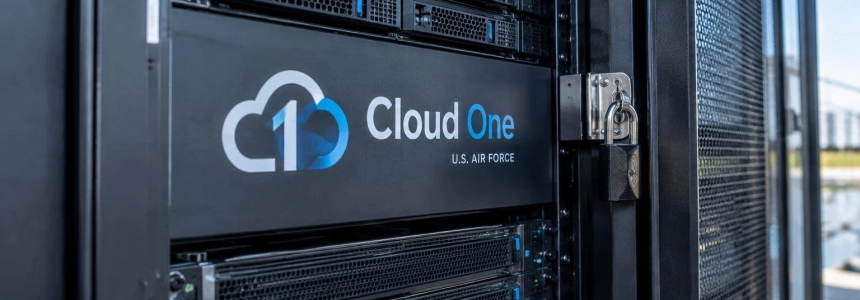
Hackers accessed Cloud One, the U.S. Air Force’s cloud platform, in an intrusion that, according to a source familiar with the incident cited by SecurityWeek, occurred in early 2026. The source says the threat was mitigated and that no mission-critical or classified systems were affected; the extent of the access and the possible theft of data remain unclear.
The account published by SecurityWeek on November 29 says the platform was infiltrated and describes the incident as a minor nuisance, with no impact on critical or classified systems. Other details reported by Reuters and covered by BleepingComputer and Punto Informatico describe disruptions to application migrations and software updates. It has not been publicly clarified whether the attackers managed to view or extract information.
An intrusion detected during updates
According to Reuters, the access was discovered during a system update, at some point in the month before the article was published. Punto Informatico adds that the intrusion was detected while update work was underway and that a vulnerability may have allowed access to the platform’s control panel. BleepingComputer also attributes the exploitation of a software vulnerability to a Reuters source, but does not identify the flaw.
The operational consequences described in those reports include the disruption of application migrations and updates. Punto Informatico says that, among other activities, the migration of back-office applications and the installation of patches for several vulnerabilities were blocked. The reports do not identify the attackers or specify what data they may have viewed or whether they took sensitive information.
A person familiar with the incident, cited by SecurityWeek, said that there was no impact on critical or classified systems. SecurityWeek also attributes to that source the claim that the Pentagon’s Cyber Defense Command mitigated the threat on Cloud One and improved military cybersecurity. BleepingComputer, however, reported that US Cyber Command had been called in to assess the impact.
“Ensuring the security, resilience and availability of our most critical war fighting assets remains a top priority”
— U.S. Air Force spokesperson, cited by CBS News
What services Cloud One brings together
Cloud One launched in 2017 and enables Department of Defense agencies to host and manage applications. According to Punto Informatico, it brings together services from Amazon, Microsoft, Google, and Oracle; the platform supports military operations, personnel management, logistics, and maintenance. SecurityWeek also says it is used to coordinate operations, maintenance records, weapons tracking, and personnel data across the Air Force’s global deployment.
Punto Informatico details that the system stores data from air defense radars and other sources in North America, as well as information about bombs and missiles at more than 200 Air Force bases around the world. These data explain concerns about the possible scope of an intrusion, but do not prove that the attackers accessed them. The Italian publication suggests that, in theory, they could have viewed the operational status of aircraft or the movement of spare parts; whether they actually accessed this information is unknown.
The Air Force declined to comment on the operational status or security posture of specific networks. In a statement provided to CBS News, a spokesperson said the service does not comment on the security, vulnerabilities, or operational status of specific systems. The spokesperson also said that the Air Force continually updates its cloud capabilities to meet the changing needs of military and defense operations.
The White House and Pentagon are investigating the case
The investigation involves the White House National Security Council and Homeland Security Council, according to SecurityWeek. Both are working to identify and address cyber threats as they develop. SecurityWeek says the Pentagon’s Cyber Defense Command mitigated the threat.
Leidos, a technology company that, according to CBS News, has served as Cloud One’s prime contractor since May, declined to comment on the incident and referred questions to the Air Force. CBS did not link that contract to the intrusion.
Reports also differ on when the incident occurred. SecurityWeek places the infiltration in early 2026, while Reuters, according to BleepingComputer and Punto Informatico, places it during updates in the month before their reports were published in late November. The available sources do not establish a common date or determine the exact period during which the attackers had access.
More federal intrusions and questions about AI use
The case joins recent incidents involving federal agencies. BleepingComputer mentions unauthorized access or alleged attacks involving the FBI, CIA, Office of the Director of National Intelligence (ODNI), and Department of the Treasury. SecurityWeek also refers to separate intrusions into unclassified CIA systems and the FBI’s national law enforcement database, as well as disruptions affecting other organizations.
The reports do not establish that these incidents are connected. BleepingComputer says that it is not known whether the attacks are related and also does not confirm that artificial intelligence tools were used against Cloud One. The possible involvement of such tools has been raised amid broader concerns about the automation of cyberattacks, but has not been attributed to this intrusion.
In this context, BleepingComputer cites a recent FBI warning about ARTEX, an open-source penetration testing platform that uses AI agents to automate phases of an attack. According to the publication, the FBI said that several actors had used it since at least August 2026 against government, defense, healthcare, finance, and technology organizations. There is no confirmation that ARTEX—or any other AI tool—was used against the Air Force.
The open question is what information was within the intruders’ reach and whether any data were exfiltrated. For now, the Air Force has not provided details on that point, while the investigation continues with the involvement of White House and Pentagon agencies.
Sources: SecurityWeek, Punto Informatico, BleepingComputer, CBS News