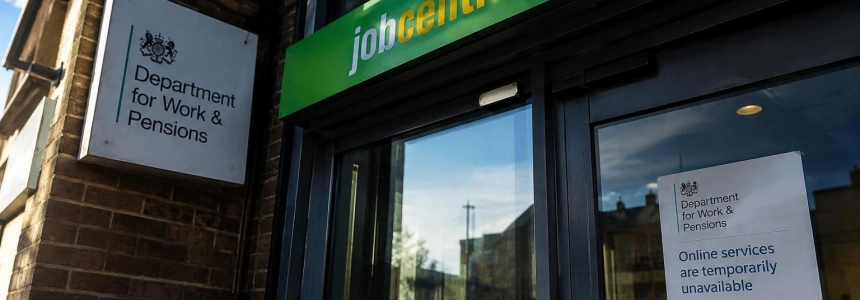
The UK Department for Work and Pensions (DWP) disconnected online services after detecting a cyber incident in its systems. The measure, announced on 27 November, prevents users from accessing several services, while the department says regular benefits and pensions will be paid as normal.
The DWP said it is working with the National Cyber Security Centre (NCSC) and the Government Cyber Coordination Centre to investigate what happened and restore services. It has not said when they will be available again or publicly identified a possible perpetrator. Downing Street said there was no evidence of customer data loss, but noted that the investigation is ongoing.
Online services and accounts unavailable
The outage affects online accounts for services such as Universal Credit and the state pension, according to Infosecurity Magazine. The BBC, as reported by The Next Web (TNW), also said that systems for applying for Personal Independence Payment, a disability benefit, and state pension applications were down. Tell Us Once, the service that lets people report a death to various public bodies, also stopped working.
Reports of the specific extent of the outage differ. Infosecurity Magazine said users could not log in to Universal Credit and state pension accounts; TNW also listed application services and Tell Us Once. In its public notice, the DWP referred to “some online services” without publishing a complete list.
The Times political editor, Steven Swinford, wrote on X on 27 November that the department had taken all its online services offline at around 21:00 GMT on 26 November. He also said that new applications could not be submitted while the services remained unavailable. The DWP did not publicly confirm that timing or specify in its statement which services remained inaccessible.
Regular payments and claimants’ accounts
The department reiterated that regular payments are not affected and will be made as usual. However, TNW reported that some Universal Credit claimants told the BBC they had not received their payments on Friday. The DWP asked anyone experiencing problems to call their usual helpline; GOV.UK said department staff would provide support.
The difference between the official assurance and those accounts remains unresolved in the available statements. The DWP maintains that the incident does not affect regular payments, but has not explained whether the cases reported to the BBC were due to the service outage or provided an individual explanation for them.
The DWP reminded people that it will never ask for bank details or urge them to click links in a message. The warning on the GOV.UK page also covers personal information sent by text or email.

What the Government and officials have said
Work and Pensions Secretary Pat McFadden described the episode as a “serious cyber incident”, according to TNW, and said the department had known about the problem since Thursday. He added that taking the systems offline was the right decision to protect personal data. McFadden said there was no evidence that anyone’s data had been compromised.
“Currently there is no evidence of customer data loss. But the investigation is ongoing so I’m not going to get ahead of that process,”
— Official spokesperson for the prime minister, according to The Next Web
The prime minister’s spokesperson described the case as an “ongoing” incident and did not rule out the possibility that a malicious actor was behind it. The spokesperson also said there was no indication that the actor had attacked other government departments. The DWP is working with the NCSC — part of GCHQ, the UK’s signals intelligence agency — and the Government Cyber Coordination Centre.
Political reactions included support for the precautionary shutdown from Debbie Abrahams, chair of the Work and Pensions Committee, who called it “absolutely right”, according to TNW. Chi Onwurah, chair of the Science and Technology Committee, said the disruption “should serve as a wake-up call”.
During an appearance before MPs on 4 November, DWP Permanent Secretary Sarah Healey described the state of the department’s IT systems: “Quite often we are working on extremely old computer systems”, according to TNW. The publication did not link that remark to a specific cause of the current incident.
A department that administers benefits for millions
The DWP administers the state pension and benefits for people of working age, people with disabilities and people with health problems. Infosecurity Magazine puts the reach of its services at 20 million claimants and customers, and says the department had 96,890 employees in 2025. TNW, citing the annual accounts for the 2025-26 financial year, puts the number of people covered at 23 million and spending on pensions and benefits at £309.5 billion.
The figures refer to different periods and measures: one concerns the 2025 workforce, while the others relate to spending and people supported during 2025-26. In both cases, they reflect the scale of the services whose digital functions remain disrupted, although regular benefits, according to the official position, continue as usual.
Previous warnings and shutdowns
The incident follows several official warnings about risks to essential services. In October, Defence Secretary Wes Streeting urged the public to prepare for cyber incidents capable of disrupting everyday services such as running water, sewage, phone networks and the internet. In November, Richard Horne, chief executive of the NCSC, warned that AI-powered malware was expected to appear in ransomware attacks on critical UK infrastructure by 2028.
Infosecurity Magazine also recalled that several UK government websites were taken offline in October following the disclosure of PHP2Shell vulnerabilities, before the planned security patches were available. The publication said the shutdown was intended to prevent those services from being exploited. No link has been established between that episode and the DWP incident.
Trevor Dearing, senior director of critical infrastructure at Illumio, argued that public bodies should use temporary shutdowns when they cannot determine how far an attacker has penetrated. At the same time, he warned that this response should not become a permanent solution, particularly for pension and benefit services on which millions of people depend.
The Register added that the UK Government announced an investment of £130 million in AI-based cyber defence technology in late October, as part of a £600 million government spending plan for artificial intelligence announced by the Treasury. The publication also noted criticism of the focus on AI defences while legacy IT systems remain in use.
The DWP says it is working to restore services “as soon as possible” and minimise disruption. It has not set a date for their restoration. The Register reported that the department declined to comment further beyond its public statement; it has also not said whether data may have been compromised or what caused the incident.
For now, anyone who needs to manage a benefit should use their usual telephone helpline and try the online service again later. The department maintains that regular payments will be made as normal while the investigation continues.
Sources: Infosecurity Magazine, theregister, TNW | Security, GOV.UK, AnewZ