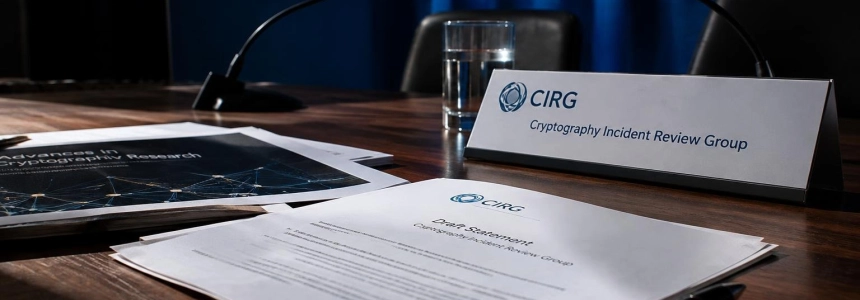
The Cryptography Incident Review Group (CIRG), a panel of 21 cryptography specialists, is preparing a statement. The signal comes as computer scientist Scott Aaronson says artificial intelligence labs may have achieved unprecedented mathematical results; so far, no verifiable attack against a deployed cryptographic system has been published.
The distinction between a sign that preparations are underway and concrete proof matters here. CIRG says it advises on how to communicate a break, inform those who may be affected, and plan for cryptographic resilience. Its page shows a “Forthcoming statement,” but does not yet reveal its content or what finding would prompt it.
A pending statement and a claim that is difficult to verify
The Decoder reports that Anthropic engineer Steve Weis shared a link to the group. Its members include experts from Stanford, MIT, and Johns Hopkins. The creation of a panel to address disclosures does not confirm that a break has occurred: the concrete fact is that it is preparing a statement on how to handle that type of incident.
The other signal comes from Aaronson, who has repeatedly said in various forums that he expects AI labs to announce a breakthrough in theoretical cryptanalysis. Crypto Briefing reports that on November 25 he said he was “virtually certain, from multiple reliable sources” that leading labs are sitting on unpublished results. Even so, he has not seen the work, according to that publication.
“virtually certain, from multiple reliable sources”
— Scott Aaronson, computer science professor at the University of Texas at Austin
Coverage differs on how specific Aaronson was. Crypto Briefing says he mentioned OpenAI and Anthropic; ExplainX, examining his November 25 blog post, notes that it does not name any labs, algorithms, or cryptographic systems. According to ExplainX, that same post expresses much less confidence about the precise nature of the alleged results.
The discrepancy does not change the state of the evidence: there is no published technical result that would make it possible to verify what may have been discovered. ExplainX adds that Aaronson fears details passed along by word of mouth may have become distorted. Thus, confidence that undisclosed work exists is not the same as knowing what problem it solves or which systems it would affect.
Factorization and RSA draw the most attention
Much of the speculation on social media has focused on a possible polynomial-time algorithm for factoring integers. RSA depends on the difficulty of decomposing large numbers into prime factors, so a major improvement in that problem could have consequences for the system. But Crypto Briefing emphasizes that Aaronson has not endorsed as verified the specific story about a factorization breakthrough.
ExplainX also points out that Aaronson’s post does not mention RSA or a factoring algorithm. As that analysis describes it, his claim is broader: there could be cryptographic “bombshells,” without specifying what kind. Translating that as “AI has broken RSA” would add a detail that has not been established.
A theoretical mathematical advance must also be distinguished from a practical attack against keys and systems in use. The Decoder reports that Aaronson does not believe the theoretical advance he expects would immediately endanger deployed cryptosystems. Crypto Briefing describes a factoring algorithm presented by Google as theoretically interesting, but not practical for breaking RSA. These are two separate matters, and neither establishes that RSA has fallen.
The mathematical context includes a recent proof that VP is not equal to VNP, a step toward resolving the P versus NP problem, according to The Decoder. ExplainX connects the discussion with other mathematical results attributed to labs, but this timing does not prove that the VP versus VNP proof is the cryptographic advance Aaronson alludes to.
What is confirmed and what remains unresolved
The sequence of confirmed facts is limited: CIRG is preparing a statement; Aaronson has said he believes undisclosed cryptographic results exist; and no work identifying a broken scheme has been publicly presented. ExplainX adds that neither the reports it reviewed nor Aaronson’s post provide a lab paper on the alleged advance.
The central unknowns are the problem addressed and its parameters: it is not known whether the result, if it exists, concerns factorization, another mathematical problem, or a more limited case. Nor is there enough information to determine whether it would be a theoretical result, a method useful for certain sizes, or an attack applicable to real-world systems. Without those details, no urgent action for a specific product can be inferred.
The companies involved have also not publicly confirmed an advance. Crypto Briefing reported that, as of November 27, OpenAI and Anthropic had not issued public statements confirming one. That absence does not prove they are not researching the topic; it does mean the rumors remain publicly unverified.
Disclose early or wait to understand the scope
The existence of CIRG highlights a practical tension: communicating a finding quickly can give those who depend on the affected system time to respond, but doing so without understanding its scope can turn an incomplete signal into an alarm. The group’s stated remit—advising on disclosure, communication with affected parties, and resilience—suggests that how information is shared is part of the response, not just the mathematical result.
For labs, keeping a result unpublished may prevent details from spreading before a response is in place; it also limits the ability of outside experts to verify its scope. Crypto Briefing frames disclosure as an open question if labs are producing cryptographic results and choose to keep them private. However, no details have been published that would make it possible to assess what specific decision they have made.
The balance depends on what has been found. A theoretical improvement with no impact on current key sizes does not require the same response as a method applicable to deployed systems. Aaronson’s warning that the nature of the results is unknown, along with the caution highlighted by The Decoder, means these scenarios should not be treated as equivalent.
Useful preparation without declaring an emergency
ExplainX recommends that teams inventory where they use RSA and elliptic-curve cryptography, for example in TLS certificates, code signing, VPNs, and SSH keys. It also recommends designing for cryptographic agility so algorithms can be replaced through configuration rather than being hard-coded. These are preparedness measures, not a response to a vulnerability identified in those technologies.
The same publication advises following NIST post-quantum standards and prioritizing secrets that must remain confidential for decades. This is protection against a different threat: the cited standards were designed to address quantum attacks. ExplainX also presents them as reasonable protection against surprises in classical algorithms, but not as proof that an attack against RSA or other systems exists now.
For products that use AI agents with access to keys or credentials, ExplainX suggests reviewing what they can sign or send and keeping approvals in place for destructive actions. The practical connection it draws is these agents’ access to sensitive assets; it does not claim that the cryptographic rumors mean those assets have been exposed.
For now, the clearest checkpoint is the publication of CIRG’s statement and any work identifying the problem, its parameters, and its consequences. The statement has been announced, but its content has not yet been published.
Sources: The Decoder, Crypto Briefing, ExplainX