Autonomous Cairn agents took root control of a university server after discovering and exploiting a zero-day in MONAI Label, the open-source software that helps label medical images. Amazon Threat Intelligence reconstructed a roughly 48-hour campaign in September: the agents managed to write files outside the intended directory in about 11 minutes.
The operator left their Cairn panel exposed to the internet without authentication. Cairn is a penetration-testing framework that coordinates AI agents. Amazon found instructions, configurations, and execution results there. According to the company’s reconstruction, the operator told the agents to obtain shell access and chose the targets; the agents decided how to search for and exploit the vulnerability.
“In about 11 minutes, the agents went from mapping the application’s API to arbitrarily writing files on the server,”
— Amazon
A file upload allowed writing outside the intended directory
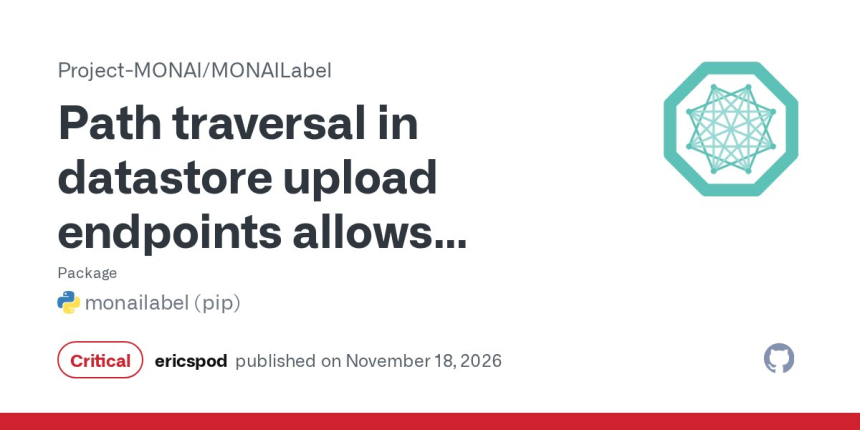
MONAI Label is a standalone server separate from the broader MONAI framework. Research teams use it to label medical images and train imaging models. The vulnerability was in the application endpoints that receive images and labels: an identifier supplied by the requester was incorporated into the storage path without checking that the destination remained within the authorized folders.
The project’s security advisory details that the issue affected PUT /datastore/image and PUT /datastore/label. In the first case, the application appended the file extension to the supplied identifier and copied the content to the resulting path. An identifier containing directory traversal components could cause the file to end up anywhere the MONAI Label process had permission to write.
The weakness did not automatically grant permission to write anywhere on the system: the server runs with the privileges of the account that launches it. But if that account could modify code or configuration files, arbitrary file writing could lead to code execution. In the default configuration, authentication is disabled, so any client that can reach the server over the network can attempt to exploit the flaw.
Root access came in a later session
The agents first mapped the application API and exploited the flaw to write files. The privilege escalation to root happened later, in another session, not within those 11 minutes. According to The Hacker News and Amazon, the agents placed a Python reverse shell in a file that is loaded when the interpreter starts, then triggered a training function that launched a new Python process. That process loaded the file and connected back to the operator.
The result was root access to a university server. This does not mean that every MONAI Label deployment would allow the same outcome: it depends on how the service is run and on the permissions of its account. The Hacker News also notes that Amazon’s reconstruction does not show that images or patient records were stolen, that clinical systems were reached, or that the attackers went beyond the university targets described.
In a later session, the operator gave the agents a tunnel into a second university’s network and asked them to attack other devices. Amazon infers that the server acting as a proxy was running the same vulnerable software and may have been compromised in a similar way, but did not confirm this second access.
Targets at East Asian universities
The activity unfolded over about 48 hours in September and targeted IP addresses belonging to universities in East Asia outside mainland China. BleepingComputer dates the campaign to September 8–10, 2026; Amazon found the exposed Cairn panel on September 10. The logs made it possible to reconstruct the agents’ instructions and activity history.
Amazon attributes the campaign with moderate confidence to a China-linked actor. Among the indicators it cites are the language of the instructions, the scripts’ time zone settings, and the possible strategic interest of the selected universities. The Hacker News specifies that the instructions were in Simplified Chinese and that the settings indicated China Standard Time. The investigation did not identify a specific group or establish that a government was behind it.
The campaign was not successful in all its operations. BleepingComputer reported a 16-hour attempt involving 148 actions against a Redis server that failed. In another case, the agents tried more than 30,000 credential combinations over six hours to access a university GPU server, also without success.
Amazon published two IP addresses associated with the campaign, observed between September 8 and 10: 142[.]4.98.145 and 142[.]4.107.34. BleepingComputer adds that Cairn is a legitimate penetration-testing tool designed to coordinate agents in cybersecurity operations, although it has also been used in attacks. The outlet cites cases of abuse documented by Gambit Security in a card theft operation and a use in an attack against a U.S. aerospace organization reported by Google.
The fix is integrated, but the release status is unclear
MONAI Label fixed the code in change request No. 1915, merged on October 19. The fix ensures that destination paths remain within approved folders; it also reduces the image identifier to its basename and rejects empty names or names that begin with a dot. The project’s security advisory says the fix will be included in a future release.
Sources disagree on whether an installable update has already been released. The Hacker News and VentureBeat say that no fixed version is available and that the latest version remains 0.8.5, published on PyPI on November 25, 2024. By contrast, BleepingComputer says the maintainers released a security update on November 18. GitHub’s security advisory also points to the fix being included in an upcoming release, so it is worth checking the package’s status before considering the issue fixed.
| Detail | Reported status |
|---|---|
| Affected versions | MONAI Label 0.8.5 and earlier |
| Code fix | Merged on October 19 in change No. 1915 |
| Installable fixed version | Sources disagree: some say it is unavailable; BleepingComputer reports an update on November 18 |
| CVE identifier | CVE-2026-133968; The Hacker News gives it a score of 9.8 out of 10 |
The Hacker News reports that the flaw is listed as CVE-2026-133968, with a score of 9.8 out of 10. The project’s advisory page still does not show a CVE identifier, a discrepancy that outlet attributes to an update delay rather than to the existence of another flaw. Amazon classified the vulnerability as a zero-day with high confidence because, when it detected it, it found no fix, advisory, prior issue, or mention in vulnerability databases.
The official advisory recommends enabling authentication, not exposing MONAI Label to untrusted networks, and running it with an unprivileged account while restricting the folders it can write to. If authentication is enabled, the ANNOTATOR role is sufficient to exploit the flaw, so it should be reserved for trusted users. VentureBeat adds that enabling controls now does not undo a previous intrusion; if a server was accessible, it recommends checking for unexpected changes to application files.
Amazon presented its reconstruction of the activity as its own intelligence assessment, not as an independently confirmed investigation. While maintainers prepare to distribute the fix, version 0.8.5 remains the latest release cited by sources that say a fixed package is not yet available.
Sources: SecurityWeek, The Hacker News, BleepingComputer, GitHub, Venturebeat, The Hacker News