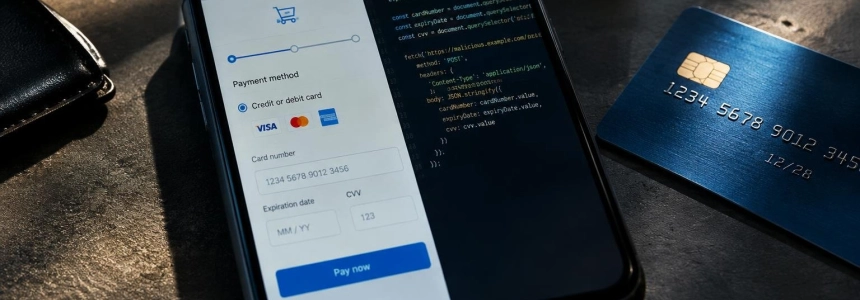
A skimmer capable of capturing card data was active on five online stores before Black Friday: Lascana, Samsonite, American Tourister, Revolve, and FWRD. InfoHawk observed the code sending test card data to a third party on Lascana before the store checked the payment; all five companies removed the script on November 24 or 25.
The technique could collect the card number, expiration date, and security code, as well as the name, address, phone number, and email address. The data was sent while the customer entered their credentials, before the payment was validated: for this reason, according to InfoHawk, the data could be exposed even if the order was rejected or canceled and the purchase appeared normal.
InfoHawk does not know how much shopper data may have been captured, if any. The only live transmission of card data it recorded was from its test on Lascana; it does not claim to have observed confirmed customer thefts.
Five stores, several entry points
The code reached the sites through three different methods. On Lascana, a Quorum marketing pixel was altered; on Samsonite and American Tourister, a Seers cookie banner configuration was changed. On Revolve and FWRD, a file hosted on Revolve's own content delivery network (CDN) was modified.
InfoHawk also describes other possible insertion points, such as a retailer's CDN file or the store's own HTML. The malicious code was then loaded from an Amazon S3 bucket. The table lists the method identified for each site and the removal dates specified in the report:
| Store | Identified method | Removed |
|---|---|---|
| Lascana | Altered Quorum marketing pixel | November 24 |
| Samsonite | Modified Seers banner configuration | November 24, 14:25 UTC |
| American Tourister | Modified Seers banner configuration | November 24, 14:25 UTC |
| Revolve | File modified on Revolve CDN | November 25 |
| FWRD | File modified on Revolve CDN | November 25 |
On November 24, InfoHawk notified the companies involved and other providers: Amazon Web Services, because of the buckets serving the script; Cloudflare, because of the services used by the attacker; the domain registrars; the pixel provider; Seers; and the affected retailers. Lascana removed the Quorum pixel at 15:48 UTC. Quorum confirmed that it had removed the malicious code from its tracker and restored the clean pixel at 21:09 UTC.
Revolve confirmed that it removed the code from both sites on November 25 and said it was investigating the potential impact. The company made the statement on behalf of REVOLVE and FWRD: “On November 25, InfoHawk notified our team of a potential security issue affecting the mobile and tablet versions of our websites, which we resolved that same day. We appreciate the notification and are actively investigating the issue to determine any potential impact.”
The skimmer's WebRTC journey
The attack was designed to activate on small or touch screens, on payment pages. The Samsonite variant ran only on the /checkout path. InfoHawk warns that checking the homepage or testing only from a computer would probably not have revealed the behavior.
WebRTC, a technology that enables audio and video calls from a browser, can also open a data channel between a page and another system. In this case, the browser first made two web requests to a domain containing a brand name and the northbridgeads[.]com domain: a GET request to /_cf/ice to obtain relay data and a POST to /_cf/rel to send the WebRTC offer.
Afterward, the exchange moved to the WebRTC data channel, which is not covered by the connect-src directive of the content security policy (CSP). The observed responses included Cloudflare relay addresses, and the traffic used its TURN service. Through this channel, the skimmer arrived in fragments, was verified with a SHA-256 digest, and was executed using eval; the stolen data was sent back through the same channel.
The loader retrieved Insds.js or gtage.js from Amazon S3 buckets. InfoHawk notes that the WebRTC channel may receive less monitoring than ordinary web requests. The report also mentions a creative use of WebRTC by Meta in 2025, cited by researchers studying the technology as a vector for compromise.
InfoHawk says its recommendations about legal liability apply to the United States: according to its interpretation of U.S. federal law, the limit for unauthorized credit card charges is $50 and is generally zero if only the number was stolen. For debit cards, it says protections are weaker and depend on how quickly the fraud is reported.
What security teams can check
The five stores used different insertion points, but InfoHawk considers it likely that other sites are also exposed because it detected common attacker infrastructure. It recommends searching page code, tag managers, banner configurations, and CDN files for references to <brand>-static.s3.amazonaws[.]com and the scripts Insds.js and gtage.js.
For pixels that load qscripts.s3.amazonaws[.]com/pscript.js, the team suggests checking the last line for one of those buckets. It also advises checking Seers configurations at cdn.seersco.com/banners/<account>/<domain>/cb.js: in the affected cases, the privacy policy link field contained a hidden image whose onerror handler loaded the malicious code.
The inspection should reproduce the payment flow on a mobile-sized touch device and look for requests to /_cf/ice and /_cf/rel directed to *.northbridgeads[.]com, as well as a WebRTC connection using relay-only candidates. InfoHawk also lists the strings KghRtc, rtc-signal-v1, and quickfetch as indicators that may warrant investigation.
To block the load, InfoHawk highlights the two web requests made before the channel opens: a connect-src rule that allows only the necessary hosts can prevent them. Without those requests, it explains, the skimmer cannot execute, even if the altered file is hosted elsewhere.
The risk of third-party scripts at checkout
The case brings renewed attention to pixels and other third-party scripts loaded on payment, login, or personal data pages. Sites load third-party code from servers they do not control, and the provider can change that code. Once loaded, the script runs with permission to read or modify the page, observe what the user types, and load other scripts. InfoHawk argues that these resources should be reviewed and restricted on pages that collect payment or login data.
The report links the incident to another attack that occurred on November 16, 2026. In that case, an attacker allegedly exploited a flaw in Optimizely's Web Experimentation product to add malicious code to customer projects; Optimizely's servers delivered it to visitors of sites belonging to 178 organizations, including Zoom, the BBC, and CNN, without any changes to those sites' own code.
In the incident involving the five stores, removal was completed before Black Friday. The possible number of affected shoppers remains unknown, while Revolve and FWRD investigated the potential impact.