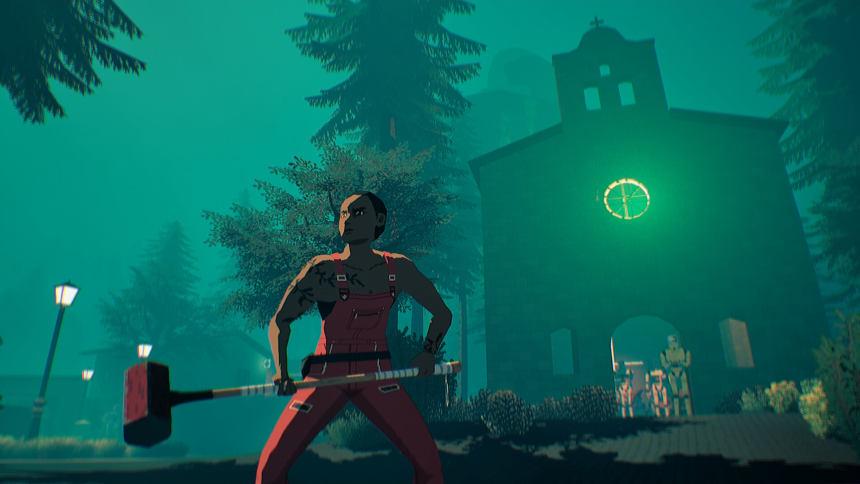
Pratelle roams her hometown tearing down walls and androids as she pieces together a family history marked by grief and harm. Virtue and a Sledgehammer turns this destructive impulse into a narrative adventure: demolishing buildings opens paths and reveals memories that give context to the violence.
- Developers: Deconstructeam and Selkie Harbour
- Publisher: Devolver Digital
- Platform: PC
A sledgehammer to break through memories
The premise pits Pratelle against a population of robots that preserve the memories of their former inhabitants. Her goal is to reach Nina, her sister, as she smashes houses, shops, and machines. Destruction is not just a way to make progress: as she breaks through the walls, the protagonist uncovers scenes from the past that expand what we know about her family and the town.
Rock Paper Shotgun describes the adventure as a narrative exploration game in which attacks are deliberate and slow. You have to charge each swing and wait for the animation to finish, a pace the outlet considers part of the experience: it makes the player pause before the rubble and mechanical bodies, and gives weight to every decision to attack. Walls give way in a shower of fragments; robots, by contrast, produce a sound impact that the review finds less satisfying.
The story is told through non-chronological memories. According to Rock Paper Shotgun, the scenes alternate between warm moments and others involving abuse and rejection, and their coexistence makes the portrayal of the family more painful. The outlet notes that Pratelle's violence is not presented as a moral trap meant to make the player feel guilty: the injustice she encounters is acknowledged as such within the story.
Phenixx Gaming focuses on the tension between what Pratelle remembers and what is actually happening. Its robots with CRT screens could be inhabitants whose consciousnesses have been transferred into machines, but the review also wonders whether this transformation might be the protagonist's perception. This uncertainty about the meaning of events was one of the reasons the outlet found the story intriguing.
Catharsis, controls, and difficult themes
Demolition is also the main draw for Phenixx Gaming, which describes the gameplay core as simple and cathartic. The review finds that the game sustains interest with several narrative mysteries and recommends the experience to those who can engage with its themes. At the same time, it warns that some content may be disturbing and that the game's own content warning is extensive.
Mouse controls involve holding down the left button for different lengths of time to vary the force of the blow. Phenixx Gaming notes that charging an attack to full strength requires holding it for a couple of seconds, and points out that this action may pose an accessibility barrier for some people. The outlet confirms full controller support, although it could not remap the left mouse button.
Rock Paper Shotgun finds another kind of friction in the pacing: the slowness can make encounters demanding in terms of timing, but it also fits the tone of grief that follows Pratelle. The review appreciates that exploring and finding memories takes effort, because that search is part of the protagonist's emotional labor. Not every blow offers the same reward: collapsing buildings make a bigger impression than the muted sound of impacts against robots.
“In Virtue, you’re being made to destroy the place you grew up in. Despite the combat, the game is a narrative experience.”
— Jordi de Paco, director of the game, writer, and CEO of Deconstructeam
Jordi de Paco told The Guardian that the team conceived the game as a narrative experience, not a challenge centered on combat. The outlet also notes that the town draws inspiration from small Spanish communities and that the team uses the family story to contrast with the futuristic setting. In this reading, the robots do not turn the game into a direct critique of digitalization: its core lies in the feeling of not belonging and in the relationship between the sisters.
The reviews agree that the sledgehammer is inseparable from the story: for Rock Paper Shotgun, the slow pace emphasizes the weight of violence; for Phenixx Gaming, the repeated blows are cathartic. They also recognize the importance of the memories and the questions the story leaves behind. The difference lies in what concerns them most: Rock Paper Shotgun dwells on the rhythm and emotional impact of destruction, while Phenixx Gaming emphasizes control accessibility and sensitive content. Demolition opens the way, but what each outlet finds on the other side is not quite the same.
Sources: Rock Paper Shotgun, Phenixx Gaming, the Guardian