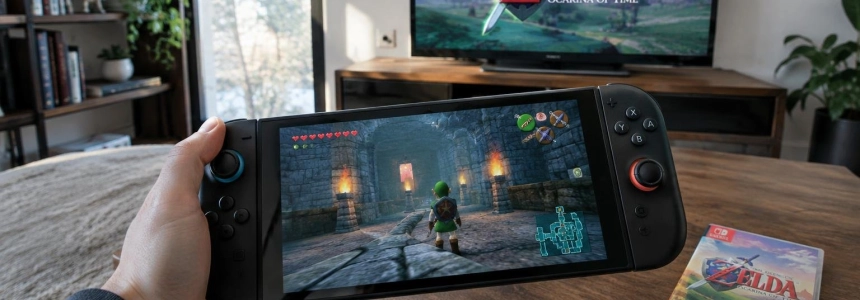
The remake of The Legend of Zelda: Ocarina of Time is now available on Nintendo Switch 2, with remade graphics, updated controls, and an orchestral soundtrack. The first reviews agree that it retains the appeal of the Nintendo 64 adventure, although they do not all view the balance between faithfulness and challenge in the same way: Creative Bloq considers the experience potentially too easy, and the remake has no Master Quest or any other hard mode.
- Developer: Nintendo EPD
- Publisher: Nintendo
- Platform: Nintendo Switch 2
- Release date: November 5, 2026
- Price: $59.99 (digital); $69.99 (physical)
A classic adventure with control changes
Nintendo presents this release as a ground-up reconstruction of the 1998 game, not a simple port. Link once again travels across Hyrule to face Ganondorf, explore dungeons, and solve puzzles; the adventure alternates between his childhood and adult years. The original story and quests remain intact, but now there are voiced cutscenes, expanded dialogue, and orchestral music.
A revised camera and movement changes are also included. Creative Bloq highlights the free camera, performance at 60 frames per second, and a dedicated jump button, as well as a quest log. The review notes that jumping takes some getting used to: the critic expected Link to jump automatically when approaching an edge.
One of the new features exclusive to Switch 2 is playing ocarina melodies by humming into the built-in microphone. Creative Bloq calls it «a gimmick, but a very apt one» and says it found the feature more intuitive than remembering button combinations. Nintendo also includes the Fallen Foes Room, where players can face opponents again, and offers hints and activities through the Zelda Notes app.
The dungeons win over Tom’s Guide
Rory, senior entertainment editor at Tom’s Guide, says he came to the remake with doubts about traditional Zelda games, having started the series with Breath of the Wild. Halfway through the adventure, he changed his mind: the dungeons and their puzzles helped him understand why some fans miss that structure in recent installments.
“They’re just a blast, and yes, I can finally admit, they flow better than Breath of the Wild’s pretty repetitive Divine Beast dungeons.”
— Rory, senior entertainment editor at Tom’s Guide
The review highlights how each dungeon introduces tools that later help open new paths and uncover secrets. Rory gives the Fire Temple as an example, with corridors that connect in ways that surprised him, and the Water Temple, which he found less frustrating than in the original. He also appreciates that the environments encourage players to explore corners and find chests rather than head straight for the exit.
His reservation is about the freedom to solve challenges. Compared with Breath of the Wild and, especially, Tears of the Kingdom, where there are often several ways to overcome an obstacle, the tools here tend to lead to a more clearly defined solution. For Rory, that linearity also has a payoff: Link’s gear gradually grows, allowing players to return to earlier areas with new possibilities.

A compact world and a refreshed presentation
PCWorld describes the adventure as more linear and less expansive than Breath of the Wild, and finds the sense of childlike wonder conveyed by this version appealing. The review adds that the format may suit people with less time to play.
In TV mode, PCWorld describes an image at 4K with HDR at 60 Hz, or at 1440p and 120 Hz. It highlights the colors, shadows, and mist of Hyrule, with Kokiri Forest as one of its favorite settings. In handheld mode, the 7.9-inch screen still looks good, although the author finds it less immersive and notices some loss of quality in distant elements.
The sound also earns praise. PCWorld highlights the new orchestral soundtrack and the musical transitions between day and night in Kakariko Village. The review also celebrates the voices in key scenes and Navi’s return, whose persistence may be welcome or annoying depending on the player.
The debate: faithfulness, ease, and design
Creative Bloq praises the visual detail and clarity of the environments: it says that some cracked walls that can be destroyed with bombs are easier to spot, and that the Water Temple’s architecture makes it easier to find your way around. It also approves of Nintendo keeping the adventure’s scale and pacing instead of adding filler content. In its view, the story and quests retain their original form, while the technical improvements make the journey smoother.
Creative Bloq’s review, however, takes issue with the difficulty. It considers the modern controls and gyro aiming make some challenges too easy, to the point of earning the best rewards in shooting minigames on the first try. It misses a more demanding option, such as Hero Mode or a Master Quest version with rearranged dungeons; it does not claim that one is coming.
Neither option is in the game. The remake has no Master Quest, no Hero Mode and no difficulty settings, and finishing the adventure doesn’t unlock anything either; Kotaku confirmed this from the reviews by RPG Site and GamesRadar. In the 3DS version, by contrast, Master Quest unlocked after beating the game, with a mirrored world and enemies dealing double damage.
That could change. Dataminer MrCheeze found references to “MQ” in the remake’s files and posted them on Bluesky on 6 November, a day after launch. MrCheeze says it will be unlocked by owning DLC rather than through an update, which suggests a paid add-on, and the data shows a mirrored world and modified dungeons, such as cows inside Jabu-Jabu’s Belly. Another dataminer, OatmealDome, also points to a flipped world and changed dungeons. MrCheeze warns that the data is incomplete, and Nintendo hasn’t announced anything.
The reviews agree that the remake improves the presentation and controls without replacing the design that made the original recognizable. They differ on what is gained and lost through that faithfulness: Tom’s Guide celebrates the linear dungeons and their progression of tools, while comparing their limited freedom unfavorably with recent installments; Creative Bloq enjoys the compact pacing but thinks some challenges have become too easy. PCWorld, meanwhile, focuses on the music, visuals, and appeal of the adventure to new players.
Sources: Tom's Guide, PCWorld, Creative Bloq, Kotaku, VGC, Nintendo