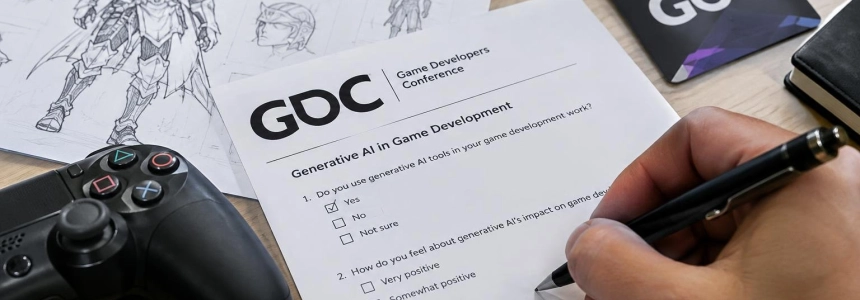
40% of video game professionals surveyed by the Game Developers Conference (GDC) use generative AI in their work; even so, 55% believe its impact on the industry is negative. The gap reflects real adoption, but far from a consensus on which uses are acceptable and who bears the costs.
The 2026 State of the Game Industry report gathers responses from more than 2,300 professionals, including developers, producers, marketing staff, executives, and investors. GDC expanded the survey to cover different roles across the ecosystem, so the 40% figure is not equivalent to the percentage of programmers who use these tools or the percentage of studios that have implemented them.
Widespread use, with a more modest increase
The proportion of users rose from 36% the previous year to 40%. GamesIndustry.biz notes that the increase is smaller than the one recorded in the previous survey. Among those already using them, 57% use them to generate text, conduct research, make early prototypes, write code, and prepare presentations. GDC adds that 57% of adopters use them daily.
This range brings together different tasks, from exploring ideas to producing code. The data shows that the most widespread use is not limited to generating assets visible to players: it also covers operations, research, and early stages of development.
The concentration by type of company is striking. GDC reports the most frequent use in operations and business services; it also highlights mobile-focused studios and those working on free-to-play games. By contrast, among employees at AAA studios, 27% say they feel encouraged or pressured to use AI, compared with 9% at independent studios. These figures measure perceived pressure, not the overall adoption rate in each group.
Acceptance depends on how it is used
55% believe generative AI has a negative effect on the industry; 35% consider its impact mixed, and 8% positive. GDC compares the negative figure with 54% the previous year and describes the sentiment as stable. Eurogamer and GamesIndustry.biz also highlight a one-percentage-point increase, a small difference that does not change the overall distribution.
Opposition is strongest in QA and community support, reaching 76%, according to GDC. GDC also reports the most frequent AI use in operations and business services, mobile-focused studios, and free-to-play games.
GDC reports support for uses such as repetitive tasks, research, brainstorming, and early prototyping, alongside concerns about environmental impact, legal issues, job losses, and the erosion of skills. Broad opposition to using AI in creative or player-facing roles also persists. The key distinction, then, is not simply whether it is used, but where it is incorporated and what it replaces.
“I didn’t enter a creative industry to hand creativity over to an algorithm.”
— UK participant, according to Eurogamer
The quote sums up a resistance that is not reducible to a debate about efficiency. For some staff, the value of their work is tied to collaborating with other people and creating content. Eurogamer also reports another respondent’s concern about using the ideas of someone who had lost their job, a criticism that links technology adoption to companies’ employment decisions.
What the percentages say—and what they don’t
The 40% usage figure and the 55% negative assessment describe different things. Someone can use AI to research or prototype and still believe its overall effect on the industry is harmful.
Adoption must also be distinguished from pressure. The fact that 27% of workers at AAA studios feel encouraged or pressured does not mean that 27% of those studios have imposed the tool on their entire workforce. And the 9% figure among independents does not show that the rest do not use it: it describes only the pressure reported in response to that question.
The age and gender percentages published by Eurogamer show other differences: 54% of people aged 45 or older said they used these tools, eight points higher than in the previous survey; among men, the figure was 45%, and among women, 33%. These are results from the surveyed population and are not enough to explain why these differences exist.
Company decisions under scrutiny
For companies, the report points to uneven adoption and legitimacy that depends on the specific use. AI’s presence in operations, services, mobile, and free-to-play contrasts with the lower reported pressure at independent studios and opposition to creative or public-facing applications. A uniform policy may overlook these differences between departments and business models.
There is also a cost to trust that the figures do not translate into revenue or productivity. If 55% of participants believe AI harms the industry, a company adopting it needs to consider how that decision is perceived within its teams. With this as the majority view, acceptance of AI cannot be taken for granted.
The employment context makes this discussion more sensitive. GamesIndustry.biz reports that 33% of its respondents had lost their jobs in the previous 24 months and that 54% of those laid off had not yet found another job. GDC reports 34% for layoffs over the same period and 54% of laid-off people still unemployed. The figures vary between publications, but both describe a market where concern about jobs accompanies the conversation about automation.
Against this backdrop of pressure, the way AI tools are introduced can influence how teams interpret their purpose: as support for specific tasks or as a substitute for creative work. The report includes both data on layoffs and opinions about AI’s impact on the industry.
A clearer dividing line
Beth Elderkin, the survey project lead, told GamesIndustry.biz that the technology is no longer seen as a theoretical issue: professionals are more familiar with the tools, how they are used, and whether they want to use them. That familiarity seems to coexist with a sharper divide over their limits, not general acceptance.
For people who develop games, the practical takeaway is that AI is already part of the work of a considerable portion of the industry, but its use and legitimacy vary by task, role, and type of studio. The report does not resolve how to balance experimentation, employment, and authorship. It does make clear, however, that the tools are spreading while most respondents continue to see a negative overall impact on the industry.
Sources: Eurogamer.net, GamesIndustry.biz, 80lv, GDC Festival of Gaming, GDC Festival of Gaming