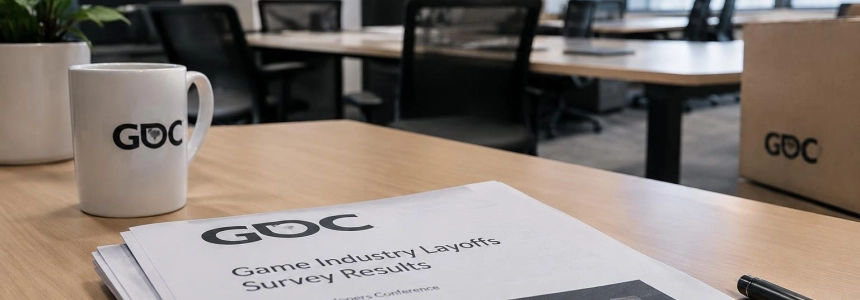
34% of the professionals surveyed by GDC lost their jobs in the past two years; among those living in the United States, the figure rises to 39%. The November edition of State of the Game Industry gathered responses from more than 2,600 industry workers and paints a picture of a crisis that involves more than layoffs: it also makes it harder to find another job and erodes confidence in the future of work.
The main figure is striking, but it needs to be read carefully. GDC notes that its survey includes a higher share of people affected by layoffs than other samples; its respondents include around 900 laid-off workers. Therefore, the percentage describes the responses collected and the experiences of those who took part; it should not be assumed to precisely represent the entire video game workforce.
Layoffs keep happening, and jobs are slow to return
The overall figure rose compared with the previous survey: Vandal reports that 28% of respondents had been laid off in the two years before the January edition, compared with 34% now. For the United States, the comparison is 33% to 39%. Game Developer also reports that the share of U.S. workers employed full-time fell from 59% last year to 50% this year.
21% of respondents are unemployed, eight percentage points higher than the 13% reported the previous year, according to Game Developer. This figure refers to all respondents, not only those who were laid off. Of the latter, 54% are still unemployed—59% in the United States—even though they continue to look for work.
The length of the problem is also reflected in job-search efforts. GDC puts the share of laid-off workers who have sent out 100 or more applications at 27%; Vandal reports that 25% have submitted more than 100 applications. The thresholds are not identical, but both figures point to an extensive job search for a significant share of those who lost their jobs.
The timing of departures adds to the pressure. Vandal reports that, among those laid off, a quarter lost their jobs in the three months before the survey and 43% between three and twelve months earlier. According to Game Developer, surveyed workers were twice as likely to have been laid off in the past year as in the preceding year: 68% versus 32%.
Layoffs are not evenly distributed
49% say their company carried out layoffs over the past year, a figure that rises to 55% among people working in the United States, according to Game Developer. The reported incidence is higher at AAA studios, reaching 68%. It falls to 14% at younger independent studios and stands at 35% at more established ones.
The reasons cited for the cuts are corporate restructuring, financial difficulties, and canceled projects. This combination links organizational decisions to the viability of a game portfolio: when a company is reorganized, faces financial problems, or abandons a project, the impact can reach teams working across different stages and specialties.
The areas most exposed, according to Game Developer, are quality assurance, marketing and public relations, and visual and technical art. Operations and business services are among the least affected. This difference matters when interpreting what the overall figure means: it does not describe an identical experience across all occupations or types of studios.
Layoffs are also repeated. Vandal reports that 17% of those laid off lost their jobs twice during the two-year period, and 3% were laid off three times. Game Developer notes that, among those who said they had been laid off once, 79% reported one layoff; it also gives figures of 17% for two and 3% for three or more. The pattern is that some workers are not facing a single break in employment, but several.
Getting back to work does not always mean returning to the same line of work
Only two-thirds of those who found work after a layoff are working in a similar field, according to Game Developer. In addition, 9% say they have left the industry entirely.
These results show that finding another job does not necessarily mean returning to the same career path. Some people return to a related field, others view their new work differently, and some leave the industry. For studios, the figures point to a concrete consequence: when hiring picks up again, it may not be enough to rebuild teams with the same experience and specialization that were lost.
The survey also reveals a gap between attachment to the work and working conditions. GDC reports that 86% of respondents find working in video games more satisfying than working in another industry. At the same time, 65% of respondents said their work had harmed their mental health in the previous twelve months. Satisfaction with creative work can therefore coexist with insecurity and burnout.
As for working hours, 57% of workers in areas such as marketing, business, training, and research say they work an average of more than 40 hours per week, compared with 44% of developers. GDC adds that 8% report mandatory overtime or crunch; of those, 69% received no compensation and 63% believe it could have been avoided.
I’ve been laid off four times in a row. The game industry left me.
— Survey respondent, according to Insider Gaming
What signals companies are receiving
The survey cannot attribute the cuts to a single cause, but it does show where they are happening: more often at AAA studios and in areas such as QA, marketing, and art, and in connection with restructuring, financial problems, or cancellations. For companies, this makes staffing decisions about more than immediate cost reduction: they can also affect team continuity and the experience available for future projects.
External work is part of the business context described in the report. 45% of studio workers said their companies hired co-development services for their most recent projects. Separately, 16% of studio workers whose companies do not specialize in co-development said their company had offered or provided those services in the past twelve months; at established studios, the figure reached 23%.
GDC reports that reasons for turning to co-development range from seeking additional sources of revenue to an interest in working within another company's constraints. The figure does not prove that outsourcing replaces eliminated jobs, nor does it establish a direct link between the two phenomena. It does show that studios combine different forms of work and financing at a time when many people describe difficulties keeping or regaining their jobs.
Insecurity is also reflected in expectations. Vandal reports that 72% of those laid off do not expect to find work in the coming year, and 73% disagree that they feel hopeful about the direction of the industry. These are responses from people who have already lost their jobs, not a hiring forecast for all companies; even so, they describe a pessimism that accompanies the job search.
The figures have clear limitations
GDC warns of participation bias: people who have experienced layoffs are more represented in the survey, particularly in the United States. This limits comparisons with aggregate employment measures and makes it necessary to distinguish between two things: the share of respondents who experienced a layoff and the layoff rate across the entire industry.
This caveat does not erase what the responses tell us: there are more than 2,600 professionals and around 900 laid-off workers, according to GDC. This allows their experiences to be examined in greater detail, from the number of applications they sent to their employment situation afterward. It also explains why the headline should not be read as a census of every studio or everyone working in video games.
The November survey also expands its employment section to cover overtime, crunch, mental health, and job security. It also asks about generative AI, engines, platforms, and business; its breadth places layoffs within a wider landscape, although the available figures do not prove that these other technological changes caused job losses.
More than half of those laid off are still looking for work, and some have sent more than a hundred applications. The next report will show whether layoff figures rise again and whether those leaving studios manage to return to the industry or end up working in other fields.
Sources: Vandal, Game Developer, Game Developer, GDC Festival of Gaming, Insider Gaming