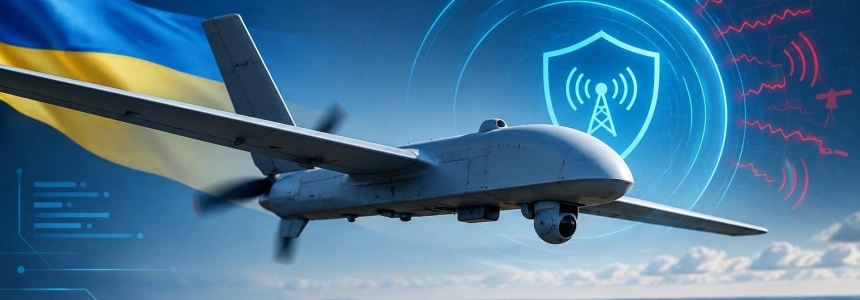
Ukraine has adapted a U.S.-made RQ-20A Puma AE drone with the Palych communications system, developed by Ukrainian company Rise Technologies, so it can maintain its link in areas affected by electronic warfare. The modification increases the stated operational flight range to 50 kilometers, compared with 16 for the basic model, and could allow aircraft that the unit had stopped using to return to service.
The aircraft was handed over to the company by personnel from Ukraine’s Unmanned Systems Forces for modification, Rise Technologies told RBC-Ukraine on November 19. The military described the Puma as a durable aircraft capable of withstanding falls and hard landings, as well as operating in rain, fog, and snow.
Its durability did not, however, solve the problem that had sidelined the drones. The standard communications link was vulnerable to modern electronic warfare systems, so the unit had stopped using the Pumas at its disposal. The Palych upgrade is specifically aimed at restoring that reconnaissance capability.
A vulnerable link at the front
U.S. defense manufacturer AeroVironment developed the RQ-20A Puma AE as a hand-launched reconnaissance aircraft. The model carries optical and infrared cameras to monitor the terrain and uses a digital data link, known as DDL, to communicate with its operators.
The aircraft has a water-resistant fuselage and can land on both land and water. Its wingspan is 2.8 meters, and it can remain airborne for more than three hours, according to UNITED24 Media and RBC-Ukraine. These features allow it to operate in adverse weather, but do not prevent interference from affecting its digital connection.
The fleet at the center of this story arrived in Ukraine as part of a delivery funded by the U.S. Army. In 2023, the Army announced funding to supply more than 500 Puma drones, along with ground support equipment and related services. Tom’s Hardware describes the delivery as comprising more than 500 RQ-20A Puma AE units intended for reconnaissance missions.
Electronic warfare at the front made it more difficult to maintain a reliable link between operators and unmanned vehicles. The problem is not limited to interference from one side: Rise Technologies said Palych can help operators work in areas where both Russian and Ukrainian electronic warfare systems are active.
Palych switches the communications band
Rather than requiring a major modification to the aircraft, Rise Technologies installed a standard Palych configuration. The company says the system shifts the drone’s original communications channel to another frequency band, which operators can select according to the radio conditions in the area.
The change is intended to avoid the most heavily jammed channels and maintain a stable connection during flight. The Rise Technologies website describes Palych as a digital system that shifts telemetry and video links for certain civilian drones operating at 2.4 GHz to other frequencies. For the Puma, UNITED24 Media and RBC-Ukraine explain the function in more general terms: moving the original link to a different band and adjusting it to the electronic warfare situation.
According to Rise Technologies, integration first went through laboratory testing and was followed by a field test. The company did not provide quantitative results from those tests in its published information, but says the system enables missions at distances of up to 50 kilometers (31 miles), even under active interference. Tom’s Hardware compares this figure with the Puma’s basic range of 16 kilometers (10 miles) and notes that the upgrade triples it.
The sources do not specify how long a particular mission at that distance lasts or provide comparable performance figures under different levels of interference.
An upgrade to an already widespread system
The Puma is not the first type of aircraft on which Rise Technologies has installed Palych. The company says it has already used the system to modify attack drones and certain DJI and Autel models. According to the company, Palych has been installed on around 6,000 drones, in several configurations, since its introduction.
The official Rise website lists compatibility with several DJI Mavic, Matrice, and Autel EVO Max models, and adds that the company can assess integration with other platforms. It also says the operator retains the drone’s usual control workflow and that the manufacturer provides a warranty and technical support while the system is in operation.
Rise Technologies describes testing Palych against Bukovel, Obriy, and Kvertus systems. This information comes from the product presentation on its website and does not provide numerical results or testing conditions. In the specific case of the Puma, the integration described by the company is based on changing the communications link, rather than significantly rebuilding the aircraft.
The adaptation is also part of a broader context of testing Ukrainian electronic technology. UNITED24 Media previously reported that electronic warfare systems developed by Phantom Defense were tested in the United States as part of Gauntlet II, a phase of the U.S. Drone Dominance program. This provides context on testing Ukrainian technology, but is not presented as part of the Palych integration program for the Puma.
What is known about returning to missions
The modification aims to make aircraft useful again that were still valued for their durability, but whose standard link had become vulnerable to interference. The company announced the integration and testing of one Puma; reports about the fleet of more than 500 units describe the scale of the U.S. delivery and do not confirm that all those drones have already received Palych.
For now, what has been reported is an upgrade to the communications system, with laboratory and field testing and an operational range of up to 50 kilometers, according to Rise Technologies. The company has not specified how many Pumas will be modified or provided a schedule for equipping the rest of the fleet. The next practical question is whether integration will extend beyond the aircraft used for testing.
Sources: Tom's Hardware, UNITED24 Media, РБК-Україна, riseuap