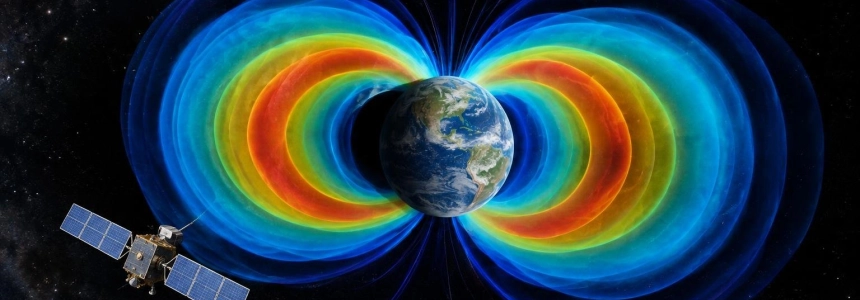
After the geomagnetic storm of May 11, 2024, Earth had four electron belts instead of the usual two. The structure persisted for more than four weeks and was detected by the EPT particle telescope aboard the European Space Agency (ESA) satellite PROBA-V. The study published in npj Space Exploration also records additional belts after several storms between 2024 and 2026.
The result changes the picture of the near-Earth environment, which is usually described as having two stable rings. It does not mean that the planet developed four permanent belts or that all particles were distributed uniformly: the researchers identified areas of concentration and loss, whose positions varied over time and with electron energy.
From two belts to four, and back again
Under normal conditions, the inner belt contains mostly highly energetic protons as well as electrons, while the outer belt is composed mainly of relativistic electrons. Between them lies the slot, a region with fewer particles. The study places this usual separation at around 2.5 Earth radii in the equatorial plane.
According to the study, the Mother's Day storm was the most intense in the past 20 years. At first, the slot filled in and the flux in the inner belt increased. Days later, the usual separation formed again, and another low-concentration region appeared in the outer belt. The resulting three slots delineated four regions with local electron maxima.
The sequence was not instantaneous. The data show that the four-belt structure became visible in June 2024 and lasted for more than four weeks; in late June, another storm increased the outer flux and temporarily erased one of the slots. By August, the normal configuration of two belts had returned.
| Period or event | Observation described in the study |
|---|---|
| May 11, 2024 | Geomagnetic storm; the usual slot fills in and the inner-belt flux increases. |
| June 2024 | Four electron belts are observed, separated by three slots. |
| Late June 2024 | A new storm intensifies the outer belt and causes an additional slot to disappear. |
| August 2024 | The usual structure of two belts returns. |
| October 2024, June 2025, February and July 2026 | The study records configurations of three belts after geomagnetic storms. |
The study uses a specific criterion for identifying a belt: it corresponds to a local maximum in electron flux, while a slot is a local minimum. To count as a structure, the feature must persist for more than five days. So, four belts does not mean that there was more radiation everywhere, but rather that the flux had four separate maxima.
The storm added particles; losses carved out the separations
The explanation begins with coronal mass ejections that disturb Earth's magnetic environment and inject electrons into regions that normally contain fewer particles. But injection alone cannot explain the final shape: interactions with electromagnetic waves scatter some of those electrons into the atmosphere and open up new slots. In the May 2024 event, one of these appeared in the outer belt, around L = 3.8.
Very-low-frequency (VLF) waves can scatter energetic electrons and promote losses in these regions. The study also describes a role for plasmaspheric hiss waves, associated with the main slot, and for EMIC waves, which are relevant to the precipitation of higher-energy electrons. These processes do not act the same way at all levels: the belts' positions and visibility depend on the energy and intensity of the storm.
The researchers also link the new inner slot, which can extend below L ≈ 1.9, to an increase in hiss-wave activity during geomagnetic disturbances. They suggest as another possibility the influence of high-power VLF transmitters used for submarine communications, which can scatter trapped electrons. The article also mentions atmospheric whistlers produced by lightning, but says there is no evidence that their frequency or intensity has increased in recent years.
In other words, the study describes possible physical mechanisms and documents when the structures appeared, but does not attribute each additional belt to a single, definitively established cause. Multiple-belt configurations typically last around one month; afterward, radial diffusion gradually erases the deep slots and the two-belt pattern returns.
“It is surprising to find four belts and, so often recently, three belts, when previously only two were observed. This means that new loss or trapping mechanisms have appeared.”
— Viviane Pierrard, lead author of the study and head of the solar wind division at the Royal Belgian Institute for Space Aeronomy, according to ScienceAlert
A signal that depends on energy and the instrument
The observation relies on EPT, an energetic particle telescope developed by the Belgian Institute for Space Aeronomy, the Catholic University of Leuven, and Redwire Space. It is installed on PROBA-V, which operates at an altitude of 820 kilometers. The instrument measures electrons from 0.5 to 8 MeV in six channels and protons from 9.5 to 248 MeV in ten.
The four belts were distinguished in the first five channels, up to 2.4 MeV, but not in the highest-energy channel, from 2.4 to 8 MeV. In some of the later observations of three belts, the structure was also clearer at lower energies and faded as energy increased. It is therefore not a sharp boundary that all detectors must record in the same way.
The study also extends the 2012 observation, when three belts were detected for about four weeks. No similar structure had been observed again after that episode until 2024. The difference is that the authors now document recurrences after storms in October 2024, June 2025, February 2026, and July 2026, in addition to the four-belt event of May 2024.
The researchers report that these three-belt structures were not observed during the 2014–2015 solar maximum: at that time, the flux was injected directly into the inner belt and the inner slot described in recent events did not appear. This difference supports the need to study why particles are now penetrating to different depths, but by itself it does not identify which process has changed.
The operational cost for satellites and crews
For a space mission, the question is not just how much radiation reaches an orbit. The new slots change where electrons are concentrated and how that distribution evolves over weeks. The authors note that particles in the belts can damage spacecraft and their components; ScienceAlert reports that electrons and protons particularly affect electronic devices and solar cells.
Duration also matters: a structure that appears days after a storm and persists for about a month means that the post-event evolution must be monitored, not just the moment of peak activity. EPT provided a time series and measurements across several energy channels; the Belgian institute says that the observation of the four belts was confirmed by the MetOp satellite. The scientific article also cites observations from other satellites, including METOP/MEPED, CIRBE, CSES, and NOAA satellites.
The risk also extends to crews venturing near these regions. The study describes radiation levels as a hazard to spacecraft and equipment, while ScienceAlert reports concerns about possible effects on astronauts' health. The practical consequence is clear: changes in the slots must be incorporated into space-environment monitoring, alongside particle flux.
What remains unresolved is which combination of waves, losses, and storm conditions explains each new slot, and why these structures have been observed repeatedly since 2024. By August 2024, the configuration of two belts had returned; later records document configurations of three belts after other storms.
Sources: Xataka, Nature, Royal Belgian Institute for Space Aeronomy, ScienceAlert