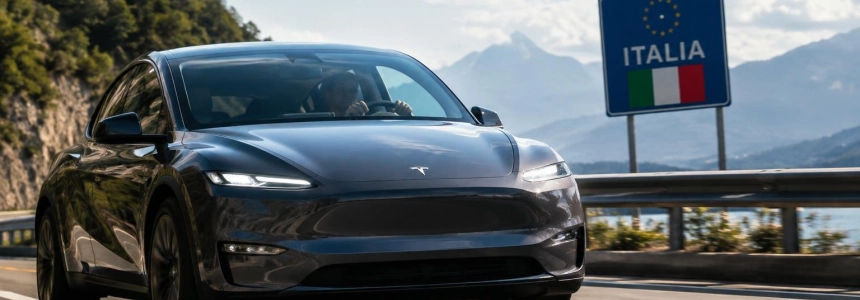
Italy has granted provisional approval to Tesla Assisted Driving, the driver-assistance system Tesla marketed in Europe as Full Self-Driving (Supervised). The company announced on November 20 that its rollout will begin soon; the feature will reach cars through an over-the-air software update, although no specific date has been set yet.
The announcement makes Italy the first major market in the European Union to accept the technology, ahead of Germany, France and Spain. The approval comes before the European process to recognize the system across the bloc is complete: an EU technical committee vote is not expected before December, according to Electrek.
“another step forward toward innovation, technology and the mobility of the future”
— Matteo Salvini, Deputy Prime Minister and Minister of Transport
National authorization ahead of the European decision
Salvini announced the decision on X and said it followed a technical feasibility assessment. Reuters reported that the permit is provisional; Electrek described the decision as an authorization by Italy’s Ministry of Transport. Tesla Europe later posted that the system had been approved in Italy and that rollout would begin soon, alongside a video of a vehicle driving through Rome.
Tesla CEO Elon Musk replied to Salvini’s message with a thank-you: “Thank you, much appreciated!”, according to Reuters. Italy’s approval joins a series of national recognitions that began in the Netherlands. The Dutch permit, granted by vehicle authority RDW on April 10, 2026, was based on Article 39 of the European vehicle-approval regulation, according to Electrek and Greenmove.
That mechanism allowed other states to recognize the authorization in their own territories. Ten other countries had done so before Italy; including the Netherlands, the European total now stands at twelve. Greenmove identifies Italy as the first of the EU’s four most populous countries to give the green light, while Electrek calls it the first major EU market to do so.
| Country | Reported status |
|---|---|
| Netherlands | First approval, on April 10, 2026. |
| Belgium, Croatia, Czechia, Denmark, Estonia, Finland, Latvia, Lithuania, Slovakia and Slovenia | Subsequently recognized the Dutch approval. |
| Italy | Provisional approval announced on November 20, 2026. |
According to Electrek, the ten countries that joined before Italy, together with the Netherlands, represent around 70 million people, or about 15% of the EU population. Italy adds nearly 59 million people, and its decision raises the share of the EU population legally able to use the system to almost 30%, the publication estimates.
What the system does and what the driver must continue to do
The name change does not turn the product into unsupervised autonomous driving. Tesla Assisted Driving remains a Level 2 driver-assistance system: it can control steering, braking and acceleration, as well as handle intersections and lane changes, but the driver must continuously watch the road and be ready to intervene.
Quattroruote describes a feature capable of handling urban situations such as intersections and roundabouts. The person behind the wheel remains responsible for the maneuvers. Reuters summarizes the system as “hands-off, eyes-on”: a phrase referring to how the car can drive while the person in the driver’s seat stays attentive and supervises its operation.
The technology relies primarily on exterior cameras and a neural network that interprets its surroundings and generates the vehicle’s commands. SmartWorld and Quattroruote note that processing takes place on the car’s computer. According to SmartWorld, the model learns from anonymized driving data and, rather than relying on rules written for each situation, directly generates driving commands.
Tesla says fleet data can contribute to the system’s learning with the customer’s consent and in anonymized form, according to SmartWorld and Quattroruote. SmartWorld also reports Tesla’s claim that the system can consume less energy than manual driving, although it does not provide a comparative measurement.
Announced price and unanswered questions about the rollout
SmartWorld and Quattroruote put the price at 99 euros per month, or 1,188 euros if kept active for twelve months. Tesla has not officially announced which models or hardware versions will be able to use it in Italy. Quattroruote notes that the company has also not detailed the compatibility requirements; Greenmove adds that the most recently approved changes by RDW apply to vehicles with Hardware 4 or later, but confirmation is still needed on which Italian cars will be eligible.
It will arrive via an OTA software update, short for over-the-air update, but no date has been set for when installation will begin. The full commercial terms for Italian customers have also not been announced. Tesla has said rollout will begin soon, but has not given a specific date.
SmartWorld cites figures Tesla uses to describe the experience accumulated so far: 28 billion kilometers driven worldwide with the feature and more than 200 million in Europe. The European figure represents less than 1% of the global total, according to the outlet. It also attributes to Tesla a reduction of up to sevenfold in the likelihood of a collision per kilometer compared with manual driving, but notes that no accompanying data or comparison method is provided.
The same publication puts the global fleet’s daily driving distance used by Tesla to train the system at 320 million kilometers, including rare scenarios. SmartWorld adds that, by the end of 2025, more than 22,000 people had tried the feature as passengers. Quattroruote and Greenmove describe demonstrations and road tests as part of the company’s efforts to obtain authorizations.
Demonstrations in Italy and political pressure
In Italy, demonstrations took place before customers could use the feature. Greenmove reports that Tesla held demonstrations on the country’s roads from 2025, with journalists and guests accompanied by company representatives. In December of that year, a test organized in Rome for the consumer association Adiconsum lasted around half an hour and covered urban traffic, intersections, right-of-way situations, pedestrians and other vehicles.
The sessions continued in 2026. During the summer, the Power Your Summer tour visited 32 cities between July and August, and Tesla organized Ride-Along tests at locations such as its Milan Linate and Vittuone centers. Those demonstrations, however, took place under Tesla’s responsibility and did not authorize private owners to activate the feature.
The debate also reached Parliament. On April 28, 2026, Senator Carlo Calenda asked the Minister of Transport whether authorization should be prioritized and proposed a technical dialogue with Tesla and RDW. MP Giulia Pastorella promoted a similar initiative in the Chamber, according to Greenmove. In a parliamentary response on May 12, the Ministry confirmed that it was maintaining formal contacts with Tesla Italy to clarify the technical characteristics, level of automation and type approval.
On October 29, Salvini said he had spoken by phone with Musk and expressed Italy’s support for a swift European approval, according to Greenmove and Quattroruote. Electrek notes that the message at the time appeared to refer to an EU-wide decision, not a national authorization. Italy’s approval came three weeks later, but there is no evidence to directly attribute the decision to that conversation.
Required changes and the upcoming European vote
In Europe, Tesla replaced the name Full Self-Driving with Tesla Assisted Driving, after Germany’s Ministry of Transport deemed the previous name misleading, according to Electrek. The company also reduced the maximum speed offset that can be set above the speed limit from 50% to 10%. On November 16, RDW approved stricter driver-attention controls, including requirements to keep hands on the steering wheel above 130 km/h; Electrek says this is the version Italy is authorizing.
Italy’s approval strengthens Tesla’s position ahead of a possible European vote, but is not enough to secure recognition across the EU. Electrek explains that the Technical Committee on Motor Vehicles postponed the vote to December after holding discussions in October. EU-wide approval requires at least 15 of the 27 member states, and those countries must represent at least 65% of the Union’s population.
Germany said in October that it would support approval following the name change and speed limit, according to Electrek. If it maintains that position, Germany and the 12 countries that had already authorized the system would represent approximately 47% of the EU population, still below the required threshold. France rejected national approval in July, and Spain has yet to recognize the Dutch authorization, the publication adds.
The immediate test will be for Tesla to activate the feature in its Italian customers’ cars and specify which vehicles can receive it. For now, the company has only promised that rollout will begin soon, while the process for an authorization valid across the EU remains pending the discussion scheduled for December.
Sources: Greenmove, SmartWorld, SmartWorld, Reuters, via Euronext, Electrek, Quattroruote