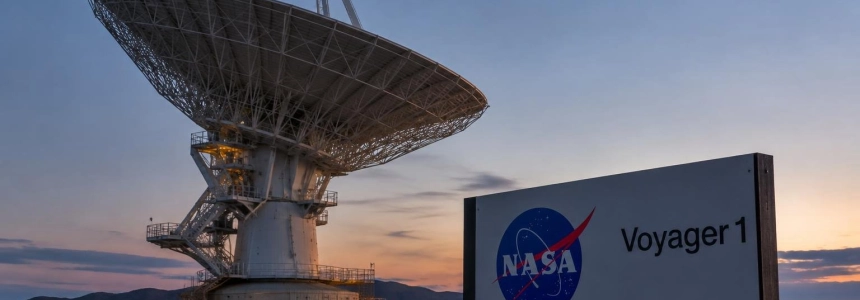
Voyager 1 is one light-day from Earth: the NASA probe crossed that threshold on Wednesday, November 18, at 5:16:07 a.m. Eastern Time, according to the agency’s calculation. It is 16.094 million miles (25.902 million kilometers) away, and a radio signal now takes 24 hours to travel the distance between the spacecraft and our planet.
A light-day does not measure how long it takes a spacecraft to reach a destination: it is a distance, the distance light travels in 24 hours. In this case, it indicates that Voyager 1 is more than 16 billion miles from home, after nearly half a century of travel. NASA describes the scale as “very, very far away.”
The milestone also changes the wait for those operating the mission. An instruction sent from Earth takes a day to reach the probe, and a response takes another day to return. So a round trip takes two days, even before counting the time needed to analyze the data or prepare new instructions.
The distance between an instruction and its response
NASA had estimated that Voyager 1 would reach the threshold at 2:16:07 a.m. Pacific Time on November 18; that moment is equivalent to 5:16:07 on the East Coast. Engadget noted that the agency would not be able to confirm the exact time until it received the next signal from the spacecraft. Tom’s Hardware later reported that the probe had crossed the boundary and put its speed at 37,844 miles per hour.
The distance released by NASA is 16.094 million miles, or 25.902 million kilometers. The signal takes 24 hours each way because radio waves travel at the speed of light. In practical terms, a question to the spacecraft and its response cannot be exchanged in real time.
Voyager mission manager Kareem Badaruddin summed up the rarity of the moment in comments to Engadget:
“It’s never happened before and may never happen again; it’s that kind of extraordinary event.”
— Kareem Badaruddin, Voyager mission manager
The figure also marks a record: no other human creation has traveled so far from Earth. Voyager 1 has gone farther than its twin, Voyager 2, although both have left the heliosphere, the bubble of particles and magnetic fields generated by the Sun.
From the Saturn flyby to interstellar space
Voyager 1 was launched in 1977 as part of NASA’s program to study the outer planets and the space beyond the solar environment. The two probes took advantage of a planetary alignment that, according to NASA, occurs once every 176 years. Voyager 2 left 16 days before its twin; even so, Voyager 1 ended up traveling farther.
Voyager 1’s primary mission included flybys of Jupiter and Saturn, completed in 1980. Voyager 2 also visited Uranus and Neptune. After those encounters, the two spacecraft continued toward the edges of the solar system to study regions the original missions were not limited to exploring.
In 2012, Voyager 1 entered interstellar space; Voyager 2 did so in 2018. NASA identifies them as the only spacecraft to have operated beyond the heliosphere. That does not mean Voyager 1 has reached the solar system’s final boundary: ABC News notes that it is still far from the Oort cloud, a region of icy objects that marks an outer boundary of the system.
The probe’s destination is not nearby either. It is heading toward Gliese 445, a star about 17 light-years away in the constellation Ursa Minor. The Verge reported that it could pass near the star in about 40,000 years; Engadget specified that the closest approach would be 1.7 light-years from the star. The spacecraft travels at nearly 38,000 miles per hour, but that speed does not make the journey close on a human scale.
An active spacecraft, with increasingly limited power
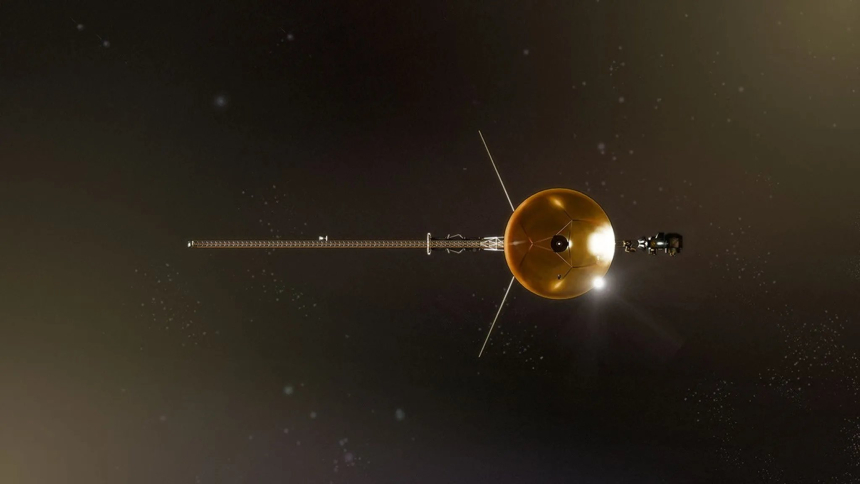
The record comes while Voyager 1 is still operating and sending measurements. According to The Verge, it can continue transmitting data about plasma waves, magnetic fields, and particles in space. NASA’s status page lists the magnetometer and plasma wave instrument as active; other instruments are listed as switched off to save power or because of degraded performance.
The spacecraft gets its power from a generator whose plutonium supply diminishes over time. ABC News reported that NASA has switched off equipment and heaters to conserve power. Linda Spilker, Voyager project scientist, told the network that the team estimates the available power and heat could allow the probes to keep operating until the early 2030s, although she also mentioned thrusters that are becoming clogged and temperatures that continue to fall.
The mission has lasted far longer than initially expected: ABC News explains that it was expected to last a decade. Spilker said she rejoined the team in 2020 thinking the spacecraft might have only a few years left. Instead, Voyager 1 is still going as it approaches the 50th anniversary of its launch, which both probes will mark next year.
The instruments’ status leaves a limited observation window. ABC News noted that only two of Voyager 1’s instruments, which measure the magnetic field and plasma, were still operating, and that one of them would probably be switched off over the following year. NASA’s page, updated on April 17, 2026, also records other equipment as deactivated and provides the status by instrument:
| Voyager 1 instrument | Status listed by NASA |
|---|---|
| Magnetometer | Active |
| Plasma wave system | Active |
| Cosmic rays | Switched off to save power since February 25, 2025 |
| Low-energy charged particles | Switched off to save power since April 17, 2026 |
| Plasma science | Switched off due to degraded performance since February 1, 2007 |
The distance also complicates any response to a malfunction. ABC News reported that NASA lost contact with the probe for about 48 hours the previous month, but communication was restored before the team could send instructions to diagnose the problem. Spilker warned that a time will come when the team waits for a signal that never comes back.
Voyager 2 and NASA’s upcoming activities
Voyager 2, launched 16 days before its twin, is following a different trajectory and will not reach one light-day until 2035, according to The Verge and Engadget. NASA says both probes continue collecting scientific observations of the environment beyond the heliosphere, although their operational capabilities are not identical: the agency’s status table shows differences between the instruments switched on and off on each spacecraft.
NASA organized activities to mark the milestone. On Tuesday, November 17, it invited the public to take part in “Shine Bright for Voyager’s Light-Day,” an initiative to create a symbolic wave of golden light around the planet after sunset. The agency prepared a page for phones and tablets to transmit “VGR,” Voyager’s call sign, in Morse code, and encouraged people to share photos or videos of the signal on social media, mentioning @NASA.
For Thursday, November 19, at 12 noon Eastern Time, NASA’s Jet Propulsion Laboratory (JPL) scheduled a moderated conversation with mission team members and agency officials. The event will cover the status of both probes, the science they are still conducting, and the challenges of keeping them operational at such a distance. It will be followed by a Q&A and a preview of NASA’s Voyager documentary, planned for 2027, when the mission turns 50.
Voyager 1 will continue moving away from Earth as long as it has power and can communicate. When contact ends, the two spacecraft will continue their journey with a golden record containing greetings in more than 100 languages, music, and instructions for finding Earth. The one-light-day distance measures how far the probe has traveled; it does not measure how long it will keep sending news.
Sources: The Verge, Engadget, Tom's Hardware, NASA, NASA Science, ABC News