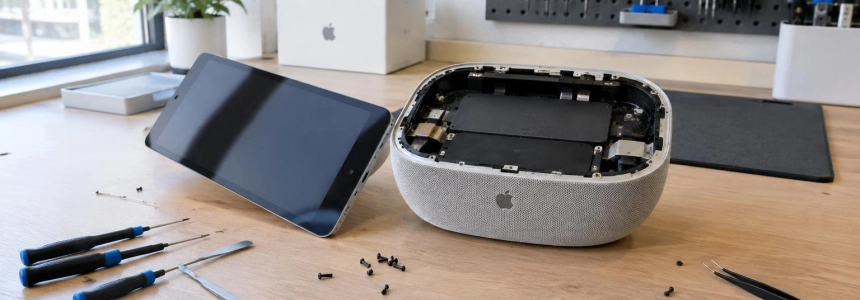
Taking apart Apple's HomeView cost iFixit a broken speaker and a torn-off connector. The team also had to apply more force than it considered safe to the logic board. Its review of the $299 device describes a repair made difficult by adhesive, fragile connectors, and a hinge that makes it hard to separate the screen from the base.
- Manufacturer: Apple
- Price: $299
- Screen: 7 inches
- Variants: desktop and wall-mounted
HomeView combines a 7-inch screen with a speaker base; there is also a wall-mounted version without that base. iFixit expected to find two separable modules: an initial CT scan showed the screen and base as distinct assemblies joined by a pivot. The actual teardown, carried out by Carsten Frauenheim alongside Elizabeth Chamberlain and Shahram Mokhtari, proved that expectation wrong.
The difficulty starts with the front glass. According to iFixit, the aluminum disperses the heat applied to soften the adhesive, so you have to wait longer; even then, the screen remains more firmly stuck than those of other Apple products the team has recently opened. Once it is removed, more obstacles appear: brackets that mix Phillips and Torx screws force you to switch tools for simple tasks.
Adhesive on the screen, speakers, and board
The speaker connectors were among the most delicate parts. iFixit scraped away the adhesive and tried to free the left connector, but the wires came away from the plastic housing, which remained attached to the board. With the right one, applying heat and cutting around it still wasn't enough to remove it without damage. Macitynet also highlights the fragility of these parts and compares them with connectors already criticized in other devices.
The logic board is not easy to remove either. Beneath its top shield, iFixit found thermal paste and another metal shield glued underneath, which conducts heat to the aluminum housing. Apple thus turns the chassis into a heat sink, but the thermal bond makes removing the board risky: freeing it requires applying force to a thin component.
The larger speaker ended up broken during removal. The team tried isopropyl alcohol, a pick, a spudger, and a metal tool that bent when prying; underneath, it found thick layers of adhesive. iFixit notes that speakers are mechanical parts susceptible to wear, and questions why a component that takes up so much space is attached in a way that makes it so difficult to remove.
Designing for repair is an intentional act, and here, Apple didn’t bother.
— Carsten Frauenheim, with Elizabeth Chamberlain and Shahram Mokhtari
The base offers the clearest relief
The bottom section is more accessible. The non-slip rubber comes off easily, and four Torx screws release the bottom plate. iFixit found a modular, replaceable USB-C port, as well as a power board that comes out after removing a few screws and disconnecting two connectors. Macitynet also considers this area the most repairable part of the assembly.
But that improvement has limits. The cable connecting the woofer to the board underneath is so short that iFixit could barely reach its latch and didn't know how to reconnect it during reassembly. The passive radiators are modular, but the cable complicates access. And the board covering the passage between the screen and base is also held in place with adhesive.
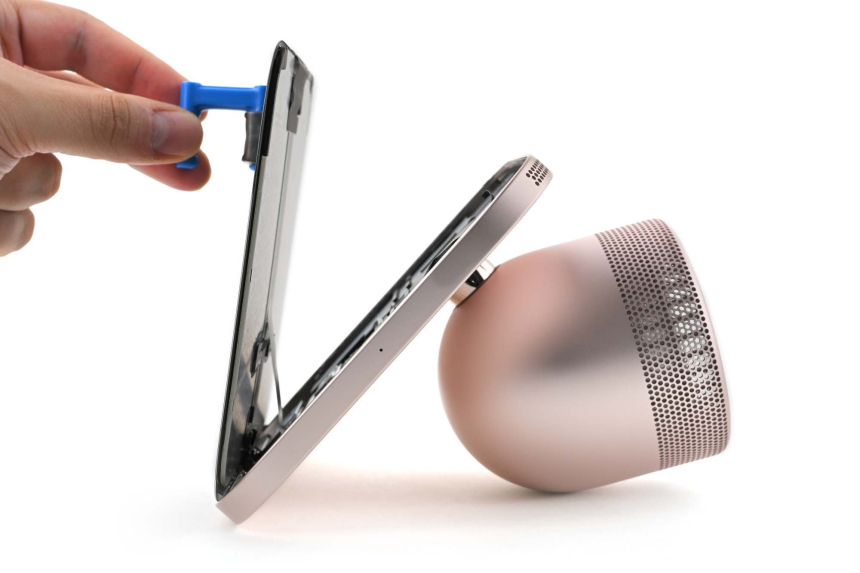
The connection between the two halves is the biggest obstacle for anyone who needs to replace either one. Apple routed the cables through the pivot before securing its screws; these are also locked with threadlocker and set at a difficult angle. According to iFixit, separating the screen and base requires specialized tools or extensive, potentially destructive disassembly of the screen.
Two models, internal and audio differences
CT scans show that the variants are not identical inside. The wall-mounted version has additional magnets, a different and larger logic board, and a USB-C port in the center; the desktop model features larger speakers and a circular pivot. 9to5Mac links the wall-mounted version's smaller internal speakers to differences between their audio systems.
Digital Trends notes that both versions cost the same, $299, and that the mount for the wall-mounted model is sold separately. The outlet advises keeping the difference in speaker size in mind if you plan to use HomeView to listen to music. It doesn't conclude that the smaller speakers sound worse, but considers them a significant hardware downgrade.
The repairability verdict is damning, although iFixit does not assign an official score in this category. In the teardown video, Shahram Mokhtari jokes that it gets a “BEEP this thing” out of 10, with the insult hidden by a beep. iFixit, Digital Trends, Macitynet, and 9to5Mac agree that the adhesive and internal design make HomeView difficult to repair; its modular base is its main advantage. Digital Trends adds another warning for buyers: the wall-mounted version has smaller speakers, and the mount is sold separately.
Sources: iSpazio, Digital Trends, macitynet.it, iFixit, 9to5Mac