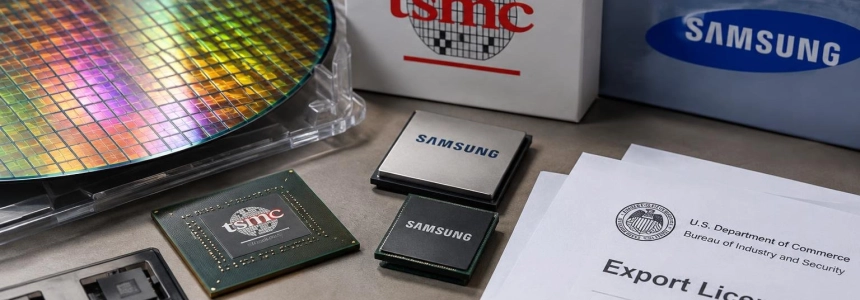
TSMC and Samsung have halted some chip shipments to Chinese customers after new U.S. export rules took effect. The companies have told their customers that they will apply for licenses from the U.S. Department of Commerce before resuming certain deliveries, the Financial Times reported.
The suspension affects semiconductors intended for Chinese customers, including advanced chips related to artificial intelligence infrastructure. It also covers processors for consumer electronics: case-by-case authorization may be required even when a chip was designed for a phone, according to coverage by the Financial Times cited by Seoul Economic Daily.
Licenses also required for consumer chips
The new provisions were introduced on November 16 by BIS, the Bureau of Industry and Security at the U.S. Department of Commerce, and began to apply on the 19th. They require export licenses for manufacturers that use U.S. technology to produce semiconductors and intend to sell them to Chinese customers.
The change directly affects foundries, companies that manufacture chips designed by other companies. Samsung and TSMC use U.S. equipment to manufacture semiconductors; therefore, when a Chinese chip design company has not received U.S. approval, foundries must separately apply for permission to ship advanced chips to it, according to Seoul Economic Daily.
In its November 16 announcement, it explained that the interim rule aims to prevent existing restrictions on sensitive U.S. technology from being circumvented through remote computing services and data centers located in third countries.
The agency noted that advances in cloud computing and superintelligence infrastructure make it possible to access advanced computing capacity from outside countries subject to controls. Drafted at the direction of the Department of the Treasury and the National Security Council, the rule aims to align protections against remote access with controls on the physical shipment of technology.
AI customers and mobile phone makers affected
Samsung's Chinese customers include Kunlun, Baidu's AI data center unit, and ByteDance, TikTok's parent company. The Financial Times reported, citing several people familiar with the matter, that Samsung and TSMC notified Chinese customers in the days beforehand that they would halt certain processors and apply for the required licenses.
The measure also closes a supply route for Chinese companies that design high-performance chips. According to the Financial Times, some had commissioned TSMC or Samsung to manufacture them and circumvented controls through orders handled by overseas packaging and testing companies, including some in Korea.
The scope extends beyond chips for data centers. Shipments to consumer electronics customers have also been suspended, because BIS withdrew an exemption that applied to advanced chips from certain designers, including Chinese ones. Previously, U.S.-approved foundries or downstream processing companies could supply these products if they certified that they were not subject to export controls.
With the exemption removed, even processors made using advanced processes and designed for smartphones now require specific U.S. authorization before shipment, according to published reports. TSMC supplies phone chips to Chinese manufacturers Xiaomi, Oppo and Vivo.
Waiting for permits could affect production
A lawyer cited by the Financial Times said that TSMC and Samsung must apply for licenses even for consumer chips made using advanced processes. The industry expects the Department of Commerce to approve licenses for phone processors, but the process could delay deliveries.
That waiting period is the immediate risk for manufacturers: even if permits are granted, delays could disrupt production. The companies have announced that they will apply for licenses for the affected shipments; the cited publications do not specify how long the pause will last or when deliveries will resume.
The timeline of the rule and its reported effects is as follows:
| Date | Event |
|---|---|
| November 16, 2026 | BIS publishes the interim rule on remote access to advanced chips and servers. |
| November 19, 2026 | The new export rules take effect. |
| November 20, 2026 | Some TSMC and Samsung shipments to Chinese customers are reported to have been suspended. |
The rule applies to companies that use U.S. technology in manufacturing and affects sales to Chinese customers. For TSMC and Samsung, the next step is to obtain export licenses for the suspended shipments; the pace of those approvals will determine how long the disruption lasts.
Sources: Seoul Economic Daily, edaily, U.S. Bureau of Industry and Security