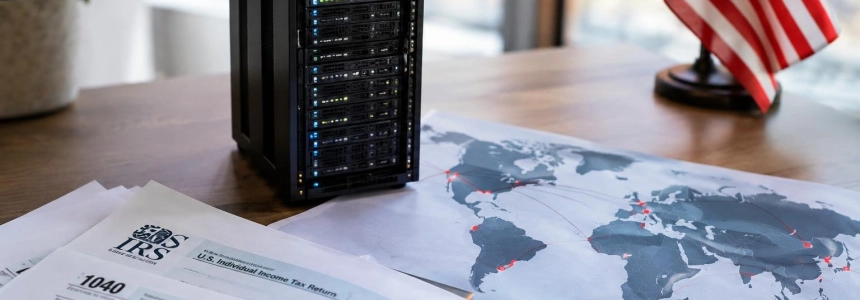
Donald Trump threatened on Friday to impose a “tremendous tax” on U.S. companies that build data centers outside the country. The president did not explain how much they would be taxed or how the measure would be implemented, announcing it during a press conference after a summit with Xi Jinping, president of China, and Vladimir Putin, president of Russia.
The warning is aimed at U.S. companies that choose to build facilities in other countries. Trump said they would be allowed to build them, but would have to pay a tax. His stated goal is for projects to stay in the United States.
“If they do that, they can, but we’re going to put a tremendous tax on them.”
— Donald Trump, president of the United States
A proposal announced without details
Trump said he had not informed his team about the proposal before making it public. At the press conference, alongside Vice President JD Vance and Secretary of State Marco Rubio, he said he was telling them about it at that moment. Although he spoke of preventing companies from building data centers in other countries, he did not describe a specific mechanism for imposing the tax.
Bloomberg Law also reports that Trump did not specify what legal authority the government could use to impose the tax. He did not explain how much the tax would be or how it would be applied. For now, the announcement is a threat without those terms defined.
The president linked his position to what happened with chips and other sectors. He also warned that if the United States does not host the data centers, China could get them instead.
Expansion runs up against local restrictions
The threat comes as states and cities across the United States are placing limits on new applications to build data centers. Some jurisdictions have imposed moratoriums and other restrictions on proposals. These local constraints may push companies to consider locations outside the country—the very alternative Trump wants to make less attractive.
The Verge describes the expansion of these facilities as an issue that has become unpopular across different political sectors. The outlet notes that even members of the Republican Party acknowledge this opposition.
Trump urged communities to take advantage of the investments and ask companies to contribute financially. At the same time, he rejected shutting the door on data centers in the United States. His message combines an invitation to negotiate local benefits with a threat to punish construction abroad through taxation.
The companies named and the legal unknowns
Bloomberg Law names Microsoft, Alphabet—the owner of Google—and Amazon among the companies that operate data centers. Trump did not explain how the tax would apply to U.S. companies that build facilities in other countries.
The lack of an explained legal basis leaves a central question unanswered: how the government could impose the tax Trump is proposing. Bloomberg Law notes that the president did not specify what authority he would have to do so. The available sources do not specify what instrument would be used to implement the tax.
The political makeup of Congress adds another obstacle. According to The Verge, a new Democratic majority will take office in a couple of months, which could make it harder for Trump to fulfill his promise. The outlet also points to political opposition to data center expansion, including among members of his own party.
An announcement that does not yet set policy
Trump said companies can build data centers in other countries, although they would face a “tremendous” tax. His announcement does not explain how the threat would apply to companies that build outside the United States. Bloomberg Law notes that Trump did not explain how it would be carried out.
The Verge reports that Trump said he had not yet informed his team about the proposal and was raising it publicly. The promise comes as state and local restrictions limit new applications to build data centers in the United States, while the president tries to make building them in other countries a less attractive option.
Sources: The Verge, Bloomberg Law