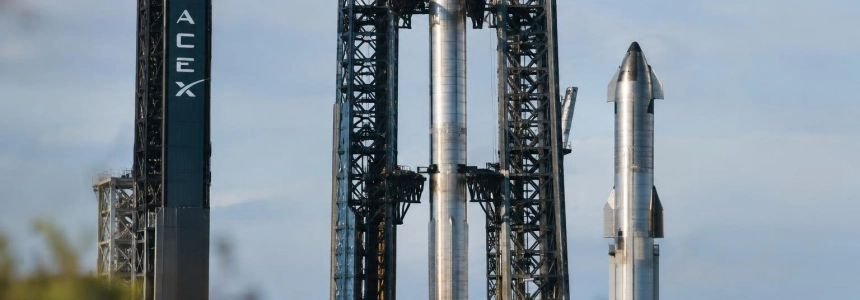
Starship 42 returned from orbit and was caught by Mechazilla’s arms at Starbase, Texas, on SpaceX’s fifteenth test mission. The catch took place on Saturday, November 14, about 22 and a half hours after liftoff; Super Heavy 22, which was supposed to complete the first dual recovery alongside it, never made it to the tower.
Mechazilla has caught Ship 42. This is incredible to see. One of the most incredible and historic feats of all time has just happened before our eyes.
— SpaceX spokesperson
Ship 42 completed the return the mission set out to test
The maneuver took place at Starbase in Boca Chica, southern Texas. According to 20minutos, the catch occurred at approximately 21:21 GMT on Saturday, or 22:21 in mainland Spain. Microsiervos puts the time since launch at 22 hours, 30 minutes, and a few seconds; 20minutos gives it as 22 hours and 32 minutes.
The ship descended from space and righted itself in the final seconds, briefly suspended in the air before settling between the tower’s mechanical arms. SpaceX calls the system Mechazilla, and its catching arms are known as “chopsticks.” A company spokesperson called the maneuver “engineering history” during the broadcast.
The flight lifted off from Starbase on Friday, November 13. Space.com reports that the launch took place at 17:47 EDT, or 22:47 GMT. It was Starship’s fifteenth test flight and SpaceX’s first attempt to recover both stages at the launch site: Super Heavy a few minutes after liftoff, and the upper-stage ship after it returned from its orbital journey.
The catch of Ship 42 was successful, but that does not mean the entire rocket was recovered. The first stage, Super Heavy 22, was not caught and ended up in the Gulf of Mexico. The result combines an unprecedented advance for the upper stage with the failure of the other half of the recovery plan.
Fourteen orbits and 26 satellites deployed
Before returning, Ship 42 completed 14 orbits around Earth, according to 20minutos. Dan Huot, a SpaceX representative, had announced a maximum speed of 17,600 miles per hour, nearly 23 times the speed of sound. Space.com says the orbital insertion maneuver was scheduled for about 26 minutes after liftoff and that the burn was expected to last around 20 seconds.
The ship deployed all 26 Starlink V3 satellites it was carrying. Space.com puts the end of the deployment at one hour and 17 minutes after launch. The broadcast showed the ship slowly rotating as it released the satellites; according to 20minutos, they were in good condition, in contact, and climbing toward their operational orbits.
The deployment was not entirely new for the program: Microsiervos notes that Starship’s second stage had already released 26 Starlink V3 satellites on flight 14. What was different this time was that Ship 42 subsequently completed its return from orbit and was caught by the tower.
The recovery of an upper stage that had entered orbit marks the test’s main milestone. 20minutos describes it as the first time in rocket history that an upper stage has returned to Earth’s surface and landed vertically after an orbital mission. Microsiervos also considers it the first recovery of a rocket after it had entered orbit.
Super Heavy 22 diverted to the gulf
The mission did not achieve its full objective. Before the ship’s return, SpaceX called off the booster catch and directed it to splash down offshore in the Gulf of Mexico. Space.com’s broadcast said Booster 22 had aborted its attempt to return to the launch site and splashed down in the gulf; the exact cause was unclear during the coverage.
A low-fuel-mass alarm may have cut short the return burn, according to a theory raised by a SpaceX spokesperson during the broadcast and reported by 20minutos. The company was still investigating the incident. Space.com also quoted Huot, who said they would review what had caused the abort during the flight back to the tower.
Microsiervos attributes the diversion to a guidance and control software failure and notes that the self-destruct system activated a few meters above the water. This explanation does not exactly match the possible fuel alarm mentioned by 20minutos; SpaceX had not concluded its investigation at the time of those reports.
The booster catch was scheduled for about six and a half minutes after liftoff, according to Space.com, while the ship’s recovery was planned for about 22 hours later. SpaceX had landed Super Heavy on other occasions, but this test was to be the first attempt to catch the upper stage as well after its return from orbit.
The return passed over populated areas
Ship 42 flew over populated areas of Texas and Mexico before reaching Starbase, as well as over South Padre Island, according to 20minutos. The launch site is less than eight kilometers from the nearest members of the public. During its approach, the ship produced sonic booms, a sound that surprised the SpaceX spokesperson commentating on the maneuver.
The upper stage returned to the tower after an orbital mission lasting about 22 hours, but the flight also included an extended period of waiting in space. Space.com reports that controllers ruled out an early-return option involving a splashdown near Hawaii, planned for about 90 minutes into the flight. That decision allowed the mission to continue, making it Starship’s longest flight to date, according to Huot.
The launch site had been prepared for the dual recovery attempt. Space.com reported that Super Heavy 22, the flight’s first stage, was moved to the launch site for stacking; Ship 42 was then placed on top of the booster. The company had carried out final catch tests before launch.
The ship still needs inspection, and the failure needs explaining
SpaceX will need to thoroughly inspect Ship 42 to assess how it withstood the flight and the catch, Microsiervos notes. The goal is to apply what was learned and move toward launches and reuses at a high cadence. The ship had already demonstrated that it could deploy satellites in orbit; this time, it also returned to Earth using the tower’s arms.
The result leaves two open tasks: determining why Super Heavy 22 could not be caught and checking the ship’s condition after its return. SpaceX had not announced a definitive cause for the booster abort. Ship 42’s first orbital catch was complete; recovering both stages on a single flight was not.
Sources: Technology, Microsiervos, Microsiervos, Space