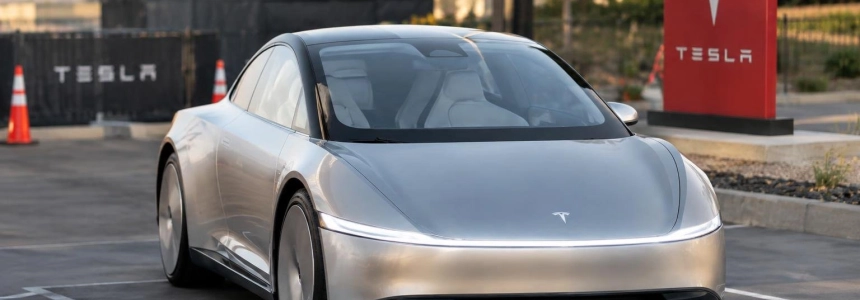
Tesla has started inviting selected customers in the United States to buy the Cybercab: the two-seat autonomous vehicle, with no steering wheel or pedals, is listed at $29,990, with deliveries estimated for December 2026.
The offer marks a shift from Tesla’s robotaxi service toward sales to private individuals, but with conditions that limit the everyday use of a car. Buyers cannot drive it outside the enabled geographic areas or use it for commercial activities. And because it has no manual controls, there is no alternative way to continue a trip if the vehicle leaves its operating area or the subscription is canceled.
A purchase price and a fee to operate
The order page lists a price of $29,990 and requires a non-refundable $1,000 deposit to reserve one. The Verge reports that the invitation mentions a December delivery window that is not guaranteed; Digital Trends also puts estimated deliveries in December 2026. The offer is limited, and according to the invitation reproduced by The Verge, initial availability will be limited.
On top of that payment is a monthly fee of $299 for the “Autonomy Subscription,” which is required to operate the Cybercab. Electrek says the first month is included and that the subscription is preselected on the order page. The fine print also requires regular vehicle maintenance. Without an active subscription, the car cannot be driven on public roads: there is no manual mode to replace autonomous driving.
| Item | Amount or condition |
|---|---|
| Cybercab price | $29,990, before taxes |
| Autonomy subscription | $299 per month; required to operate |
| First month | Included, according to Electrek |
| Reservation deposit | $1,000, non-refundable |
| Estimated delivery | December 2026 |
| Approximate cost over five years | About $47,600 before taxes, charging, and insurance |
Five-year cost estimates vary slightly by publication and by which items are included. The Verge calculates that 60 monthly payments add up to $17,940 even with the first month included, bringing the starting cost to about $47,600 before taxes, charging, and insurance. MuyComputer estimates a total outlay of $47,631, assuming the fee does not change, excluding taxes, insurance, charging, and other expenses. Electrek likewise gives an approximate figure of $47,600, before insurance, maintenance, taxes, and charging.
In addition, The Verge reports that Tesla can change the subscription price with 30 days’ notice. If the customer continues using the service after a change to the terms, they accept the new terms. If they cancel or Tesla suspends their access, they do not receive a prorated refund for the remainder of the month they have already paid for. The contract therefore leaves open the possibility that the recurring cost could change while the owner depends on that fee to use the car.
Authorized areas define every trip
The Cybercab can only operate within areas compatible with Tesla’s Robotaxi service. Digital Trends describes initial deliveries in five Texas cities: Austin, Dallas, Houston, San Antonio, and Fort Worth. Electrek, by contrast, lists eight cities where Tesla offers Robotaxi: those five and, in Florida, Miami, Orlando, and Tampa. Both publications agree that the vehicle is restricted to geographic areas enabled by the company.
The availability of a service in a city does not necessarily mean that its entire area is covered for private owners. MuyComputer notes that it has not been confirmed that all Robotaxi zones are enabled for them. Electrek cites testing by Koby Pierce, creator of Robotaxi Tracker, who tried thousands of addresses in the app and found that the areas where pickups and destinations were accepted accounted for between 59% and 78% of the announced zones in six cities. In Austin, the share was approximately 59%.
Electrek adds examples of practical limits found in those areas: in Houston, the tracker found that the app calculated about 40 minutes to travel two blocks downtown, apparently because the vehicle avoided railroad crossings. The publication also says Tesla includes San Antonio airport within its perimeter, even though the service does not serve it. These observations describe the Robotaxi service and do not guarantee that every address can be used with a privately owned Cybercab.
The car has two seats and a 21-inch central display, along with 20.1 cubic feet of cargo space, according to Electrek. Tesla presents it as a fully autonomous vehicle managed through an app. The absence of a steering wheel and pedals means that geographic restrictions have direct consequences: the owner cannot take manual control to leave the authorized area.
No commercial use, with regulation still pending
The sales invitation does not allow owners to use the Cybercab as a commercial vehicle. The Verge reports that the terms prohibit using it for services such as Uber or DoorDash and also prevent owners from adding it to Tesla’s own Robotaxi network to generate income. That possibility had been part of Elon Musk’s 2024 presentation, under the idea that private owners could add their vehicles to the fleet and earn money while they were not using them.
Ashok Elluswamy, Tesla’s head of artificial intelligence, has floated the second quarter of 2027 as a possible target for allowing customer cars to join the network, according to The Verge. It is not a firm date for the first buyers. Under the current offer, therefore, the monthly fee cannot be offset by putting the vehicle to work in Robotaxi.
The regulatory review is also still pending. Bloomberg reports that the National Highway Traffic Safety Administration (NHTSA) opened an investigation one day after the vehicle debuted in September, focusing on the process and technical data Tesla used to self-certify that it met federal safety standards. The Verge describes a formal audit of a vehicle without a steering wheel, pedals, or side mirrors, and says Tesla submitted its legal justification in October, requesting that the response remain confidential.
Electrek provides an additional detail about the review: it says NHTSA asked Tesla to demonstrate under oath that a car without a brake pedal complies with federal standards that require one, and that Tesla responded on October 30 by requesting confidentiality for its entire response. The agency had not yet issued a decision, according to the publication. Bloomberg also notes that it is unclear whether regulators will prevent autonomous vehicles from being delivered to consumers.
“The monthly fee is too high.”
— Elon Musk, on X
Musk responded to Marques Brownlee on X that the monthly price should be around $115, a figure he compared with the Full Self-Driving and connectivity services on other Tesla models. Digital Trends reports that Musk also said the Cybercab will be available nationwide as it receives regulatory approvals. He did not announce a reduction in the $299 fee.
Cost and legal authorization are not the only unknowns identified by The Verge. Tesla says the subscription covers autonomous driving, maintenance, and towing, but excludes car insurance. The company has not explained how private insurers would calculate coverage for a car without a human driver or how liability would be divided between the owner and Tesla in the event of an accident during autonomous operation. It has also not detailed the criteria for selecting invited customers or how many vehicles it is reserving for private sale versus its own fleet.
From Tesla’s fleet to the first private orders
The Cybercab is already part of the Robotaxi service in Austin. The Verge dates the start of rides in the vehicle to September, as part of a fleet that also uses Model Y vehicles. According to the collaborative Robotaxi Tracker count cited by the publication, Tesla had 278 Cybercabs in operation, close to 40% of its fleet. Bloomberg confirms that the model debuted in Austin as part of the service and that the new offer expands sales to individual buyers, after Tesla had published an interest form for fleet operators.
Orders opened just weeks after Musk told investors that the vast majority of Cybercabs would be owned by Tesla and operate in its Robotaxi service. The company, however, had already mentioned that it would deliver some vehicles to customers before the end of the year. It has now started doing so through selective invitations: Matt Holm, president of the Tesla Austin’s Owners Club, posted screenshots of the email he received and the order he placed, according to Bloomberg.
Tesla began Cybercab production early this year, according to Digital Trends. The publication also reports that the company plans to scale back Cybertruck production around mid-2027 to expand robotaxi production. No date has been announced for when ordinary customers can order the vehicle without an invitation, and there is no confirmation that Tesla will reduce the subscription fee.
The next expansion depends on regulatory approvals, according to Musk; for current buyers, the vehicle’s usefulness depends on whether their home and destinations are within operating areas. While NHTSA’s review remains pending, Tesla is already accepting non-refundable deposits for deliveries expected in December.
Sources: Digital Trends, MuyComputer, The Verge, Yahoo Finance, Electrek