96,000 U.S. chips reached China from South Korea in shipments that, according to customs authorities, were concealed as samples and not declared. The case came to light in January 2024; reports from November 2026 describe a separate investigation in Malaysia into possible re-exports of artificial intelligence chips linked to Megaspeed.
The South Korean case: three years of concealed shipments
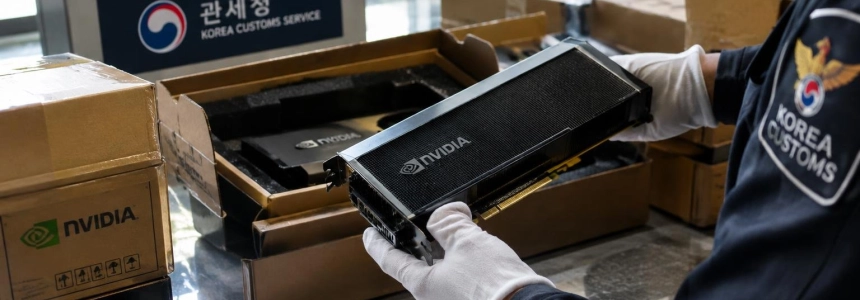
The Korea Customs Service announced on January 25, 2024 that it had detected the alleged illegal export of components to China. Yonhap put the shipment at 96,000 chips manufactured by a U.S. company, with a combined value of 13.9 billion won, equivalent at the time to $7.49 million.
The accused were two executives at an electronic components distributor, both in their 40s, according to Yonhap. The Asia Business Daily identified them as the CEO B and director C of company A; the Seoul customs office referred them to the Seoul Central District Prosecutors' Office without arrest on suspicion of violating several laws.
| Case detail | Figure or period |
|---|---|
| Chips sent to China | 96,000 units |
| Total value | 13.9 billion won |
| Components subject to strategic controls | 53,000 units; 11.8 billion won |
| Shipment period | August 2020 to August 2023 |
| Air-mail shipments | 144 |
The components had been imported by a South Korean telecommunications equipment development company for internal use. According to Yonhap, the two executives sent them to China 144 times by air mail, after presenting them as sample products. The Asia Business Daily adds that the distributor allegedly colluded with the development company to obtain more units than necessary and divert the surplus.
Some of the material was subject to an additional control category. Authorities said that 53,000 chips, valued at 11.8 billion won, were strategic goods requiring state authorization. The regulations cited by The Asia Business Daily required applicants seeking an export permit to submit documentation on the import's use and purpose, as well as undertakings from the importer and end user.
“The U.S. has tightened its control on semiconductor exports to China and concerns have risen over South Korea being used as an export detour. We will enhance monitoring and sternly deal with such illegal acts,”
— Korea Customs Service official, according to Yonhap
The additional allegation involving money
The Asia Business Daily also described an alleged financial scheme linked to the smuggling. The people under investigation allegedly exported low-priced semiconductor devices worth about 4 million won to Hong Kong and falsely declared 7.5 billion won to customs. The publication says they submitted fake shipping invoices to banks to collect that amount as proceeds from chip sales.
According to the investigation cited by the outlet, the difference created by the false declaration was allegedly laundered and transferred through illegal channels, including the hawala system. These are allegations attributed to the customs investigation: the reports do not present a court ruling establishing the two men's guilt.
The case concerns authorities because South Korea could serve as a diversion route to China for goods subject to export controls. The Korea Customs Service said it would strengthen monitoring and information analysis to combat the smuggling of strategic goods and other controlled products.
A new investigation, but in Malaysia
The investigation described in November 2026 is not a reopening of the South Korean case. Malaysia's Ministry of Investment, Trade and Industry is examining whether Speedmatrix, the local subsidiary of Singaporean cloud company Megaspeed, re-exported artificial intelligence chips that it had imported along with servers to operate as a tenant in a data center.
The ministry is working with customs to determine whether the chips left the country and, if so, whether the shipment complied with the law, The Next Web reported, citing Reuters. Malaysian Prime Minister Anwar Ibrahim said his country would cooperate with any investigation, although it had not yet received requests from Singapore or the United States. He added that there was no evidence that chips linked to Megaspeed had left Malaysia.
The legal distinction depends on where the hardware ends up. According to The Next Web, chips that remain in Malaysian data centers and are rented remotely to customers, including Chinese companies such as Alibaba, may be used under current rules. By contrast, since July 2025, re-exporting, transshipping, or transiting high-performance AI chips of U.S. origin requires a commercial permit; providing false information to customs is a crime.
Malaysia's ministry said it is coordinating its work with authorities in Singapore and the United States and is considering tightening controls. The case puts Speedmatrix and Megaspeed under scrutiny, but it does not amount to a finding that the chips were sent to China.
Megaspeed and the allegations involving Nvidia
The Malaysian review comes amid U.S. allegations that Megaspeed may have been used to evade controls on advanced semiconductors. The New York Times reported, according to The Next Web, that Megaspeed had purchased more than $4.8 billion worth of Nvidia chips over two years. The company says on its website that it takes its U.S. compliance obligations “extremely seriously” and did not respond to Reuters about the ministry's statement.
The Next Web said that U.S. Department of Commerce agents suspected Megaspeed of smuggling Nvidia chips into China, before the investigation was halted and transferred to the Department of Justice. The publication also linked the controversy to Alice Huang, a former Megaspeed executive, but those claims are part of the allegations and the investigation's context, not a conclusion about where the chips went.
Separately, Reuters found more than 150 hiring notices, investment plans, construction contracts, and company statements related to computing projects in China that would include Nvidia H100, H200, and H800 processors. Wccftech valued these projects at more than $3.2 billion and said they span companies, initiatives backed by local governments, universities, and regional computing centers.
That tally does not by itself prove that each processor reached its destination: Wccftech said it had not been confirmed that the GPUs had reached the intended facilities. Among the projects, it mentioned a facility in the northwestern province of Gansu that is reportedly being adapted to house thousands of Nvidia processors before the end of 2026. Operators may also be forced to redesign their facilities to use Chinese chips if enforcement of the restrictions is tightened.
What remains under investigation
In Malaysia, authorities must establish whether there was a re-export and, if so, whether it had a permit. The ministry is also considering stricter controls; Anwar said the country would cooperate with the investigations. There is still no evidence that the chips left the country, according to the available information about the case.
In South Korea, the two executives were referred to prosecutors on suspicion of offenses related to the Foreign Trade Act, the Customs Act, and the law against concealing criminal proceeds. Authorities announced increased monitoring, while the Chinese projects described by Reuters leave another question open: whether the GPUs contracted for those centers actually reached the facilities.
Sources: Wccftech, TNW | Asia, Tom's Hardware, Yonhap News Agency, The Asia Business Daily, Yonhap News Agency