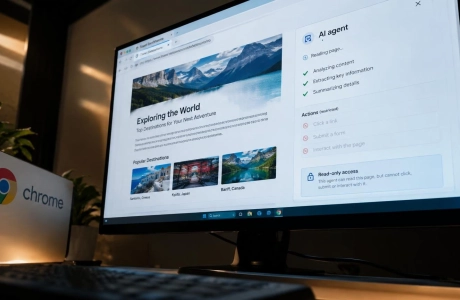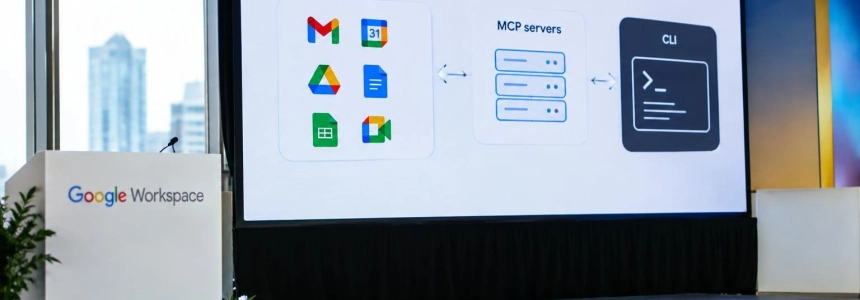
Starting February 1, 2027, artificial intelligence agents will have to connect to Google Workspace through Google’s MCP servers or its command-line interface (CLI), rather than calling REST APIs directly. The company presented the change as a security and control measure; for those developing agents, it means migrating integrations before the rule is technically enforced.
Two managed gateways for agents
Google announced the general availability of Workspace MCP and Workspace CLI as two managed ways for agents to interact with its services. The MCP servers, based on the open Model Context Protocol standard, provide tools for Gmail, Google Drive, Docs, Sheets, Slides, Calendar, Chat, and Tasks. The company says Keep will be added soon.
The CLI is designed for local agents, desktop environments, and terminal-based automation, virtual machines, and container sandboxes. It includes sign-in with scoped permissions, dynamic command discovery, and packaged skills for agents. According to Google, it makes it possible to read and update Workspace data without each team having to build a custom integration.
Google says MCP can return relevant context within Workspace’s security boundaries, rather than downloading emails and files line by line through REST. The company also claims that this approach reduces token usage and latency; the CLI, meanwhile, makes it possible to chain tools from the terminal.
The change does not affect traditional applications, which can continue using existing REST APIs. The requirement applies to AI agents and similar access tools. The relevant distinction, therefore, is not just which API a product uses, but whether it operates as an AI-powered agent or tool.
What controls apply to each call
Requests through MCP and the CLI will be checked against the organization’s permissions, data loss prevention (DLP) rules, and classification labels. Google also provides for user confirmations for sensitive actions and audit logs so administrators can review what an agent did.
The distinction between routine and sensitive actions matters. Creating a draft can remain an automated task; sending an email to someone outside the organization, changing Drive sharing permissions, or making bulk changes may require explicit user confirmation, according to the rules set by the administrator.
External agents will have to identify themselves as agents and use dedicated OAuth client IDs, along with least-privilege scopes. Google says usage quotas will be part of this model and that time-limited approvals will arrive later. Administrators will be able to view, audit, and revoke agents from the admin console; direct review and revocation by users are still pending.
“for human-paced apps where a valid OAuth token implied user intent.”
— Google, in its November 25 announcement
The phrase sums up Google’s rationale: a conventional application can use a valid token in a workflow designed for people, but an agent operates at machine speed and can act autonomously on emails, documents, datasets, and cloud infrastructure. In the company’s view, possession of the token is no longer enough to assume user intent.

The addendum sets limits on data use
The new Workspace AI Tools Addendum prohibits using agents and other access tools for certain activities Google considers risky. These include permanently storing raw data, training models, and scraping Workspace APIs. The company also stipulates that derived data must be deleted within a defined period and that data must be deleted when a tool is disconnected.
The coverage includes standalone agents, programs that deploy or orchestrate them, and applications or services that use AI models, according to Unite.AI. The outlet explains that the addendum prohibits disguising a tool to avoid having it classified as an agent or circumventing the MCP requirement. It also notes that user data and Google technical information may only be processed to complete active tasks authorized by the user.
Unite.AI adds that this technical information cannot be retained for more than 30 days and that covered data must no longer be retained when a tool is disconnected or its access is revoked. The same outlet says Google may restrict or remove a tool’s access, or suspend or terminate the customer’s access to affected services, if it believes these rules have been violated.
Google also plans to provide controls for blocking external agents in Gmail messages and specific Drive files or folders. These restrictions have only been announced as coming soon. User activity review and revocation are also still pending, although administrators already have access controls, confirmation rules, and audit logs.
Quotas and billing: two different dates
The agent migration coincides with a tiered usage model for Workspace APIs and its new tools. The Standard tier is free and applies published quotas; Scaled is intended for projects that need higher limits. Google says more than 99% of active developers currently operate within the Standard tier and will be able to continue accessing it at no additional cost.
| Date | Change |
|---|---|
| February 1, 2027 | Technical enforcement of the MCP or CLI requirement for agents begins. |
| April 1, 2027 | Billing begins for Scaled-tier usage that exceeds the free daily allowances. |
| April 1, 2027 | Projects that keep higher limits without switching to Scaled or being marked as internal will be downgraded to Standard quotas. |
Projects used exclusively within a Workspace organization can be marked as internal by an administrator to retain higher limits included in the subscription. For other projects that exceed Standard, Google says a billing account must be linked and the project switched to Scaled. If no action is taken before April 1, 2027, limits will automatically revert to Standard quotas at no additional cost.
Google also says Google Cloud Support customers will be excluded from the variable support fee calculation for Workspace APIs, at least until December 2027. Any changes will be communicated at least 90 days in advance. The company will email billing administrators and owners of affected projects with details and next steps.
Agent Gateway adds controls in Google Cloud
The Workspace policy is part of a broader set of controls for agents. Google Cloud introduced Agent Gateway, a gateway for language model, MCP, and Agent2Agent (A2A) traffic. It checks agent identities against the Agent Registry, applies identity and access management (IAM) policies, sets default-deny egress rules, and scans requests with Model Armor, Google’s service for filtering attacks such as prompt injection.
According to Unite.AI, the gateway controls both incoming traffic from clients to agents and outgoing requests from agents to tools, APIs, and other agents. It can also delegate custom authorization checks to an organization’s policy engines or third-party security tools through Service Extensions.
Some limitations of the rollout remain unresolved: support for Cloud Run and the gateway for cross-cloud Kubernetes environments are in Limited Preview. Each instance can manage up to 5,000 registered resources in Agent Registry. Google also recommends filtering instructions and responses for indirect prompt injection, which can be hidden in untrusted content such as emails or documents.
Unite.AI also lists known issues with the setup: some approval prompts are available only in English, users still cannot view or revoke saved tool approvals themselves, and these approvals expire after 90 days. Google plans to roll out more granular controls over the coming months; in the meantime, the date marking the migration of Workspace agents is February 1, 2027.
Sources: Infosecurity Magazine, Google Workspace Blog, Workspace Updates Blog, Unite.AI