Genie 4 is now available in Project Genie: Google has begun offering its new interactive world model to eligible Google AI Ultra subscribers. The update also adds an agent that helps create scenarios through conversation and a gallery for discovering, exploring, and remixing worlds.
Google announced the launch on November 18, 2026. Project Genie is an experimental browser-based prototype that lets users generate and explore interactive environments. Previously introduced as a research version for testers, Genie 4 is now available to paying subscribers for the first time through this product.
Edit the scene without leaving the exploration
The most noticeable difference in Genie 4 is that users can change the world mid-session. While exploring the environment, they can enter another prompt to change the weather, introduce a character, or redirect the action. The model updates the scene in real time, rather than limiting interaction to the description used to create the world initially.
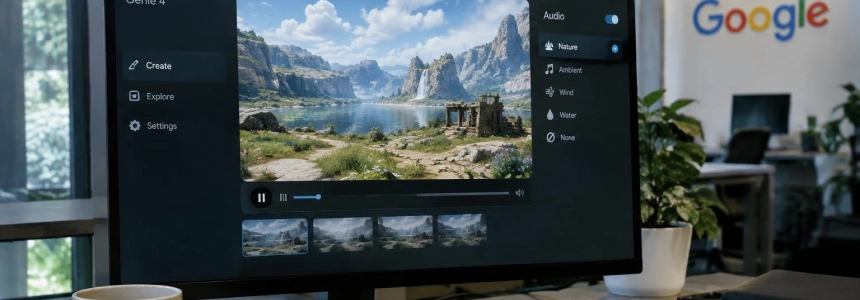
Sound generation also becomes part of the experience. Genie 4 produces native audio in real time to accompany what is happening, from ambient sounds like wind in the trees to character dialogue. Google DeepMind presents this capability as a first for the Genie series. The voice can respond to user prompts and events in the scene.
Google describes Genie 4 as its most realistic and interactive world model to date. According to Google DeepMind, it combines capabilities from the Gemini family: Gemini Omni helps ground simulations in the appearance and behavior of the real world, while other Gemini models help maintain their coherence and continuity. In Project Genie, these models are integrated with Genie to create and modify spaces in the browser.
Generation is not limited to moving images. Google explains that the model can simulate how an environment responds to an event, what it sounds like, and how the people in it move or react. The company highlights advances in visual realism, movement, and physics, while keeping the system in the research phase and acknowledging that limitations remain in long sessions.
An agent for building worlds and a gallery for sharing them
The update adds the Project Genie agent, which turns a natural-language description into a starting point for an interactive experience. Google says the agent coordinates its multimodal models to produce initial images that define the look of the world and a background soundtrack suited to its atmosphere.
Gemini models can also be brought into a session during exploration. They observe what appears on screen and can offer contextual suggestions about where to go next or trigger events within the world. This expands the use of prompts beyond a single text or image instruction: users can talk about what they want to build and continue to make changes as they explore.
The new gallery brings together worlds selected by Google and creations from the community. Experiences mentioned by the company include Living Memory, which transforms personal photos into explorable spaces; Dino Field Guide, featuring prehistoric habitats based on 360-degree panoramas; and Rock Paper Scissors, where themed objects face off on a table and Gemini acts as a real-time referee.
There are also projects made with creators who had early access. The Life of Ants, developed with filmmaker Anand Gandhi, lets users explore a colony from an ant’s perspective. Villa Giallo, created with creative technologist Will, known as BLVCKL!GHT, turns a Gothic mansion into an interactive mystery to explore room by room.
Users can start a world with a description or remix an experience that has already been published. The agent can modify elements such as the environment’s structure, soundtrack, or rules; the creation can then be published in the community gallery for others to explore and remix.
Genie 3 gets longer sessions and 360-degree panoramas
Genie 4 does not replace the previous version. Genie 3 remains available in Project Genie’s model selector for those who want longer sessions or to create spaces from panoramic images. Google has increased the maximum length of each generation from 60 seconds to three minutes.
The previous version also adds the ability to link multiple worlds to extend an exploration and use 360-degree panoramic images as a basis for generating spaces. It also supports changes to the environment through natural-language prompts while exploring. Google describes, for example, a seamless transition between forests, underwater ruins, and icy seas.
The company also showed how a panorama can help preserve a location’s visual continuity when looking around. In one example, the environment maintains the relationship between the canyon and the facade of Petra. These features make Genie 3 a distinct option in the selector: less focused on the visual and audio capabilities Google attributes to Genie 4, but offering more time per generation and panorama support.
Access starts with AI Ultra
The announced availability is for eligible Google AI Ultra subscribers, to whom Google is rolling out the new experience. Google AI Pro members can sign up for a waitlist. Google did not announce a general release for other users in this update.
Consumer access follows Google DeepMind’s introduction of Genie 4 to trusted testers as a research preview. In October, TechCrunch reported on that first phase and described the model’s ability to modify a simulation with prompts mid-session. The publication noted potential uses at the time, such as prototyping for film, as well as video games, interactive learning, and robotics.
At that presentation, Google DeepMind engineer Diego Rivas explained that real-time interaction could help accelerate ideation and storyboarding:
“The real time aspect becomes most valuable in the areas where keeping a state of flow in the creativity space becomes incredibly useful,”
— Diego Rivas, Google DeepMind engineer
TechCrunch also noted that the product’s final experience was still unclear and that details and objects could change as a simulation continued. Google maintains that caution in this launch: it presents Genie 3 and Genie 4 as frontier research models, not as systems that have already solved every problem involved in persistent simulation.
Watermarks and unresolved limitations
Google says all audio and video generated in Project Genie include SynthID, its invisible watermark for AI content. In addition, model inputs and outputs pass through safety checks. The company says it is continuing to work on camera latency, complex physical interactions, real-time audio accuracy, and the long-term persistence of scenes.
Among the limitations Google mentions are details drifting during extended sessions, difficulty maintaining legible text, and challenges with complex physics. DeepMind’s description adds that Gemini models can observe the scene and guide its evolution, but the company does not present this combination as a guarantee of perfect continuity.
Google suggests that world models could be used to prepare training environments for robots and agents before they operate in the real world, as well as to power new interactive experiences. In its research on Genie 4, it describes using Gemini as an agent that breaks goals into steps, reviews frames, and adapts its plan when the simulation changes or the user intervenes. For now, the announced consumer access begins in Project Genie for eligible AI Ultra subscribers.
Sources: TNW | Artificial-intelligence, The Decoder, Google, Google DeepMind, Google DeepMind, TechCrunch, AI Watch