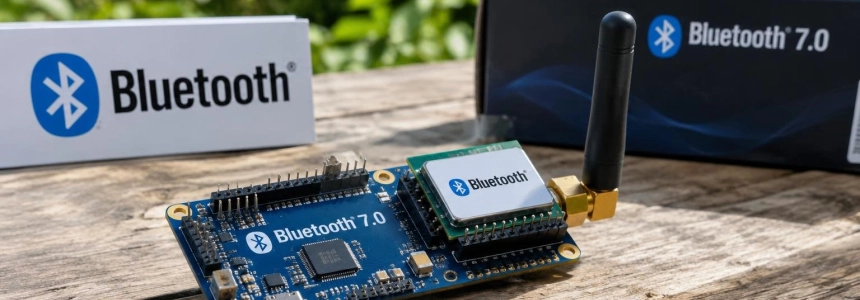
Bluetooth 7.0 has been adopted: Bluetooth SIG ratified the Core specification on November 3, 2026, incorporating High Data Throughput (HDT), an optional feature that raises Bluetooth LE's maximum physical rate to 7.5 Mbps. The increase targets faster transfers and paves the way for high-resolution, lossless wireless audio, but it will not reach current devices through a simple software update.
An adopted specification, not just an announcement
Bluetooth SIG announced the adoption of HDT on November 4, one day after the date shown in the Bluetooth Core 7.0 specification published by the organization: November 2. CNX Software dates the ratification of Bluetooth 7.0 to November 3. The dates describe different milestones: publication of the document, ratification, and public announcement.
The specification defines the technologies needed to create interoperable Bluetooth devices. HDT is part of Core 7.0, but support is optional: not every product adopting the version has to implement it. Bluetooth SIG presents it as an extension of Bluetooth LE, not as a standalone technology.
The new maximum of 7.5 Mbps is nearly four times LE 2M's 2 Mbps physical rate, according to Bluetooth SIG. The organization attributes simultaneous gains in capacity, power efficiency, and reliability to HDT, in addition to speed. By transferring more data in less time, the radio can switch to lower-power states sooner, while channel airtime remains available for other communications.
Five rates and changes across several layers
HDT adds a new physical layer (PHY) that uses higher-order coherent modulation and forward error correction. The technical specification details five transmission rates, up to 7.5 Mbps, and a PHY that is not based on GFSK, the modulation used by previous Bluetooth LE PHYs.
The design retains Bluetooth LE's bandwidth and channel spacing, and operates in the 2.4 GHz ISM band. Rather than widening the bandwidth or increasing the signal-to-noise ratio, HDT targets greater spectral efficiency: transmitting more bits using the available radio resources. It also incorporates adaptive rate selection to respond to changing connection conditions.
The change affects most of the Bluetooth LE stack, though not the Security Manager block, according to CNX Software. At the link layer, it introduces a new packet structure, three format variants, and a procedure for exchanging HDT configuration information. Procedures for switching PHYs and creating connected isochronous streams are also updated.
The Host Controller Interface adds commands for setting parameters, reading payloads, and enabling tests, along with events that report HDT rates and encryption status. L2CAP, GAP, ATT, and GATT also require adjustments; the technical documentation lists minor changes to ISOAL and the Host layers, including support for transporting larger payloads and checking code integrity length requirements.
At the link layer, packets can organize data into CRC-protected blocks and be divided into physical intervals to facilitate synchronization and reception. The documentation distinguishes between the two mechanisms: blocks organize the payload and allow errors to be detected, while intervals help with radio transmission and receiver adjustment.
Compatibility with hardware limitations
HDT retains the Bluetooth LE architecture and is backward-compatible at the connection level: devices first establish a connection using a GFSK PHY and can then switch to HDT if both devices support it. They can also switch back to previous PHYs. However, the first version of HDT does not support advertising, according to Bluetooth SIG's technical overview.
Compatibility does not turn existing radios into HDT radios. Bluetooth SIG notes that implementing the new PHY requires new radio hardware; a device with GFSK only will not be able to reach the higher rates. The specification can therefore coexist with current Bluetooth LE products, but the performance leap will depend on devices designed to support it at both ends.
The revision also includes security changes. Encryption Key Schedule (EKS) introduces a method for creating and managing session keys, with establishment based on ECDH and derivation using CMAC. It can facilitate key renewal during a connection and coordinate encryption changes when switching between PHYs, without disconnecting the link or restarting encryption.
Other elements include Transient Application Key (TAK), which allows a connection to be encrypted without pairing or long-term bonding, and Encryption Production Debugging (EPD), a mechanism for the Host to receive active encryption credentials during an encrypted connection. The specification also adds longer MICs, intended to strengthen data authentication.
Premium audio expected in 2027
Bluetooth SIG identifies standardized premium wireless audio as HDT's first major application and expects it to launch in 2027. The organization mentions lossless and high-resolution audio, as well as advances in multichannel surround sound and spatial audio. It has not specified in these materials which products will be the first to incorporate it.
The prospect is appealing because high-quality Bluetooth audio today often depends on codecs such as aptX or LDAC, and on both the phone and headphones supporting the same format. What Hi-Fi? notes that at least 11 wireless codecs are in circulation and cites aptX compatibility figures: fewer than 16% of current phones support aptX Adaptive and fewer than 1% support aptX Lossless, according to Sennheiser.
Those figures describe the current codec landscape; they do not guarantee that HDT will immediately eliminate differences between devices. The feature is optional, and to listen to HDT audio, both the transmitter and receiver will need to support it. Bluetooth SIG presents standardization as a foundation for lossless and high-resolution audio, not as a feature already available on all phones and headphones.
“Bluetooth HDT brings a new level of performance to Bluetooth technology, expanding the role it can play across consumer, commercial, and industrial markets and creating a powerful foundation for the next generation of wireless innovation.”
— Neville Meijers, CEO of Bluetooth SIG
Wearables, smart glasses, and a test with a 2 MB file
Potential uses extend beyond music. Bluetooth SIG cites XR and spatial computing devices, AI products, industrial solutions, and everyday connected equipment. Nordic Semiconductor suggests examples such as syncing workout data from a watch, transferring information from smart glasses to a phone for processing, or reducing the time needed for a firmware update on a home device.
CNX Software also mentions fitness data synchronization, PC peripherals with small displays, and external AI processing for smart glasses. These are cases where quickly moving larger payloads could be useful; the publication does not present them as features already available in commercial products.
Nordic Semiconductor implemented HDT on a test chip or development platform and demonstrated the transfer of a 2 MB file over different PHYs. With HDT 7.5, the transfer averaged approximately 3.8 Mbps, peaked at close to 3.9 Mbps, and took about four seconds. The specified maximum physical rate therefore does not equate to the average throughput in that test.
In the demonstration's comparison, LE 2M averaged and peaked at around 1.4 Mbps, completing the transfer in 12 seconds. LE 1M averaged about 0.76 Mbps, with a peak of 0.77 Mbps, and took 22 seconds. CNX Software reports the demonstration's observation that LE 1M and LE 2M remain suitable for low-power applications.
| PHY tested | Average throughput | Peak | Time for 2 MB |
|---|---|---|---|
| HDT 7.5 | Approximately 3.8 Mbps | Approximately 3.9 Mbps | Approximately 4 seconds |
| LE 2M | Approximately 1.4 Mbps | Approximately 1.4 Mbps | 12 seconds |
| LE 1M | Approximately 0.76 Mbps | Approximately 0.77 Mbps | 22 seconds |
The demonstration provides an initial implementation benchmark, not a performance guarantee for every device or environment. The difference between the 7.5 Mbps PHY maximum and the roughly 3.9 Mbps achieved in the test shows that the nominal rate and measured throughput are different figures.
Adoption does not mean products are ready
Bluetooth SIG has more than 43,000 member companies and says its members ship more than 5 billion Bluetooth products each year. The adoption of Core 7.0 gives this ecosystem a common specification; its arrival for users will now depend on implementation in chips and products.
What Hi-Fi? expected the first compatible devices in early 2027 and pointed to CES in January as a possible showcase. Bluetooth SIG, meanwhile, has set 2027 for the first flagship premium audio application. For now, the concrete milestone is the adopted specification: it remains to be seen which manufacturers will announce HDT devices and when they will be available.
Sources: CNX Software - Embedded Systems News, Bluetooth® Technology Website, Bluetooth SIG, Bluetooth® Technology Website, What Hi-Fi?, Tom's Hardware