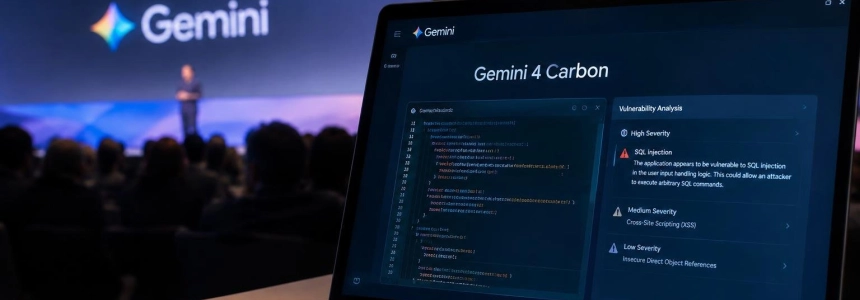
Gemini 4 Carbon is now available to developers, businesses, scientists, and users, following an initial access phase through the Fairwind program, which is aimed at cybersecurity experts. Google describes it as its most powerful model for demanding programming, scientific research, and software defense tasks. The company, however, continues to recommend Gemini 4 Argon for most software engineering and knowledge work.
The general launch was announced on November 10, 2026. Carbon can be used through the Gemini API in Google AI Studio and Android Studio, as well as in Gemini for businesses, for paying customers. It is also rolling out to Google Antigravity, the Gemini app, and Search AI Mode for Google AI Ultra subscribers. Google is not replacing Argon: the two models are designed for different workloads, and Carbon uses more tokens when it spends more time reasoning and verifying its results.
“Shipping Gemini 4 Carbon in Search today for Google AI Ultra subs! With deeper reasoning & better instruction following, you’ll get more helpful responses for your toughest questions in AI Mode. I’ve loved using this internally – excited for more people to try it out.”
— Robby Stein, Google
Carbon complements Argon and charges by the token
Google describes Carbon as a model for assignments that push an AI system to its limits: multi-step programming, complex debugging, open-ended scientific research, and agent workflows that can run for a long time. Argon, introduced earlier as part of the Gemini 4 family, remains Google's recommended option for most software engineering and knowledge tasks.
The difference also shows up in the effective cost. Both models have the same promotional launch price: $2 per million input tokens and $10 per million output tokens. Google says Carbon's promotional rate will rise to $4 per million input tokens and $20 per million output tokens when the promotion ends. Although the unit price currently matches Argon's, Carbon can result in a higher bill because it uses more tokens to explore hypotheses, reason, and run extended verification cycles.
The Decoder reports a test by Artificial Analysis, published two weeks before the general launch, in which Carbon cost $7.76 per task solved, calculated at the standard rate. In that evaluation, it came in below the cost of Flash 3.8, according to the publication, and above GPT-6 Astra Max, which recorded $6.25; Opus 5.5 Max reached $10.04, and Fable 5.2 at its highest level cost $26.50. At the High level, Fable 5.2 cost around $9 per task and scored 62 on the overall index, compared with Carbon's 60.
The comparison does not represent a fixed price per query: spending depends on token usage and the task. Google DeepMind's model card notes that Carbon accepts text, image, audio, and video inputs, with a combined input and output window of up to 1 million tokens. It also warns that the model may use more tokens, especially at high reasoning levels, and may experience slowness or timeouts.
Results in programming, documents, and agents
Google says Carbon ranks first on CursorBench 4.0, Perplexity's WANDR, and Zapier's AutomationBench, at a per-task cost more than two times lower than that of the next-highest-ranked external model. The Decoder reports that Carbon's result on CursorBench 4.0 was slightly below 60%; Fable 5.2 and Argon ranked behind it in the same test. DeepMind's model card provides a specific figure for AutomationBench: Carbon scored 53.9%, ahead of Argon's 51.3%, Claude Opus 5.5's 42.5%, and GPT-6 Astra's 41.4%.
The company has also added an evaluation for tasks involving dense documents, charts, blueprints, and tables. In collaboration with Artificial Analysis, it created the Multimodal Knowledge Agent (MKA) benchmark, in which Carbon ranked second, behind the top-ranked model and ahead of Opus 5.5, according to Google and The Decoder. Google puts its average cost per task at less than one-sixth that of the leading model. In other results listed on its model card, Carbon scored 58.6% on Blueprint-Bench 2 and 72.5% on Chartography.
For development work that requires tasks to be distributed, Google is showcasing the /swarm feature in Antigravity. An initial instruction becomes a coordinated team of agents whose progress can be tracked in real time. Carbon can handle the parts that require deeper reasoning—such as designing the architecture, coordinating, or auditing—while faster, lighter models work in parallel in isolated workspaces and adversarially verify changes.
Google presented several /swarm examples. In one, agents built a 3D open-world game in which players explore the Mountain View campus as a pelican driving a GBike. The work combined 3D assets modeled in Blender from Omni and Nano Banana references, a Three.js browser app with WebGL shaders, generated audio effects, and music from Lyria.
Another example turned historical photographs and engineering drawings into an interactive 3D exhibition about the construction of the Eiffel Tower between 1887 and 1889. Google also says a group of agents reconstructed its Platform 37 office from seven public municipal planning PDFs, using 206 views extracted from engineering blueprints. The result was an interactive Three.js scene with 906,000 triangles, developed over ten overnight cycles.
The Antigravity demonstration also included a playable fortepiano from around 1780, reconstructed from CAD drawings and X-rays. The instrument had 61 keys with escapement action and was placed in a 3D model of Koerner Hall at the Royal Conservatory of Music in Toronto, with seat-specific spatial acoustics. The Decoder adds that the industry is debating the cost-benefit of agent teams and that OpenAI, Anthropic, and some researchers have expressed caution or skepticism about this approach.
Cybersecurity testing and real-world findings
Cybersecurity is one of the areas in which Google distinguishes Carbon. In tests available through Fairwind, the company says the model ranks first on SEC-bench Pro for locating vulnerabilities, ExploitGym for exploiting them, and CWE-bench for fixing them. DeepMind's model card publishes results from October 2026: Carbon scored 88.2% on SEC-bench Pro, 54.8% on ExploitGym, and 71% on CWE-bench. Google notes that the cybersecurity results are for access through Fairwind.
The company also provided examples of use beyond benchmarks. In Wiz's Scan for Good program, Carbon found zero-day vulnerabilities while analyzing two large software-as-a-service providers in under two hours. Google says the work reduced weeks of research to an afternoon and that the teams worked with the affected organizations to fix the flaws. It did not identify the providers.
Google's cloud vulnerability research team used Carbon to demonstrate that two bugs in a popular open-source project could be exploited. The company compared their potential severity to PHP2Shell; after proof-of-concept demonstrations were submitted, the maintainers reclassified the bugs as critical and released a patch, according to Google. The company said it will share more details once the responsible disclosure process is complete.
In Project Fortify, Google's autonomous system for scanning, classifying, and remediating issues, Carbon achieved 100% scan recall and 95% classification precision in an internal evaluation. In tests on open-source repositories, Google measured a relative improvement of more than 25% over Argon's detection rate. The Decoder notes that the company did not publish specific figures for some cybersecurity test results and that specialized capabilities are offered to verified defenders through Fairwind.
Scientific results and safeguards
Google also identifies scientific research as one of Carbon's main use cases. At Axiom Bio, a company focused on drug toxicity research, the model reportedly found toxicity mechanisms that had not been identified before. Axiom is moving scientific analyses and production agents to both Carbon and Argon, according to Google's announcement.
Google researchers used Carbon alongside other models in AlphaProof Code, an agent framework for formal verification. The team translated security goals for the Signal cryptographic protocol into mathematical theorems and generated millions of lines of Lean code to prove key properties. Google says the work took weeks, compared with the years it would historically have required expert teams.
In protein structure prediction, researchers used Carbon to search for remote homologs in large archives of unannotated sequences, environmental and viral catalogs, and 3D structure databases. Across seven protein families with few homologs in the CASP17 blind test set, the model increased the number of recovered homologs by an average of 40 times. Google clarifies that the broader evaluation is still underway.
The rollout includes safety measures strengthened to account for the model's cybersecurity capabilities. In simulated attacks, Google says Carbon blocked 99% of an adaptive red team's attack paths and reduced the intrusion rate per attempt to 0.8%, compared with Argon's 3.1%. In Gray Swan tests, the success rate for automated cyberattack queries was 2.17%, compared with Argon's 9.86%. Trajectory Labs found no new universal jailbreaks over 132 hours and more than 13,000 requests.
In an internal honesty test with 375 tasks, Carbon passed 92%, compared with Argon's 70%; it refrained from inventing missing experimental data in 98% of cases and flagged methodological flaws in 68%. Google also says Carbon achieved a 0% prompt injection success rate in Gray Swan IPI. The company qualifies this by noting that resistance to these techniques remains an area for improvement and that the tests do not mean the problem has been solved.
Access for scientists is part of a program offering 10,000 researchers six months of free Argon use in Antigravity. Google says it has already enrolled thousands and is expanding Carbon access to current and future participants; applications remain open, with weekly admissions subject to eligibility, capacity, and selection. For users of the Gemini app and Search AI Mode, however, access to Carbon requires a Google AI Ultra subscription.
Sources: Hipertextual, Search Engine Roundtable, The Decoder, Google, Google DeepMind, Google, Engadget