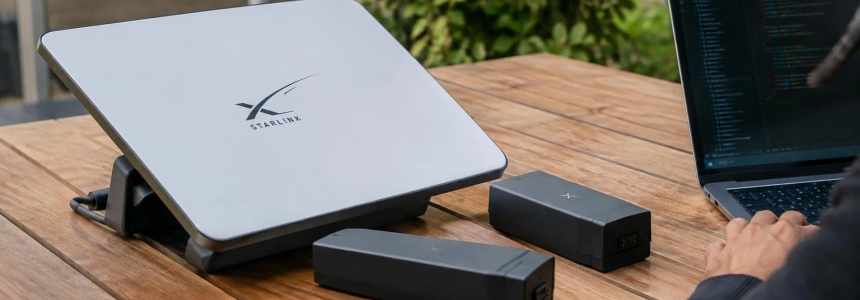
Starlink Mini 2 features a removable battery that promises up to 4.5 hours of connectivity per charge and lets users extend runtime by swapping it for another. SpaceX has introduced a new version of its portable satellite internet terminal, which also adds Wi‑Fi 6, a thinner enclosure, and a physical power button.
For now, purchases are limited to selected customers in the United States who receive an invitation. The Verge and Infobae put the price of the offered package at $999, including one year of Roam Unlimited. However, other prices appear in preliminary listings on the Starlink website; they do not establish the hardware's final retail price.
A battery you can swap without tools
The practical difference from the original Starlink Mini is that the new terminal no longer relies on an external battery to operate away from an outlet. The Mini 2 has a detachable 71 Wh battery pack that attaches to the back with a quick-release mechanism. According to SpaceX, it provides up to 4.5 hours of connectivity on a full charge.
The battery can be replaced with another when it runs out. The Verge says additional units will be sold separately; Digital Trends and Notebookcheck cite a $50 reference price for a replacement battery in internal listings, but that amount is not a confirmed retail price. Infobae puts the pack's weight at about 490 grams and notes that it includes status LEDs and its own USB-C port.
The terminal can also be powered directly via USB-C without using the attached battery. Digital Trends and Infobae describe support for 60 W power. According to the latter, the retail package includes a 60 W wall charger and a three-meter USB-C cable. The Verge also mentions connecting to a 60 W power source, though it does not detail the box contents.
The change addresses a limitation of the first Mini, which required an external power source. SatelliteInternet.com notes that this dependence made a device designed for travel, camping, or working away from conventional networks less convenient. The integrated battery eliminates the need to carry a separate external battery to power the antenna, although bringing spares will extend runtime at the cost of carrying more weight.
Thinner, but heavier with the battery
The Mini 2 measures 314 × 263 × 23.1 millimeters, according to Notebookcheck and Infobae. The first thickness figure contrasts with the 38.5 millimeters cited for the previous model by The Verge; Notebookcheck and Infobae give the original Mini's thickness as 1.45 inches, or about 36.8 millimeters. Published measurements vary slightly, but the outlets agree that the new antenna is thinner.
The unit weighs around 1.6 kilograms — 3.53 pounds — with the battery and stand, according to Digital Trends, Notebookcheck, and Infobae. Notebookcheck puts the original Mini's weight at 1.1 kilograms. The battery can be removed when it is not needed, although not all publications give a consistent figure for the terminal's weight without it: Notebookcheck estimates about 1.1 kilograms for the antenna and stand.
The enclosure retains its IP67 rating, which, according to the outlets, protects against dust and water. Hipertextual attributes to SpaceX the goal of keeping the device connected in rain, wind, and sand. The new version also has a folding stand, a standard tripod mount, and a 55-degree field of view, according to Notebookcheck and Infobae.
With more durable materials, a redesigned enclosure, and an IP67 rating, Mini 2 is designed to keep you connected through rain on the trail, wind on the water, and sand on the beach
— SpaceX, in a post on its X account
Digital Trends reports that the device includes a physical power button and LED indicators for checking battery status. Infobae also highlights the button, which replaces the previous model's direct-connect operation. Notebookcheck describes the battery as having its own status lights and a USB-C port.
Wi‑Fi 6 and expanded wireless coverage
The integrated router upgrades from Wi‑Fi 5 to Wi‑Fi 6. Starlink puts wireless coverage at about 167 square meters, equivalent to 1,800 square feet, according to Hipertextual, Digital Trends, Notebookcheck, and Infobae. Hipertextual compares this area with the 111 square meters of coverage it attributes to the first Mini.
The antenna connects to Starlink satellites and shares access with nearby devices over Wi‑Fi. Hipertextual says it can come online in about 60 seconds if placed somewhere with a clear view of the sky. The lack of an Ethernet port, noted by Hipertextual and SatelliteInternet.com, limits wired connections to third-party routers or mesh systems.
Starlink Mini 2 retains its predecessor's portable form factor but adds mounting options and a power supply that is less dependent on the electrical grid. The publications associate its use with travel, camping, and working in places without fiber or mobile coverage. Digital Trends notes that it could be useful on car trips, though it clarifies that it is not a system integrated into the vehicle.
U.S. invitations and still-divergent prices
Early reservations are open by invitation in the U.S. The Verge cites the Starlink website, which refers to selected U.S. customers and a future expansion to more users and countries. Infobae says the offered package costs $999 plus taxes and includes twelve months of Roam Unlimited, which SpaceX values at $2,100. The Verge also reports those figures for the included service.
Infobae adds that buyers can reserve the terminal with a refundable $100 deposit and that SpaceX would charge the remainder when the device ships. Shipping is scheduled for mid-December, according to Infobae and SatelliteInternet.com. The former publication refers to the first distribution wave, while Infobae links that date to the balance being charged.
Published prices are inconsistent because they mix invitation packages, prices for previous models, and preliminary references. Hipertextual puts the Mini 2's cost at $999 and says it includes unlimited roaming; it also says the plan for users on the move starts at €45 per month. The Verge and Infobae specify that the $999 package includes one year of Roam Unlimited.
Meanwhile, Digital Trends says YouTuber DISHYtech spotted a $249 listing for a “Mini 2 beta kit” in the internal part of Starlink's website, alongside a $50 extra battery. Notebookcheck also describes $249 references for the device and $50 for the battery, but considers them indications of a beta rollout, not confirmation of the final price. Digital Trends explicitly warns that these records do not set the retail price.
Comparisons with the original Mini also vary. Hipertextual recalls that it launched in 2024 for €399 and later received a €100 discount. Notebookcheck says the original Mini was discounted to $149 and notes a $100 difference compared with the new model; SatelliteInternet.com compares the $999 launch package with a $149 price for the current Mini on Starlink's website. These figures relate to different markets, promotions, and products, not a single directly comparable price.
International expansion has no date yet
Starlink said the Mini 2 will reach more customers and countries later, but has not announced when general sales will open or what it will cost outside the United States, according to The Verge, SatelliteInternet.com, and Digital Trends. Hipertextual also expects expansion into other markets where the service already operates, without specifying dates.
For those who receive an invitation, the U.S. package combines the antenna with twelve months of Roam Unlimited. Infobae describes the plan as suitable for road trips, streaming, and video calls, and says it supports connectivity while in motion at speeds of up to 160 kilometers per hour. It also says international travelers can use it abroad for periods of up to 30 consecutive days.
The battery, Wi‑Fi 6, and IP67 protection update a terminal that Starlink targets at people who need connectivity away from home.
Sources: Hipertextual, The Verge, SatelliteInternet.com, Digital Trends, Notebookcheck, infobae