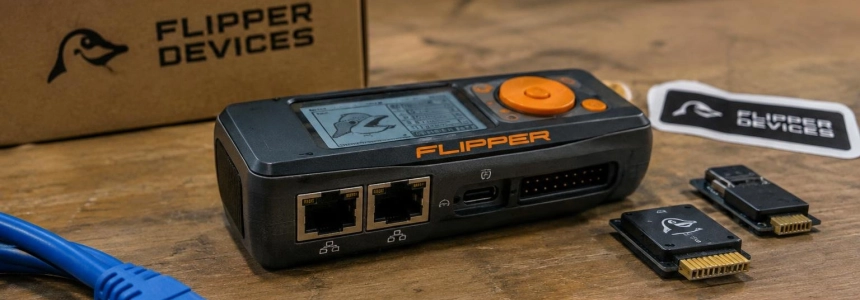
Flipper Devices has launched its Kickstarter campaign for the $399 Flipper One, a portable Linux computer with two Gigabit Ethernet ports, Wi-Fi 6E, and an M.2 slot for expanding its capabilities. The company says the price covers manufacturing costs, with no profit margin, and estimates that the first shipments will begin in July 2027.
The device runs Flipper OS, a Debian-based distribution, and is designed for both networking tasks and portable computing. It can manage up to five network connections, function as an access point, run VPNs and a firewall, and connect to an external display via USB-C. Flipper Devices presents it as a product distinct from the Flipper Zero, not as its successor.
A campaign to fund the first production run
The Kickstarter campaign began on November 17, 2026, and will end on December 17. Its goal is to fund the first production run. BleepingComputer reports that RAM and UFS storage account for about half the hardware cost; despite this pressure on component costs, the company decided to keep the starting price at $399.
“Instead of waiting for perfect market conditions or raising the price, we’re moving forward with the Kickstarter campaign,” Flipper Devices wrote in a statement shared with BleepingComputer. The company says it will not add a profit margin to the hardware price and that the announced amount will cover production costs.
“We aim to make Flipper One as accessible as possible without building a profit margin into the hardware's price.”
— Flipper Devices
CNX Software noted that just over 12 hours after the campaign began, it had raised nearly $10 million from around 19,000 backers. This figure was reported during the first few hours, not as the final fundraising total. Shipping is not included in the price: the company will share the details with backers closer to the delivery date.
Rewards include the device without modules and several bundles with add-ons. The prices published by CNX Software are:
| Reward | Price |
|---|---|
| Flipper One - Kickstarter Special | $399 |
| Bundle with LoRa | $439 |
| Bundle with SDR | $539 |
| Bundle with 5G | $599 |
| Bundle with all modules | $759 |
The campaign only includes shipping to the United States, Canada, the United Kingdom, Australia, the 27 European Union countries, Switzerland, Norway, Singapore, and Hong Kong. Flipper Devices estimates deliveries will begin in July 2027, provided the planned schedule is met.
A Linux computer, not another Flipper Zero
Flipper Zero and Flipper One share a manufacturer, but target different uses. The Verge describes the Zero as a device focused on NFC, RFID, infrared, and Sub-1GHz wireless frequencies. The One, by contrast, is geared toward IP networking and local computing, with more ports and an eight-core ARM processor.
The difference is also reflected in size and price: The Verge notes that the One is larger and more expensive, comparing its $399 campaign price with the $169 price of the Flipper Zero. BleepingComputer notes that the Zero launched via Kickstarter in 2020 and that more than one million units have been sold since then. Its campaign reached its funding goal in eight minutes and raised $4.8 million in 30 days.
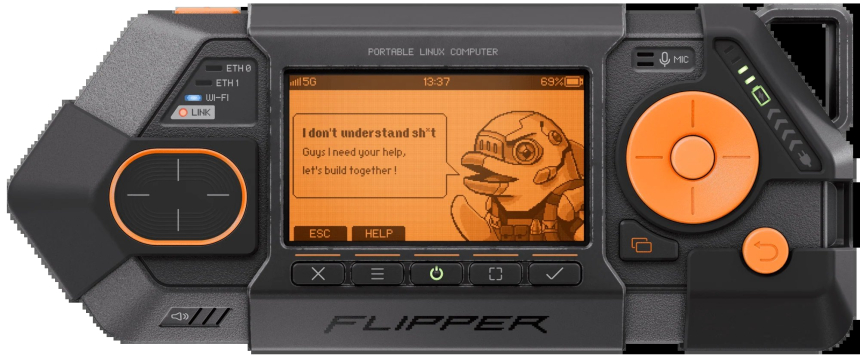
The new device is powered by the eight-core Rockchip RK3576, paired with a Raspberry Pi RP2350 microcontroller. Flipper's page explains that the main processor runs Linux and applications, while the microcontroller manages the display, buttons, and power. This separation makes it possible to continue accessing device controls even when the Linux subsystem is off or has not yet booted.
According to specifications reported by CNX Software, the RK3576 combines four Cortex-A72 cores at 2.2 GHz and four Cortex-A53 cores at 1.8 GHz. It includes a Mali-G52 MC3 GPU and an NPU with an advertised capacity of 6 TOPS for INT8 operations. The device has 8 GB of LPDDR5, 64 GB of UFS 2.2 storage, and a microSD card slot.
The built-in display has a resolution of 256 × 144 pixels and 64 grayscale levels; it is controlled by the RP2350. For desktop use, Flipper advertises DisplayPort output over USB-C, while CNX Software also lists an HDMI 2.1 port. According to that outlet, both outputs support up to 4K at 120 frames per second. The device also includes a speaker, microphone, and 3.5 mm audio jack.
Connectivity and modular expansion
For networking, the configuration described by CNX Software includes two Gigabit Ethernet ports, tri-band Wi-Fi 6, and Bluetooth 5.2. The manufacturer's page specifies Wi-Fi 6E and presents cellular connectivity as an add-on: the device has an eSIM, but using the advertised data plan requires installing a 5G modem in the M.2 slot. A physical SIM can also be used.
The M.2 Key-B slot accepts several types of modules, including cellular modems, SDR radios, AI accelerators, SSDs, and Wi-Fi cards via adapters. Flipper specifies compatibility with 2242, 3042, and 3052 sizes, as well as 2230 with an extender. The platform provides PCIe 2.1 ×1, USB 2.0, USB 3.1, SATA3, SIM, serial audio, UART, and I²C connections.
Add-ons featured in the campaign include LoRa, 5G, and software-defined radio. Flipper Devices cites LoRa compatibility with MeshCore, Meshtastic, and Reticulum, as well as a walkie-talkie mode. CNX Software says the specifications for the SDR add-on have not yet been finalized; the current published specifications are a range of 24 to 1,700 MHz and a bandwidth of 10 MHz.
For 4G LTE or 5G, CNX Software reports that the company is working on a module with a Quectel RM520 modem, download speeds of up to 1 Gbps, and four antennas. The same outlet lists a Nano SIM slot in addition to the eSIM. The manufacturer's specifications also mention NTN satellite connectivity, but describe it as a goal for which the company is seeking a partner; it is not presented as a feature already available.
Using a single USB-C cable is another feature highlighted by Flipper Devices. The port can be used to charge the device and access a Linux console over SSH, and the device can appear to a connected computer as a network adapter, serial port, or mass storage drive. In desktop mode, USB-C can carry DisplayPort video, power, and peripheral connections.
Open Linux, with development still underway
Flipper Devices promises a Linux-based system with a mainline kernel and open drivers. The company says it is working with Collabora to integrate the RK3576 into the mainline kernel and avoid relying on a manufacturer-specific board support package. Its page also describes a blob-free platform without proprietary drivers as a goal.
The software is still under development. BleepingComputer reports that the Flipper One is already running the mainline kernel, while patches for DisplayPort output over USB-C are still under review for possible inclusion. The company is continuing to work on memory power efficiency and removing the remaining closed boot components.
CNX Software cautions that fulfilling all the promises of openness could be difficult and points to possible binary components in the wireless and cellular connections. The manufacturer's page, meanwhile, describes the MediaTek MT7921U chipset for Wi-Fi 6E, with monitor mode support, Bluetooth 5.2, and the open mt7921u driver. The final hardware and software configuration is still in development.
The design also includes a 20-pin GPIO connector for custom modules and an open mounting system. Flipper says it will publish mechanical parts, 3D models, and technical drawings so the community can design accessories, antennas, or cooling solutions. The product page also includes a power consumption meter and tools for exploring IP networks, detecting active devices, and finding open ports and services.
A first unit that has yet to be manufactured
The project had an earlier community-focused phase: in May, Flipper Devices asked the community to help develop the product and outlined the complexity of the work, according to BleepingComputer. The campaign is now seeking to fund the first units; this is not yet a launch with devices available for immediate delivery.
The company is opening up its technical work through its developer portal, which brings together documentation on hardware, firmware, Flipper OS, and the FlipCTL interface, as well as tests, task tracking, and the status of Linux integration. CNX Software also mentions repositories related to Linux build scripts and RP2350 firmware.
With a starting price of $399, the Flipper One competes as a portable Linux computer and networking tool, not as a direct alternative to the Flipper Zero. Its final configuration, module availability, and delivery schedule will depend on production and development progress. For now, the next announced milestone is the end of the Kickstarter campaign on December 17; the first shipments are expected in July 2027.
Sources: How-To Geek, BleepingComputer, Flipper, CNX Software - Embedded Systems News, The Verge