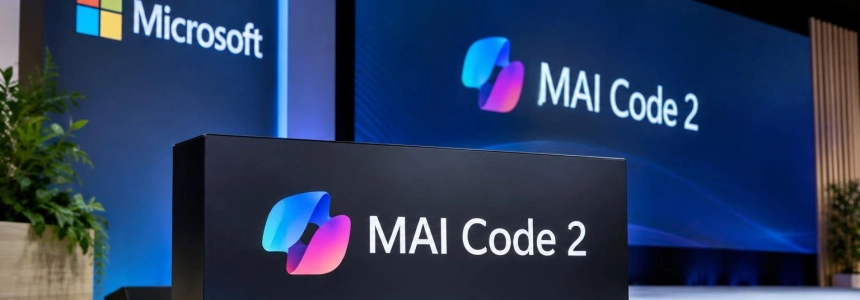
MAI Code 2 costs, according to Microsoft, 5% of Claude Opus 5.5 and delivers 96% of its performance on programming tasks. The company introduced the family at Ignite 2026 and says its flagship model also achieves 98% of GPT-6.1 Sol's coding quality for around 40% of its price.
A model for everyday enterprise programming
The November 17, 2026 announcement included MAI Code 2, Microsoft AI's new flagship coding model, and MAI Code 2 Flash, a lighter alternative for frequent, fast-paced work. The company describes them as models for everyday programming tasks in businesses, rather than tools fine-tuned for the toughest research problems or agents expected to work for very long periods.
Microsoft calculates Code 2's quality using the average of four benchmarks: DeepSWE 1.1, Terminal Bench 2.1, SWE-Atlas, and FrontierCode v1.1. According to the company, this combination evaluates everyday enterprise coding tasks of the kind encountered in GitHub Copilot. On this benchmark set, Code 2 reaches 98% of GPT-6.1 Sol's performance for about 40% of the price, and 96% of Claude Opus 5.5's for 5% of the cost.
The claim about Claude is a performance and price comparison, not equivalence across every task. Microsoft presents the model for ordinary programming work and explicitly notes that it is not yet tuned for fundamental scientific research or very long-horizon agentic work. The company also says Code 2 performs well at deep debugging, multi-file implementation, repository-scale reasoning, and interface development.
In a blind, side-by-side evaluation of frontend work, developers preferred MAI Code 2 over GPT-6 Sol 64% of the time, according to Microsoft. The company adds that the model has been tuned to create dashboards and visualizations. The announcement did not provide an equivalent figure for a direct comparison with Claude in that evaluation.
Pay per use, not a cheaper subscription
The 5% figure refers to the pay-per-use API price, not the cost of a monthly Copilot subscription or a flat rate for individuals. ZDNET cautions that the comparison does not mean a $100-per-month subscription would drop to five dollars; it is based on API usage metrics.
ZDNET also notes that Microsoft announced its prices with an introductory 50% discount. In its illustrative calculation, the outlet uses a cost of $0.001 per request instead of $0.0005 to account for that discount. This is an assumption about spending and volume, not a saving announced as an observed financial result.
The outlet gives the example of a company that pays $0.01 per request and reduces that cost to $0.001: with daily inference spending of one million dollars, the calculation would fall to about $100,000 a day. If that difference continued for a year, the estimated savings would be $325 million. ZDNET presents these amounts as a hypothetical scenario, not as an official Microsoft forecast or as savings already recorded.
Microsoft argues that cost reduction matters because many AI uses in its products involve routine requests. If it can handle them with sufficiently capable in-house models, it could pay external providers less for those operations. ZDNET interprets this shift as potentially reducing Microsoft's reliance on OpenAI and Anthropic as well, although it finds no direct evidence that the company is building models to completely replace those providers' offerings.
Code 2 Flash for quick changes
The MAI Code 2 Flash version targets high-volume tasks: explaining code, applying specific changes, fixing routine bugs, and iterating quickly. Microsoft says it delivers performance comparable to GPT-6 Luna for 65% of the price and to Claude Haiku 5.5 for 20%, according to three everyday coding benchmarks: DeepSWE 1.1, Terminal Bench 2.1, and SWE-Atlas.
The company announced that both models are available in GitHub Copilot and Microsoft Foundry. Microsoft's corporate blog post specifies that Code 2 and Code 2 Flash can be selected from Copilot's model picker and are also offered as part of Copilot Fusion. Code 2 Flash is also available in a limited-access preview in Microsoft Foundry, according to Microsoft AI.
The versions are also being rolled out across other products. In his keynote, Satya Nadella described Code 2 as a family of agentic coding models for shipping code to production, debugging, and working across multiple files. Microsoft also announced the integration of its new models as options for GitHub Copilot, Microsoft 365, and Fabric, according to ZDNET.
From coding tools to Office tasks
Alongside the coding models, Microsoft introduced MAI Work Flash, derived from Code 2 Flash. The company says it can generate Excel formulas, work with documents and instructions in Word, and track decisions or extract useful information from Teams. The proposal extends capabilities developed for programming to office tasks.
ZDNET links this move to the similarities between coding agents and work agents: both must navigate a complex environment, use tools, and produce reliable results. The outlet notes that code offers measurable results, making it a useful setting for developing and testing capabilities that can later be applied to tasks unrelated to programming.
The initiative fits with Nadella's broader presentation of Copilot. Microsoft's CEO described it as an experience bringing together chat, work, code, and autopilot, with a system of models that assigns the right capability to the context and task. In this strategy, Code 2 is one part of an offering that combines Microsoft's models with other models available in Foundry.
The figures still depend on Microsoft's tests
Code 2's performance figures are results reported by Microsoft. ZDNET cautions that the numbers could vary in independent tests and suggests that the selection of benchmarks may favor a particular comparison. For now, the results from Code 2's four benchmarks and Code 2 Flash's three benchmarks are the evaluations Microsoft has disclosed.
The company itself limits the intended use: its models are optimized for everyday coding work, not fundamental research or long-running agentic tasks. The favorable assessment of interface and visualization work points to other related uses, such as designing interface elements, charts, and slides, but Microsoft does not present them as a universal solution to every programming problem.
The announcement also comes amid Microsoft AI's development of its own models. At Ignite, the company announced a family of seven models, including offerings for cybersecurity, images, voice, transcription, and decision-making, in addition to Code 2 and Code 2 Flash. Nadella said the goal is to combine in-house models with third-party options and choose the right capability based on the task and its cost.
For people already using Copilot, the immediate impact is straightforward: Code 2 and Code 2 Flash are among the models available in the product, while access to Code 2 Flash in Foundry remains limited to a preview. Microsoft's announced price difference is tied to API usage and does not automatically turn an existing subscription into an option that is five times cheaper.
Sources: ZDNET, Microsoft AI, The Official Microsoft Blog