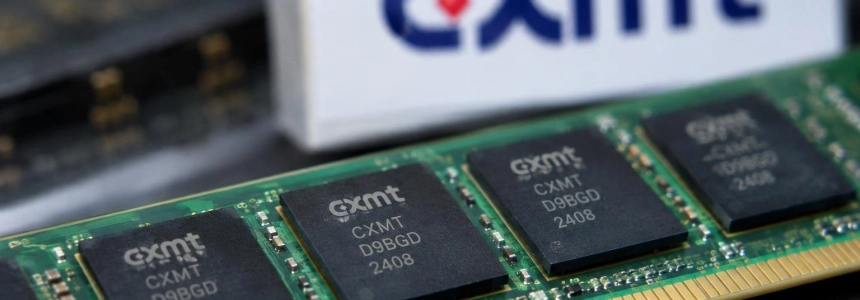
CXMT now earns 9% of global DRAM revenue, up from 5% a year earlier. The Chinese manufacturer has become the world’s fourth-largest by revenue in this memory market, as the artificial intelligence boom fuels sales, profits, and plans to expand its capacity.
The figure does not mean that China literally manufactures one out of every eleven DRAM units: it is a revenue-based share, according to Counterpoint Research. Samsung remains in first place, followed by SK hynix and Micron. CXMT’s rise, however, is already reshaping the position of established suppliers in a market where demand for memory for AI systems has sent sales soaring.
| Manufacturer | DRAM revenue share, third quarter of 2026 |
|---|---|
| Samsung Electronics | 38% |
| SK hynix | 29% |
| Micron Technology | 21% |
| CXMT | 9% |
Figures from Counterpoint Research published by The Korea Times still place CXMT well behind the three major players, but show rapid progress. The company, founded in Hefei in 2016, increased its quarterly revenue sevenfold in a year, to 118.71 billion yuan, according to those figures. Businesskorea puts the year-over-year growth in third-quarter sales at 613%.
AI demand is funding expansion
The opportunity is not limited to chips designed for AI accelerators. Data centers need memory for their servers, while manufacturers are also seeking DRAM for computers, mobile phones, and other devices with AI features. CXMT says demand extends to phones, PCs, smart glasses, and autonomous vehicles; growth in these markets is allowing it to expand its product lineup beyond conventional memory.
The company said its sales for the first nine months of 2026 reached 269.02 billion yuan. Businesskorea attributes part of the increase in profitability to memory prices, a greater presence of DDR5 and LPDDR5X, and improved utilization of its three 12-inch wafer fabs. It also reported a decline in the liabilities-to-assets ratio, to 36.34% at the end of the third quarter.
External capital is reinforcing that momentum. CXMT’s Shanghai IPO in July raised 66.6 billion yuan, according to The Korea Times. In addition, Morgan Stanley estimates that the company’s wafer processing capacity could reach 500,000 per month in 2028, around 15% of global DRAM capacity. This is a forecast, not capacity already installed.
Public support is also behind the expansion. The National Integrated Circuit Industry Investment Fund, known as the Big Fund, backs China’s push for semiconductor self-sufficiency. This strategy is driven, among other factors, by US restrictions that limited China’s access to high-bandwidth memory, or HBM, in 2024.
More capacity does not yet mean technical leadership
CXMT says it has begun mass production of its fifth-generation DRAM platform, which would produce at least 50% more chips per wafer than its predecessor. It has also validated prototypes of a sixth-generation 4F2 architecture, designed to theoretically reduce memory cell size by one-third. The company expects to send samples of server modules to customers before the end of the year, according to The Korea Times.
Prototype validation does not mean the process is ready for mass production. Businesskorea specifies that CXMT completed validation of engineering samples, but did not thereby announce the start of volume production. Estimates of when it might reach that stage vary: Nomura puts mass production of 4F2 between 2027 and 2028, while Xataka reports that it will not happen before 2028.
Estimates of the technology gap also differ. TechInsights, cited by Xataka, puts CXMT about two generations behind in conventional DRAM; Macquarie estimates that its process delivers around 65% as much memory per wafer as leading processes, and Nomura estimates a lag of at least three years. In any case, increased capacity does not eliminate yield issues and per-unit costs.
The gap is more pronounced in HBM, which stacks DRAM chips to supply data rapidly to AI processors. CXMT does not yet produce HBM profitably, and its manufacturing yields are far below those of SK hynix, according to analyses cited by The Korea Times and Reuters. As a result, CXMT’s immediate threat is concentrated more in conventional DRAM than in the advanced memory currently in highest demand for accelerators.
“Chinese suppliers do not need to flood foreign markets to create that pressure.”
— Laila Khawaja, research director at Gavekal Technologies
The 4F2 architecture is not a cost-free bet, either. SK hynix plans to extend its 6F2 design before switching architectures; Samsung is also developing 4F2, while Micron has left it out of its roadmap because reducing transistor size alone does not guarantee greater density. The capacitors that store electrical charge may continue to limit the result.
YMTC opens another front in NAND
The other part of China’s strategy is YMTC, which specializes in NAND, memory that retains data without power. Counterpoint ranks it third globally by shipment volume, with a 16.5% share in the second quarter of 2026. Its Xtacking technology manufactures the cells and control circuits on separate wafers and then bonds them together, an approach that allows density and transfer speed to increase, according to The Korea Times.
YMTC is directing some of its growth toward storage for data centers. Counterpoint forecasts that server products will generate close to 39% of its revenue in 2028, compared with virtually no contribution in 2024. The challenge will be turning technical capacity into contracts with customers outside China: winning sales among domestic operators does not by itself guarantee entry into international supply chains.
In NAND, the company remains approximately one generation behind in layer count, according to Xataka: around 270 compared with 321 for SK hynix and 286 for Samsung. Manufacturing increasingly deep structures depends on specialized equipment, and US restrictions have made it harder for YMTC to access suppliers such as ASML. Equipment limitations, along with manufacturing experience and the validation of domestic tools, are slowing the pace at which it can close that gap.
Price pressure may come first
For Samsung, SK hynix, and Micron, the risk does not require CXMT to export large quantities. If Chinese manufacturers supply local customers, those buyers can replace some of the purchases they previously made from foreign suppliers. The potential consequence is less bargaining power for the three leaders, even if Chinese memory stays within China.
The first battleground will probably be conventional memory for mobile phones, PCs, and storage, not HBM. China’s localization policies and companies’ interest in diversifying supply may benefit CXMT. In addition, shortages are leading some customers outside China to evaluate Chinese alternatives; if they qualify them as a second or third supplier, they could add them to their purchases, although that does not yet amount to displacing the dominant manufacturers.
Expansion could also moderate prices if available supply grows faster than demand. The medium-term risk described by Gavekal Technologies is that investment in new capacity coincides with a slowdown in AI spending. In that scenario, established manufacturers could allocate more DRAM to conventional products, where CXMT competes more directly. Equipment restrictions, however, make an immediate flood of the Chinese market less likely.
The cycle depends on AI customers continuing to spend and fabs being able to turn investment into usable chips. SK hynix expects demand to exceed supply through 2030, while Morgan Stanley argues that AI expansion does not eliminate the sector’s cyclical nature. CXMT already has the revenue and capital to grow; the outstanding test is whether it can produce at scale, with yields and costs that bring it closer to the leaders.
Sources: Xataka, The Korea Times, Businesskorea, The Korea Times