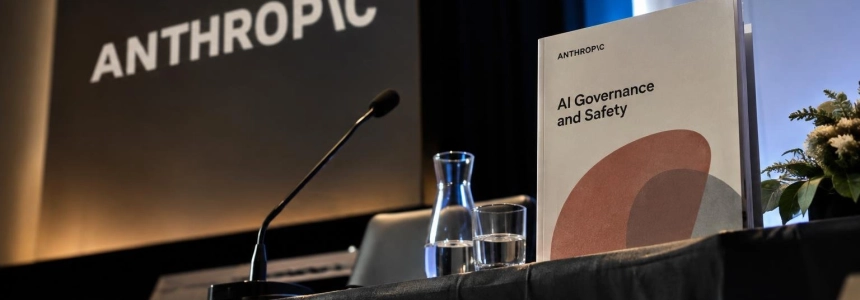
Dario Amodei’s position is unequivocal on one point: AI should not govern society. The Anthropic CEO rejected the idea that people should hand over their political will or the authority to make decisions on their behalf to artificial intelligence systems. He is right to defend the principle that democratic legitimacy cannot be traded for speed or efficiency. But his position becomes less clear when he moves from politics to automation: there, he acknowledges benefits, risks, and difficult decisions—the very territory where much of human control is at stake.
The controversy arose after Axios reported, citing people familiar with internal conversations, that some Anthropic employees believed humanity could safely transfer authority to superintelligent systems and that, in some cases, doing so would be preferable to fighting to retain control. Amodei responded on X that this interpretation was absurd and that he has long argued AI should be subject to legitimate democratic processes.
“We should never sacrifice legitimacy or self-determination at the altar of efficiency or security.”
— Dario Amodei, CEO of Anthropic
Efficiency does not legitimize power
Amodei’s central argument does not depend on proving that an AI would make better decisions. Even if it could, technical capability would not give it political authority. Legitimacy and self-determination are distinct from effectiveness: a machine could produce a quick answer and still lack the right to impose it. Making better decisions does not mean having a mandate.
This is the most convincing aspect of his intervention. Debate about more capable systems often slides from “they can solve this task” to “they should decide what we do.” Amodei insists these are different questions. A system can help citizens organize their views, find common ground, or understand alternatives; that does not mean it should take the place of those who make collective decisions.
The distinction matters, too, because governing is not an isolated task that can be evaluated solely by its outcome. It involves deciding which goals to pursue and which costs to accept. If those choices are handed to a system because it is more efficient, citizens lose the ability to determine the direction, even if the tool seems competent. Authority must remain human, not a prize awarded to the system that can solve things faster.
Automating tasks is not governing
Amodei, however, is not proposing a halt to automation in general. He points out that AI can drive, design a cancer drug, or write software from start to finish, and believes that completing broader tasks can drive advances in medicine, transportation, energy, and programming. He also argues that, in some cases, such automation can save lives. His rejection does not extend to all delegation: it is directed at handing over governance and political will.
It is a useful distinction, but not always a clear-cut one. Technology can carry out a task without formally setting public policy and still shape who has options, which jobs disappear, or which decisions remain within people’s reach. Amodei acknowledges some of this problem: he warns of serious labor disruptions and says some deployments could be slowed or halted to allow time to adapt. He also notes that there are activities people would prefer to keep doing themselves, even if AI could do them better.
These concerns strengthen his argument, but they do not settle who sets the limits. Amodei says some decisions will belong to society, others to the government, AI companies, or people as consumers. This distribution recognizes that there is no single answer; at the same time, it could leave high-impact decisions divided among actors with different powers and responsibilities. The practical question is who can stop automation when its costs fall on others.
The weak point: AI that accelerates AI
The tension becomes more concrete with recursive self-improvement, or RSI: systems that help develop their successors without human intervention. Amodei warns that this process could make AI advance faster than people can control or adapt to. He adds that Anthropic does not consider it safe for Claude to build successive generations of frontier models fully autonomously, without meaningful human oversight or understanding. Oversight cannot be just a label: what matters is how much people actually understand about the work being automated.
TechCrunch offers a detail that makes this caution uncomfortable: Anthropic said in June that Claude had written more than 80% of the code incorporated into its codebase. The same outlet cites an independent evaluation by METR, an AI safety research organization, according to which Anthropic’s models are improving at roughly twice their historical rate, primarily due to AI-assisted research. These figures do not prove that human control has been lost; they do show that the company already uses AI in a substantial part of its own development.
Amodei does not hide this tension. He argues that AI-assisted alignment research can be valuable, but must be treated cautiously because the system’s work cannot always be trusted. The contradiction is not that Anthropic uses AI while its CEO rejects AI governance. It is that acceleration can erode oversight before anyone has formally decided to hand over power.
A defense that needs consequences
The strongest counterargument to Amodei’s caution also deserves to be taken seriously: automating tasks can deliver medical and technical benefits, and rejecting a tool simply because it is a machine could deprive people of valuable outcomes. The CEO himself acknowledges this. He also argues that companies do not differ much in their orientation toward automation and criticizes those who repeat slogans about human control without changing their products or facing their costs. The promise of usefulness is not enough, but neither is simply proclaiming limits.
David Krueger, founder of Evitable, responded to Amodei with a sharper objection: humanity does not have to consciously decide to surrender in order to lose control. According to Krueger, pressure to remove people from decision-making will grow as AI capabilities increase, and Anthropic should pause its work if it truly fears such a loss. It is an extreme demand, but it points to a problem that a statement of principles does not resolve: who turns concern into an effective constraint.
Amodei says he was willing to put Anthropic’s future at risk by refusing to allow its existing models to be used in autonomous weapons, even in the face of legal penalties. That precedent gives substance to his defense, although it does not, by itself, answer future questions about automation, research, or employment. The test will be whether concrete limits are applied even when they curb capabilities the company considers useful.
Rejecting AI governance is a clear and defensible line. The next task is less comfortable: deciding how much human control should be retained while systems take part in the work that produces their successors. If the answer depends on meaningful oversight, it must be possible to explain what that means in practice and who has the authority to stop the process when it ceases to be meaningful.
Sources: The Decoder, TechCrunch, Al Jazeera, X (formerly Twitter)