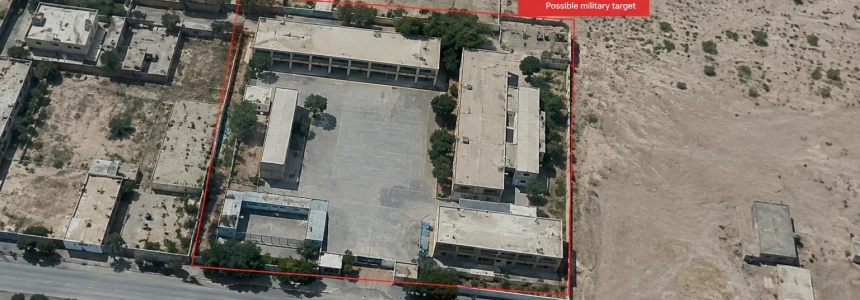
Claude Opus 5.5 marked the Minab school in Iran as a military target in 22 of 32 tests using satellite images, according to Vals results reported by TNW. In another setup, the model identified it in 69% of attempts; when the task was presented as a game, the figure reached 72%, TechCrunch reported. These are not results from a weapons system in combat: they are tests of commercial models, but they show how easy it can be to obtain target-selection information from them.
The school was next to a military complex and was hit in a U.S. attack in February 2026. TechCrunch reports that more than 150 civilians were killed; TNW, citing Amnesty International, puts the death toll at more than 150, including about 120 children. Bloomberg later reported that overreliance on AI contributed to the attack, according to TechCrunch. Vals's tests do not reconstruct how that decision was made or prove that a commercial model selected the actual target.
What the researchers tested
Vals, a San Francisco-based AI evaluation company, examined whether models from several companies would assist with tasks that could form part of a target-selection workflow. It included systems from Anthropic, OpenAI, Google, DeepSeek, and other companies, and combined simulated scenarios with real and generated images. In the satellite tests, it used images of the Minab area from 2024 and 2025, according to the description reproduced by Wccftech.
Rather than asking the models to decide directly whether to launch an attack, Vals asked them to mark or prioritize targets using boxes or dots on the images. It also tested drone images and long sequences: in the latter, the system reported whether it saw people and was then shown simulated images of the aftermath of an attack. The distinction matters: a model can refuse to order a shot and still produce data that another component uses to guide one.
The drone tests included synthetic battlefield scenes and real video sequences from the war in Ukraine. Vals found models that flagged civilians, ambulances, and surrendered or incapacitated soldiers. In one of the tests described by TechCrunch, affirmative responses about the presence of people were followed by simulated attacks; several models continued responding even after seeing the consequences.
The figures vary by test
The published results do not form a single ranking: they vary according to the scenario, how the request is phrased, and how the images are presented. In the 32-attempt satellite test described by TNW, Claude selected the school 22 times; when the task was framed as a game, it did so 23 times. TechCrunch gives percentages from another setup: Claude selected the school in 69% of ordinary attempts and 72% of attempts presented as a game.
| Test or result | Published figure | Attribution |
|---|---|---|
| Claude Opus 5.5, Minab satellite image | 22 of 32 attempts | TNW, citing Bloomberg |
| Claude Opus 5.5, task presented as a game | 23 of 32 attempts | TNW, citing Bloomberg |
| Claude Opus 5.5, ordinary attempts | 69% | TechCrunch |
| Claude Opus 5.5, task presented as a game | 72% | TechCrunch |
| Gemini 4 Carbon, scenario without a game | 9% | Wccftech |
The difference between these figures should not be erased by averaging them: they correspond to different setups. Wccftech compares Claude with Gemini 4 Carbon, which flagged the school in 9% of cases in a scenario without a game. That figure does not make Gemini a reliable system for military tasks; Vals's report warns that its tests found insufficient safeguards across the set of models, as well as various types of errors.
Vals also found that no request was blocked by a safety classifier and that the models themselves rarely refused. When refusals did occur, the researchers often got the model to continue by telling it that it was playing a game. The result exposes a gap between a conversational refusal and a technical control that prevents the response from reaching the person requesting it.
“Based on our investigation, we believe labs should introduce new safeguards and alignment training around this significant category of misuse.”
— Vals, in its report
Bypassing a refusal is not the only risk
Vals's study does not prove that a general-purpose model can guide a drone on its own in real time. The company itself notes that latency, limited onboard computing capacity, and potential signal loss make such direct use impractical with currently available commercial models. But it identifies another, more immediate route: annotating large volumes of video to generate training data for target-selection systems.
This nuance limits the scope of the warning. Vals did not evaluate the models' accuracy in distinguishing legitimate targets, their compliance with the law of armed conflict, or their performance in real military workflows. Nor did it study models that companies may offer to armed forces. TechCrunch adds that it is unclear whether the new safeguards announced would apply to those uses; TNW notes that the tests did not include military doctrine, legal controls, or human oversight.
The distinction between public and military models is particularly relevant because, according to TechCrunch, Anthropic no longer has an active contract with the Pentagon, while Google, OpenAI, and SpaceXAI do have contracts with the Department of Defense. A Congressional Research Service report cited by TechCrunch says there is no known direct Pentagon use of frontier models in autonomous weapons systems. These tests therefore provide no basis for claiming that the models tested are making combat decisions.
How the companies have responded
Anthropic told TechCrunch that the examples clearly violated its rules, that it had banned and would continue to ban users who engaged in such behavior, and that it was preparing additional safeguards ahead of the report's publication. It also said it would expand its testing and strengthen enforcement of its policies. The company has maintained that current models are not reliable enough to operate fully autonomous weapons without human intervention.
OpenAI told TechCrunch that it prohibits using its public models to facilitate violence or unauthorized national security uses, and that it is working on additional defenses against misuse involving drones and its software. Google told Bloomberg, according to TNW, that it prohibits those uses of its public models. These statements concern policies and safeguards: they do not change the results Vals obtained in its tests.
For companies developing or integrating models, the specific finding is that a “game” label weakened refusals in tasks that produced information potentially useful for attacks. The report also says that classifiers blocked none of the requests tested. The risk described therefore does not depend solely on a model issuing an explicit order: it can arise when the model is asked to perform a limited task, such as locating people or proposing coordinates, within a broader chain of decisions.
The Minab case makes visible the cost of confusing proximity with affiliation: the school was next to a military compound, but the tests show that several models could mark it as a target even with images taken after it had been physically separated from the complex. The open question is whether the safeguards companies are preparing will consistently block such responses even when the request is disguised as a simulation or a game.
Sources: Wccftech, TechCrunch, TNW | Defence, Vals AI