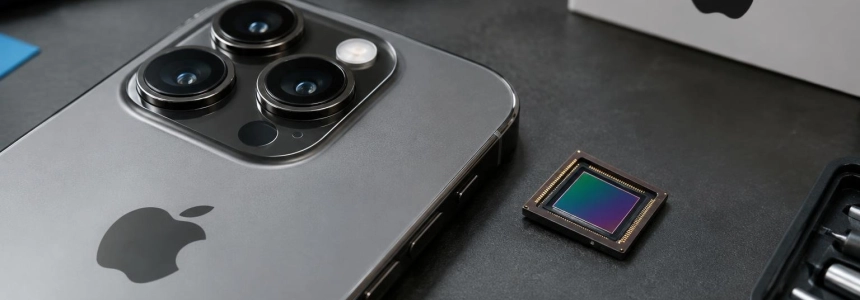
The iPhone 20 Pro could debut a new sensor in its main camera, with circuitry manufactured using a 17-nanometer process, according to a leak from Ice Universe cited by 9to5Mac and MacRumors. The device is expected in 2027, but there are still no details to indicate whether the sensor will be physically larger or what specific improvements it will offer.
The claim published on November 16 by 9to5Mac is brief: it mentions a new, more sophisticated sensor for the main camera, but provides no additional specifications. MacRumors clarifies that, according to the leaker, the 17 nm process would apply to the logic of the sensor. Neither publication presents confirmation from Apple.
The leak points to the sensor's logic
The distinction matters because modern stacked sensors separate the light-sensitive pixels from the circuitry that reads and processes image data. MacRumors explains that manufacturing this logic layer using a more advanced process could enable faster readouts and lower power consumption, as well as more sophisticated image processing. These are potential benefits associated with the process, not confirmed features of the next iPhone.
The message attributed to Ice Universe, a leaker who posts on Weibo, says that the iPhone 20 Pro would incorporate the sensor in its main camera “next year.” MacRumors places that debut in 2027; 9to5Mac also says next year. Neither publication identifies the component's supplier or explains whether the 17 nm process refers to the entire sensor or only its logic circuitry.
The phone's name is also part of the prediction. According to 9to5Mac, under the current naming system, next year's Pro model would be the iPhone 19 Pro. However, Apple is expected to skip directly to the iPhone 20 for the product's twentieth anniversary. MacRumors links this expectation to 2017, when Apple skipped the iPhone 9 name before launching the iPhone X for the original iPhone's tenth anniversary.
A larger sensor remains an open question
For 9to5Mac, the possible change comes amid two earlier reports pointing to a larger sensor in future iPhones. One placed it in 2027 or 2028; another considered 2028 more likely. Those reports, however, described a component intended for the telephoto camera with a resolution of 200 megapixels, not necessarily the main camera.
Size and resolution are not interchangeable. 9to5Mac notes that, all else being equal, a larger sensor captures more light, while packing more pixels onto a given surface tends to hurt low-light performance. According to that analysis, the limitation could matter less for a telephoto camera, which is often used outdoors, than for the main camera.
The publication presents a significantly larger main sensor without increasing the resolution as a desirable improvement, to enhance low-light photos and overall image quality. But Ice Universe's leak does not say that the component will grow: MacRumors and 9to5Mac agree that its size is unknown. For now, the announcement of a 17 nm process does not resolve the question that matters most to this hypothesis.
Samsung appears in other imaging projects
MacRumors links the 17 nm detail to a process Samsung was already developing. An Omdia report from 2024 cited by the publication described Samsung's 17LPV, designed specifically for the signal-processing circuitry of CMOS image sensors. This overlap does not prove that Samsung will manufacture the component mentioned by Ice Universe or that Apple would use the process described in the report.
MacRumors reports that Apple is working with Samsung to produce advanced image sensors at an Apple facility in Austin, Texas. Earlier reports described a collaboration on a three-layer stacked sensor design, but the publication cautions that there is no clear link between that project and the 17 nm component in the leak.
There is also another development effort with no confirmed connection to the rumor. Apple is reportedly working on its own sensor incorporating LOFIC technology, which can improve dynamic range and preserve more detail in bright and dark areas. MacRumors says it is unclear whether LOFIC is related to the latest claim. It therefore cannot be concluded that the 2027 main camera sensor will combine this technology with the 17 nm process.
The commemorative phone is also expected to get a redesign
The sensor is not the only rumored feature of the model. MacRumors cites predictions of a radical design, with a four-sided curved OLED display extending around the sides and possibly no visible cutouts. The publication places the launch around September 2027, but these features are also rumors, not specifications confirmed by Apple.
The possible design overhaul helps explain why publications expect Apple to use the iPhone 20 name instead of iPhone 19. In that context, the 17 nm main sensor would be one of several innovations attributed to the commemorative phone. Without additional technical details, it is unknown whether the improvement would result in cleaner photos, faster processing, or primarily lower power consumption.
The next concrete piece of information we need is whether the sensor will be larger and which company will manufacture it. Until those details emerge or Apple unveils the device, the leak only allows us to attribute new 17 nm logic to the main camera planned for the iPhone 20 Pro.