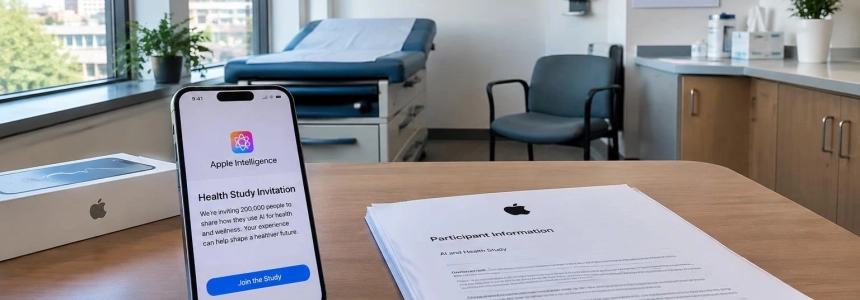
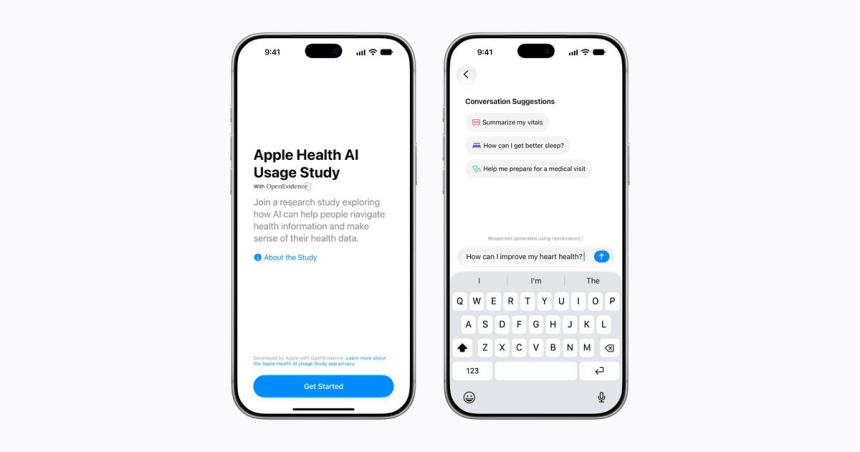
Apple has opened a study on the use of artificial intelligence for health questions to up to 200,000 participants in the United States. Developed with OpenEvidence, the initiative offers an iPhone app that answers questions with medical information and allows users, if they choose, to incorporate personal HealthKit data.
Apple presents the initiative as a research study, not as the launch of a healthcare service available to everyone. The goal is to understand what makes an AI response seem reliable, whether people understand it, and whether it helps them in everyday situations, such as preparing for a medical appointment.
A study app, not a medical service
The app, called Apple Health AI Study App, lets users ask about symptoms, conditions, and other health-related topics. Its answers are written in accessible language and link to peer-reviewed clinical sources, so users can check where the information comes from rather than relying solely on the chatbot's response.
The AI technology comes from OpenEvidence, a clinical AI company, while Apple designed the research experience. Publications cited as references include The New England Journal of Medicine, JAMA, and Nature. The study will examine how people understand and evaluate these answers, what inspires trust, and whether they help participants prepare to talk with their doctors.
Apple also wants to observe what happens after users read an answer: whether they act on it and how they rate its quality. Participants will be able to rate responses and submit feedback; they will also be offered monthly surveys, according to TechCrunch. MacRumors also describes occasional questionnaires about the experience.
The app can help put health data into context, understand symptoms or conditions, and prepare personalized exercise or nutrition plans. Apple stresses, however, that it does not diagnose or treat illnesses and does not replace the judgment of healthcare professionals. The company recommends consulting a doctor or clinical professional about health concerns or to verify medical information.
HealthKit adds context if users allow it
Taking part does not require sharing all the data on an iPhone. Those who wish to can connect HealthKit information, such as resting heart rate, physical activity, sleep, and lab results. Apple plans to study whether this personal data makes responses more relevant and easier to understand; participants control whether to share metrics.
The data could also help prepare for a medical appointment or generate more personalized suggestions. If a query appears concerning, the app includes safeguards designed to detect certain cases and direct users to a healthcare professional or other resources. Apple does not specify in these communications all the questions that trigger such a referral.
The company acknowledges that health tools based on language models can produce incomplete or unclear answers. For that reason, the study is not only testing the system's usefulness: it also aims to learn what people understand, what they consider reliable, and what limitations they encounter when using AI-generated clinical answers.
Apple promises to keep the study separate from model training
One of the central commitments is that responses will not be used to train AI models. Apple says questions are processed to remove identifying information before being sent to OpenEvidence. TechCrunch adds that data is sent to a secure third-party cloud provider and that OpenEvidence deletes questions and answers within 24 hours; MacRumors also reports that they are deleted within that timeframe.
Participants can choose whether to share HealthKit data and survey responses. Apple says it protects the confidentiality of the information collected. The design therefore combines the use of real questions and potential personal data with participation controls and an explicit separation from model training.
“Health is deeply personal, and conducting a dedicated research study is the most thoughtful way to understand how people interact with, understand, and evaluate AI for health in their everyday lives.”
— Sumbul Desai, Apple's vice president of Health and Fitness
The research also addresses a gap between the tools used by patients and professionals. Robert M. Wachter, professor and chair of the Department of Medicine at UCSF, noted that both groups use AI, but their tools are often developed and tested separately. In his view, working with shared, reliable tools can help patients come prepared for appointments and improve those conversations.
Who can participate and which iPhone is required
The study is limited to U.S. residents aged 21 or older and accepts up to 200,000 people. TechRadar specifies that an iPhone 15 Pro or later running iOS 26 or later is required; MacRumors and TechCrunch describe the requirement as an iPhone compatible with Apple Intelligence running iOS 26 or later. The app can be downloaded from the U.S. App Store to learn more and participate.
| Requirement or detail | Details |
|---|---|
| Participant limit | Up to 200,000 |
| Location | United States |
| Minimum age | 21 years |
| iPhone | iPhone 15 Pro or later, according to TechRadar; compatible with Apple Intelligence, according to MacRumors and TechCrunch |
| Operating system | iOS 26 or later |
| Expected duration | More than 12 months, according to TechCrunch |
The difference in how the device is described does not change the shared requirement of having an iPhone compatible with Apple Intelligence and running iOS 26 or later. TechCrunch puts the expected duration at more than 12 months; Apple and the other publications describe the study and its participant limit but do not specify that timeline in their announcements.
A possible foundation for future Apple features
The study comes after rumors circulated for more than a year about a Health+ app with AI features. TechRadar believes the new app could serve as a foundation for AI health products, although Health+ has not been announced as part of this initiative. iSpazio mentions earlier reports about a scaling back of plans for Health+, but provides no further details about those changes.
Apple has not said whether it plans to integrate AI responses into the Health app or Siri. For now, the app is focused on collecting research data about how clinical answers are used and evaluated, not on announcing a general feature for its devices. The results could inform future products, but the company has not confirmed a launch plan stemming from the study.
TechCrunch places the initiative in a market where OpenAI and Anthropic already offer chatbots with features geared toward health questions. Apple, by contrast, plans to first study how people respond to answers supported by clinical sources. The immediate question is what patterns it will find in understanding, trust, and everyday use among a sample of up to 200,000 people.
Sources: TechRadar, MacRumors, iSpazio, Apple Newsroom, TechCrunch