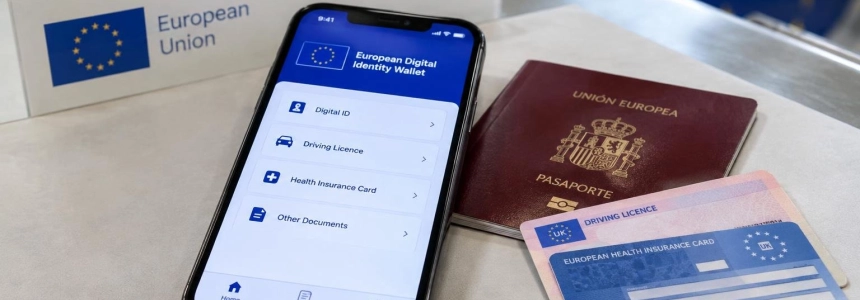
The EUDI Wallet will bring official documents together on your phone: from your national ID and driving licence to the European Health Insurance Card, prescriptions and academic qualifications. The European Union requires each Member State to offer at least one compatible wallet by the end of 2026; which credentials will be available and when each person can use them will depend on the rollout in their country.
The European Commission presents the initiative as a tool for identifying yourself and using public and private services, both online and in person. There will not be a single European app: countries will develop national wallets to the same specifications so they can work across borders.
A national wallet for cross-border use
The application, known as the EU Digital Identity Wallet or EUDI Wallet, is part of the European digital identity framework. Computer Hoy describes it as free and voluntary. The European Commission says it will be available to citizens, residents and businesses who want to use it; States are required to offer it, not to make its use compulsory.
The planned documents include national IDs, driving licences and the European Health Insurance Card. It also covers academic and professional qualifications, medical prescriptions, tickets and digital receipts. The Commission gives further examples, including university certificates, membership cards and travel credentials.
The wallet could also be used to identify yourself to public and private services, open a bank account, register to get a SIM card and sign documents electronically. The Commission also cites tasks such as applying for a passport or driving licence, filing taxes, checking social security information and making online payments.
In healthcare, the proposal includes sharing prescription details with a pharmacy and storing documents such as the European Health Insurance Card. For travel, the Commission mentions presenting information from travel documents, such as a passport or visa. These are uses covered by the framework; whether each credential is added will depend on the issuers and the rollout in each country.
Share only the data you need
Users will be able to add verified credentials and decide what information they share, with whom and for what purpose. One example from Computer Hoy is proving that you meet an age requirement without showing your entire ID or revealing other details that are not needed for the transaction. The Council of the European Union, as cited by the outlet, says users will remain in control of the information they provide.
The prototypes described by the Commission show a process in which a person approves the requested data, confirms the transaction with a PIN and returns to the service that requested it. When presenting information via a QR code, users can review which fields will be shared before confirming. The Commission clarifies that the screens are illustrative and do not necessarily represent what national apps will look like.
The Commission also envisages legally binding electronic signatures within the wallet. Its website explains that electronic signatures can be used to sign documents and contracts; euronews adds that the free signature will have the same legal validity as a handwritten one in Member States.
Data control does not resolve every privacy concern. Thomas Lohninger, executive director of the digital rights organisation epicenter, told euronews: «People should have the right to say no, to not share any of your information or only selectively share information.» The outlet also reports his concern that the ease of verifying identities could lead to people being asked to identify themselves in situations where it was not previously necessary.
If you put all eggs in one basket, then that basket hopefully never fails.
— Thomas Lohninger, executive director of epicenter
The risks depend on how credentials are stored
Bringing sensitive documents together in one tool could mean that a technical failure, service outage or stolen phone affects access to several credentials at once. Euronews also raises the risk that centralised verification could leave a record of when and where a person identifies themselves, even though the legal framework prohibits States from tracking wallet use.
The architecture chosen by each country will affect security. Euronews says storing credentials exclusively on a phone’s secure chip offers the most privacy, while cloud copies or central servers could create more valuable targets for attackers or insider threats.
The outlet also warns that some protections, such as zero-knowledge proofs, rely on cryptographic technology that is still being developed. This method could make it possible to prove, for example, that someone is over 18 without revealing their date of birth. Lohninger told euronews that parts of the necessary technical framework are still unfinished.
The Commission says wallets must follow common security and interoperability standards. The technical rules are set out in the Architecture and Reference Framework (ARF), which defines standards, protocols and formats for exchanges between credential issuers, wallets and the services requesting them. The Commission also provides a reference implementation with open-source libraries and modular components to help build the applications.
Six pilots and uneven national rollouts
Before the general rollout, more than 550 companies and public authorities are taking part in large-scale pilot projects, according to the European Commission. Its website says participants are based in 26 Member States, as well as Norway, Iceland and Ukraine; euronews describes six pilots testing more than 11 use cases in the EU and those three countries.
The Commission says four large-scale projects have already ended and two are still testing use cases. Among the active projects, euronews mentions APTITUDE, which is testing digital travel credentials to speed up border checks, and WE BUILD, focused on payments between businesses, public administrations and consumers.
The EU deadline is the end of 2026, but progress will not necessarily be the same in every country. Computer Hoy says Spain is preparing the procedures and regulatory framework needed to launch the application. Euronews, meanwhile, reports that Thomas Lohninger expects few States to have a fully functional and interoperable wallet by the deadline.
Italy, France, Finland and Bulgaria are among the countries that, according to euronews, are ahead of the curve. Italy is integrating the framework into the public IO app through IT-Wallet, with health cards and driving licences available to load in a test environment. France is developing EUDIW Unfold Playground on France Identité, an environment for issuing and verifying digital credentials.
Croatia is adapting Certilia Wallet to the European technical framework. By contrast, euronews says Sweden has published a roadmap suggesting possible availability in 2028 or 2029, while Germany is still at the prototype stage, facing procurement difficulties and debate over a public or public-private model. Greece and Slovakia remain in private testing, while Romania has accelerated a hybrid model through a private partnership with Mastercard.
One common system does not mean a single app
The system will involve several participants: States will offer the wallet, providers will build and maintain it, and public or private organisations will issue credentials. Services—for example, a pharmacy or university—will be able to ask users to identify themselves or present a document to complete a task.
The proposal aims to make it possible to use a credential issued in one country in another, without relying on a single app for the entire Union. The Commission gives examples such as presenting a university degree when applying for a job, opening a bank account in another country or showing a mobile driving licence. Whether these uses are actually available will depend on each country and service enabling them.
The wallet will be voluntary, and the addition of credentials will depend on the rollout in each country. The first common deadline for Member States is to offer at least one version by the end of 2026.
Sources: Computer Hoy, European Commission, European Commission, euronews