Android phones in Italy can now receive earthquake alerts before shaking begins. Google announced the system’s activation on November 19, after Italy was left out of the expansion to more than 200 regions announced by the company on October 15.
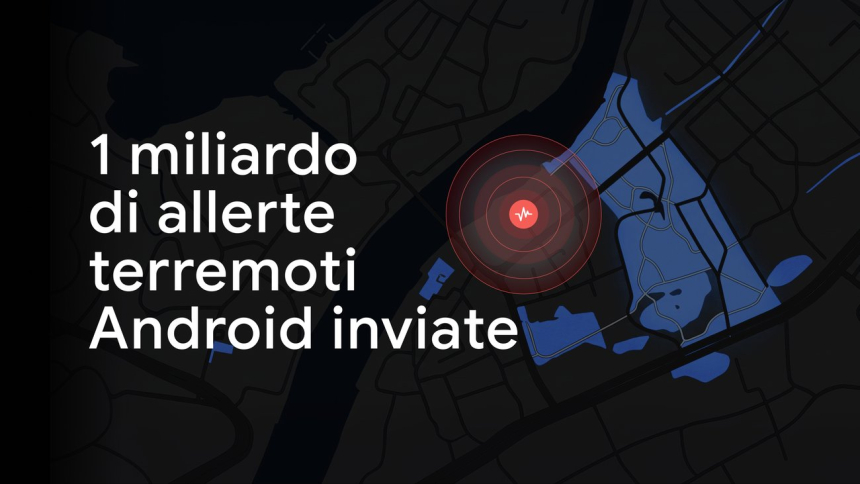
The goal is to gain a few seconds to take cover, not to predict an earthquake. According to Google, more than one billion alerts have been sent worldwide since the system launched in 2021. The company describes its network as the world’s largest mobile-based earthquake detection system.
Three alerts for different intensities
Google offers three types of notification for Android users in covered areas. Attenzione reports a nearby earthquake with an estimated light tremor; the notification is simple and, according to the demo described by TuttoAndroid, combines an alert with vibration.
Preparati warns of stronger tremors and invites users to prepare to act. The third level, Intervieni, is intended for moderate to strong shaking: it fills the screen and provides immediate instructions on how to stay safe. TuttoAndroid notes that this alert includes sound and vibration, as well as a full-screen display.
The names vary across the publications consulted: Google uses Attenzione, Preparati and Intervieni in its Italian announcement; La Stampa translates the levels as “Pay attention,” “Preparati” and “Act.” In both cases, the descriptions distinguish the alerts according to the estimated intensity of the tremor.
Preparati will add a map and estimated magnitude
The Preparati alert will receive an update in the coming months. Google plans to add a map of the area where the movement was detected, an estimated magnitude, actions users can take, and a button to check for updates as they become available.
The company had already announced these changes on October 15, when it announced the international expansion of the alerts. At that point, the rollout was growing from 98 countries and regions to more than 200, but Italy was not yet among the places included. The Italian announcement on November 19 added the country to the service.
The October expansion also said that alerts would begin reaching users in the new regions that day and that full availability was expected within the following week. Google’s Italian announcement does not provide a more precise timeline for the Preparati improvements.
How to check whether your phone displays the feature
TuttoAndroid says the path on Android is Settings > Safety & emergency > Earthquake alerts. If the option is available, the page should no longer display the message saying that the feature was not supported in the region. It also includes “See a demo,” where users can view the three types of alert.
TuttoAndroid attributes availability to a rollout through Google Play services and explains that the app usually updates automatically. If an update is pending on the phone, users can find its listing in Google Play and tap “Update.” La Stampa says the feature is enabled automatically on compatible Android devices and requires a Wi-Fi or mobile data connection to receive alerts.
Availability is limited to compatible Android phones. La Stampa notes that iPhones are not part of the detection and alert network. SmartWorld adds that no additional app needs to be installed to enable the service.
The network aims to provide a few seconds’ warning
Google explains that the system aggregates information from mobile phones to detect seismic activity and send alerts to affected areas. La Stampa details that the accelerometers in mobile phones can register vibrations and that signals from several devices are sent to Google servers, where they are compared to estimate the event’s location and magnitude.
The amount of warning time is not the same for everyone: it depends, among other factors, on the distance from the epicenter. La Stampa says an alert may arrive a few seconds in advance, provide 10 or 15 seconds’ warning and, in particular circumstances, arrive more than a minute beforehand. Close to the source, however, it could arrive at the same time as the shaking or afterward.
La Stampa also reports that the alerts concern earthquakes with an estimated magnitude of at least 4.5 and that the system uses phones’ approximate locations to decide which devices to send alerts to, without identifying individual users. It adds that detection may be more difficult in areas with few mobile phones or at sea, and that estimates may be inaccurate or notifications may be sent for shaking that is not felt.
A mobile network that complements seismic monitoring
In Italy, Google’s system joins an existing public infrastructure. La Stampa puts the National Institute of Geophysics and Volcanology’s National Seismic Network at about 500 stations, which continuously transmit data to a monitoring room operating 24 hours a day. The outlet specifies that Android does not replace it, but provides an independent network based on mobile devices.
Google’s alerts are also distinct from IT-alert, the Civil Protection Department’s national public warning system. According to La Stampa, the latter uses cell broadcast technology to send messages to phones in an area, but currently does not include alerts for ongoing earthquakes.
The company dates the start of the Android system to 2021. In its November 19 post, Boone Spooner, Group Product Manager of Earthquake Alerts, said: “Since launching in 2021, we have sent over a billion alerts to help people stay safe before the shaking even starts.”
This cumulative figure does not mean that every earthquake can be detected in advance or that every user will always receive a warning beforehand. Availability depends on whether the phone is compatible, is in a covered area and has a connection to receive the notification; the amount of warning time also varies according to the user’s location relative to the epicenter.
Google’s next announced change is the Preparati update: it will include the map, estimated magnitude, recommended actions and a follow-up button in the coming months.
Sources: TuttoAndroid, DDay.it, SmartWorld, Google, Google, Google Android Help, La Stampa