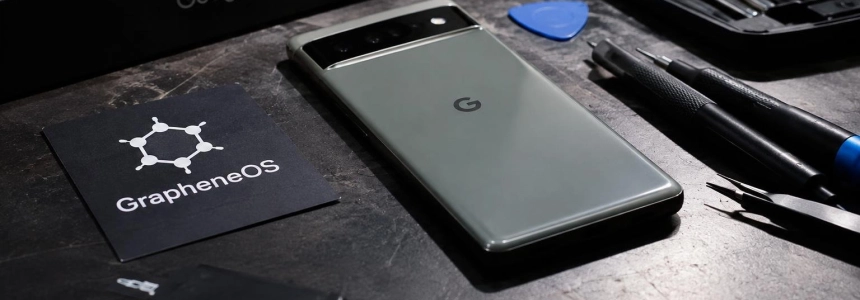
GrapheneOS accuses Google of trying to convince mobile phone manufacturers not to support its system or even allow the bootloader to be unlocked. The project, a privacy- and security-focused alternative to Android, also expects Google could lock the bootloader on future Pixel phones; for now, that possibility is a hypothesis put forward by its developers, not a decision announced by the company.
The allegations appeared in GrapheneOS posts on Mastodon and X on November 20. The project claims that Google is increasingly reserving features and updates for its own phones, harming both other manufacturers and systems derived from AOSP. It also accuses the company of directly trying to undermine GrapheneOS.
The dispute comes as the alternative system seeks to expand its compatibility beyond Pixel phones. Google has not confirmed that it plans to lock bootloaders on its phones. Xataka and TechRadar say they requested comments from the company; their articles indicate that they will update the information if they receive a response.
What GrapheneOS alleges and what it fears may happen
In the message reproduced by Xataka, the developers claim that Google is trying to persuade manufacturers not to support GrapheneOS or allow the bootloader to be unlocked. TechRadar reports the same allegation and adds that the project attributes the conflict to Google's business strategy, not its engineers.
GrapheneOS also points to Play Integrity API, Google's service that allows apps to obtain information about the integrity of the app and the Android environment. The project claims that Google will continue promoting it and that this could make systems derived from AOSP unviable. In its posts, it describes some of the company's practices as illegal and goes so far as to claim that several could violate U.S. criminal law.
“Google is sabotaging its manufacturing partners by making more and more features and updates exclusive to Pixel phones.”
— GrapheneOS developers
The specific concern for Pixel phones is that Google may prevent the bootloader from being unlocked on future models. The project presents this as a prediction, not as a measure that has already been adopted. IlSoftware.it also emphasizes that there is no official Google announcement confirming this intention.
The bootloader is involved in the early stages of startup and checks which software images can be loaded. Phones are usually sold with this component locked; if the manufacturer allows it, users can unlock it to install another operating system and lock it again afterward, provided the device can verify the installed image.
The security model that limits compatibility
GrapheneOS does not present itself as a ROM that can be installed on any phone with an unlockable bootloader. According to its documentation, it requires hardware and firmware conditions that allow the device's security protections to be maintained. Its method on Pixel phones, IlSoftware.it explains, includes relocking the bootloader after installing the system to preserve Android Verified Boot.
The project's official documentation explains that compatibility depends on factors such as verified boot, reliable firmware updates, dedicated security components, and mitigations against memory attacks. It also lists requirements for future devices, such as monthly security updates, rollback protection, hardware-based memory tagging, and verified boot for the firmware and operating system.
That is why GrapheneOS's goal is not to expand its catalog at the cost of accepting any phone. The project explains that many mobile phones cannot provide a sufficient level of security, even if the code could be adapted. It also notes that maintenance depends on manufacturers releasing updates for the firmware and other device-specific components.
The official list of devices with production support includes Pixel models, from the Pixel 6a family through the Pixel 10 series, as well as the Pixel Fold, Pixel Tablet, and various Pro and a variants. For the Pixel 6 and Pixel 6 Pro, GrapheneOS provides extended support as a temporary measure; it clarifies that these versions cannot provide all security patches.
Motorola aims to move the project beyond the Pixel orbit
GrapheneOS currently depends on Pixel phones for its official support, but is working with Motorola to develop phones that meet its requirements. Xataka identifies the Motorola Signature 27 as the brand's first model with announced official support and notes that Motorola opened reservations in the United States on the same day the allegations were published.
IlSoftware.it dates the collaboration to March 2026 and says it was announced at that year's Mobile World Congress. The project has cited 2027 as the target for the arrival of the first compatible Motorola phones. These include the Signature 27, which will also have a GrapheneOS variant.
The collaboration could make it easier to access firmware, drivers, and HAL, the hardware abstraction layer that allows the system to interact with components such as cameras, sensors, and modems. For GrapheneOS, the issue is not simply porting its code: the manufacturer must provide ongoing support and a platform that meets its standards.
That plan explains why the allegations about the relationship between Google and other manufacturers come at a delicate time for the project. Motorola could offer a way to reduce its dependence on Pixel, but no specific launch date has been published for compatible devices beyond the 2027 target.
Play Integrity and app limitations
GrapheneOS also criticizes apps' use of Play Integrity API. IlSoftware.it explains that an alternative system can relock the bootloader, use valid cryptographic signatures, and receive security updates without necessarily meeting all the requirements some apps expect when querying Google.
The Italian outlet cites IO and IT-Wallet on GrapheneOS as examples: some features may be inaccessible because the environment does not receive the verdict requested by the app, even though no intrusion into the phone has been detected. The project proposes using Android hardware attestation, based on cryptographic keys and verifiable information about the device's state, so that services can evaluate different operating systems.
TechRadar reports an additional allegation: GrapheneOS believes that Google's licensing terms for Google Mobile Services are intended to prevent competition. The project is not limiting itself to alleging technical effects; it argues that Google's business decisions are intended to eliminate alternatives to Android.
The European precedent and unanswered questions
Xataka links the dispute to Android's regulatory history in Europe. In July, the Court of Justice of the European Union definitively upheld a €4.125 billion fine against Google for using its position with Android to harm rivals. The practices cited included requiring certified manufacturers not to sell phones with unapproved versions of Android.
After that fine, Google had to allow so-called forks in Europe, according to Xataka. The outlet also recalls that the European Commission has required Android to open up to other artificial intelligence assistants, with a deadline of July 2027, and that Google had to enable alternative payment methods in Google Play.
GrapheneOS's current allegations are not accompanied by public evidence of pressure on manufacturers, and the project does not identify which brands may be affected. Xataka adds that the group's track record includes alarms that later changed: in August, it considered the Pixel 11 lost because of the lack of MTE, but in November confirmed that those phones will indeed be supported.
GrapheneOS says it wants to work with the U.S. Department of Justice and Attorney General Todd Blanche to seek a remedy, according to TechRadar. In the meantime, Google's response is still pending, and the next known milestone for the Motorola alternative is the expected arrival of the first compatible devices in 2027.
Sources: Xataka, IlSoftware.it, TechRadar, GrapheneOS