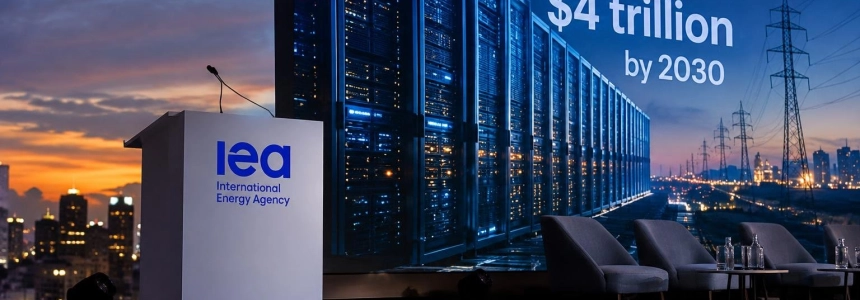
Global investment in data centers could reach $4 trillion by 2030, up from the $565 billion invested in 2025, according to the International Energy Agency (IEA). Growth is being driven primarily by artificial intelligence: nearly three-quarters of the projected expansion would be in centers dedicated to training and running these systems.
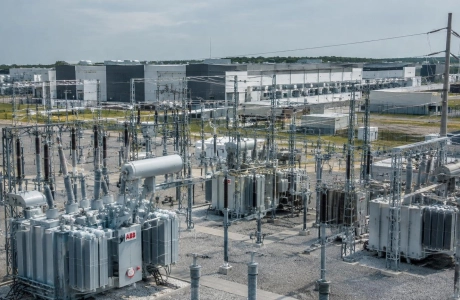
The scale of this investment has an immediate consequence: power grids face projects whose projected consumption could exceed the current peak demand of some expanding markets. Fewer than one hundred large artificial intelligence facilities would require 50 gigawatts of power, comparable to Great Britain's peak electricity demand, according to information from Bloomberg published by Energy Connects.
An expansion already being measured from space
The IEA is tracking the construction of 93 large AI data centers using satellite images. The analysis found that data center capacity multiplied tenfold in two years, reaching 17 gigawatts, according to The Guardian. The agency also drew on global shipments of AI servers, which have increased eighteenfold since 2020.
These figures describe different measures: the 17 gigawatts is the capacity observed in the analysis of the expansion, while the 50 gigawatts refers to the projected combined capacity of large AI facilities once they are completed. The anticipated scale helps explain why the IEA sees pressure on power grids even before all the projects are operational.
In the agency's central scenario, existing global data center capacity—including facilities using AI-optimized servers—stands at 120 gigawatts. Another 120 gigawatts would be added before the end of the decade, and three-quarters of that new capacity would be AI data centers, The Guardian reported.
More electricity, and not just for training models
The IEA expects data centers to consume twice as much electricity in 2030 as they do today. AI would account for three-quarters of the global increase, with AI facilities using an additional 350 terawatt-hours a year: more than Great Britain's annual electricity consumption, according to The Guardian.
The impact is not limited to large training centers. The IEA's forecast includes both AI training and use, while the rest of data center demand covers traditional services such as cloud storage and video streaming. The share of investment attributed to AI facilities shows that this change in scale is concentrated in that workload.
Pressure on supply will not automatically be resolved by purchasing renewable electricity, either. Data center developers have become the largest corporate buyers of renewable energy, but the IEA also expects fossil fuel generation to grow more rapidly to meet demand. The estimated result is a 70% increase in sector emissions by 2030.
“I don’t see any credible pathway for the energy world to return to the way it was before,”
— Fatih Birol, IEA executive director
Birol was referring to an energy landscape altered by the war in the Middle East and the policy decisions made in the wake of the crisis, according to The Guardian. In this context, AI's expansion adds to other sources of demand cited by the agency, such as population growth and the need for air conditioning.
Supply varies by region
Generation forecasts for data centers are not uniform: they vary from U.S. gas to Chinese coal and a larger renewable share in the European Union. This difference matters for emissions, but it also shows that deployment depends on the mix of energy sources each region expects to use.
| Region | Projected data center power supply |
|---|---|
| United States | Gas would provide around 60% of electricity in 2030. |
| China | Around half of the electricity used by AI data centers would come from coal. |
| European Union | Renewables would provide around 70%, followed by nuclear and gas, with a very small contribution from coal. |
The regional figures come from IEA forecasts reported by The Guardian. For the United States, the agency counted plans in August for nearly 180 gigawatts of new gas-fired power plants linked to data centers, almost as much as the European Union's entire currently installed gas-fired generation capacity.
Comparison with other markets underscores the contrast. U.S. developers' appetite for gas-fired generation would be more than sixteen times greater than Canada's, where the IEA identified plans for 11 gigawatts. In the rest of the world, projects for new gas-fired power plants linked to AI developers would total 4 gigawatts.
The trade-off behind a $4 trillion investment
For companies, this expansion means electricity is no longer a secondary consideration in digital infrastructure: projects announced in some markets could require more power than current peak demand. This follows directly from the scale described by the IEA; it does not guarantee that every planned data center will be built. The 50-gigawatt figure refers to projects that would be completed.
For companies developing and operating AI services, the projected growth brings two specific pressures: more computing capacity and power availability, which is already a concern for grids. The IEA notes that the boom has also sparked concern in communities where residents fear that expansion will drive up electricity costs. This tension pits the speed of deployment against the local consequences of supplying power.
The other cost is reflected in emissions. Although data centers lead corporate purchases of renewable electricity, projected fossil fuel generation in the United States and China is pushing sector-related emissions higher. The IEA estimates they will rise by 70% by 2030, while data center electricity consumption would double.
The financial bet, then, is not just a race to build more servers: it tests the capacity of power grids and the energy mix that will fuel this infrastructure. The scale of the challenge is captured by the contrast between the projected $4 trillion and the additional 350 terawatt-hours per year that AI data centers would consume.
Sources: Energy Connects, the Guardian