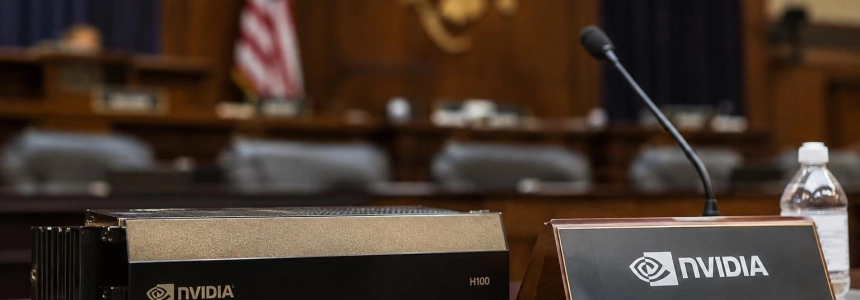
Jensen Huang will appear before three U.S. House committees on December 1 after voluntarily agreeing to a transcribed interview. Tim Teter, Nvidia’s general counsel, will answer lawmakers’ questions on December 2; both agreements came after a warning that they could be subpoenaed.
The joint appearance concerns the House Foreign Affairs Committee, the Select Committee on the Chinese Communist Party, and the Intelligence Committee. The congressional investigation seeks to clarify how Nvidia’s most advanced chips ended up in the hands of Chinese actors and what role may have been played by a person considered a possible Chinese intelligence asset.
“The American people need answers about Mr. Huang and Nvidia’s role in enabling dangerous actors in the People’s Republic of China to access our most advanced chips, as well as the role of a possible Chinese intelligence asset in this scandal.”
— Brian Mast, John Moolenaar, and Rick Crawford, committee chairs
An interview agreed to after a subpoena threat
The Republican chairs of the three committees—Brian Mast of Florida, John Moolenaar of Michigan, and Rick Crawford of Arkansas—announced the agreement on November 17. The House said the interviews would be transcribed and that both Huang and Teter had agreed to appear voluntarily.
The agreement puts an end, for now, to the threat of compelling Huang to testify. According to CBS News, lawmakers had given him until 8:00 p.m. on November 13 to respond to a request for a closed-door interview. Talks continued after that deadline and carried on through the week, the outlet reported.
A November 12 letter warned that failure to cooperate would lead the Foreign Affairs Committee to issue a subpoena to compel testimony, in whatever format the committee decided. It also said the other committees could issue their own subpoenas. TNW dates the letter to the day Huang left the CEO role; CBS News reports that he resigned the week before its story was published.
The dates of earlier communications differ across published reports. CBS News and TNW place an initial letter requesting information about Nvidia’s security measures and Huang’s relationship with Alice Huang on November 4. Tom’s Hardware, however, says the request to appear came in a letter dated November 9. The outlets do not share a single, detailed timeline.
Nvidia chips and an investigation into Megaspeed
Lawmakers’ interest centers on both Nvidia’s controls and access to its chips. According to CBS News, the first letter requested a briefing on the company’s protocols for guarding against espionage by foreign adversaries. It also asked about Huang’s relationship with Alice Huang, a former Megaspeed executive who is not related to him.
Megaspeed, a Singapore-based data center company, obtained Nvidia chips that the United States prohibits exporting to China, according to CBS News. The company is under investigation in the United States and Singapore for allegedly smuggling those chips into China. Megaspeed has denied the allegations.
Tom’s Hardware links the interest in the personal relationship to the investigation into a possible Chinese agent and says Huang acknowledged the relationship on November 8. CBS News describes Alice Huang as a woman considered a possible spy by investigators. The committee chairs have framed the issue as a question about the possible role of a Chinese intelligence asset, not as an established conclusion.
Political concern also extends to national security. In their statement, lawmakers said they want to determine how Chinese actors were able to access Nvidia’s advanced chips and what role the company and Huang played. In an initial letter cited by CBS News, they wrote that it was vital for Congress to establish the extent to which U.S. national security had been put at risk.
The agenda does not end with the House
The House appearance is not Congress’s only request. Tim Scott, chair of the Senate Banking Committee, has asked Huang to testify on December 3, according to TNW. That date would place the Senate session two days after the interview with the three House committees.
Separately, Nvidia’s board has created a national security committee tasked with overseeing export controls, also according to TNW. The sources do not detail what specific measures the committee will review or what results it has produced so far.
The House committees have also linked the case to chip legislation. In a November 12 statement, their chairs called on Congress to pass four bills as part of the NDAA, the annual defense authorization act: AI OVERWATCH Act, Chip Security Act, MATCH Act, and Remote Access Security Act. Available reports do not specify the legislative timeline for each proposal.
With the voluntary agreement, the subpoena lawmakers had raised is no longer necessary to secure the December 1 appearance. Immediate attention now turns to the transcribed interviews with Huang and Teter and, two days later, the Senate Banking Committee’s request.
Sources: Tom's Hardware, TNW | Nvidia, Republican Foreign Affairs Committee, CBS News