On September 1, 2026, PlayStation removed hundreds of StudioCanal movies that customers in the UK and Europe had already paid for from their libraries. The list published by the company includes titles such as Terminator 2, Paddington, and Apocalypse Now: a digital purchase could stop providing access to the content.
The Sony case is not an isolated one. The five episodes—PlayStation, Funimation, Apple, UltraViolet, and Redbox—point to different dependencies behind a digital library: distribution agreements, regional accounts, companies changing direction, and systems that stop working. For buyers, the practical result can be similar: losing the ability to play a movie.
PlayStation: an expired license, 551 titles removed
Sony stopped selling and renting movies on PlayStation Store in August 2021, but at the time assured customers that existing purchases would remain available. The licensing agreement with French studio StudioCanal ended, and the company lost the right to distribute those titles. In 2022, it removed 314 movies in Germany and 137 in Austria; in 2026, it announced another removal affecting customers in the UK and Europe.
PlayStation’s legal notice specifies the scope: from September 1, 2026, the affected titles would no longer be accessible and would disappear from the video library. The published list includes movies and series, among them The Deer Hunter, Total Recall, and several seasons of TV series. The company itself summed it up this way:
“you will no longer be able to access your previously purchased content from Studio Canal, and it will be removed from your video library.”
— PlayStation Store
According to How-To Geek, affected customers received neither refunds nor store credit. The service no longer sold movies, but the expectation that purchases would be retained still depended on a license that Sony did not permanently control. PlayStation Network’s terms also clarify that words such as “buy” or “purchase” do not mean that users own the content.
The difference between paying and owning is not merely semantic: it determines who can maintain access when an agreement ends. In this case, users did not receive an independent copy, but rather access mediated by a platform and a third party’s distribution rights.
Funimation: a merger that did not transfer the codes
Funimation’s shutdown in 2024, after Sony bought Crunchyroll and consolidated the service there, affected another kind of library. For years, some anime DVD and Blu-ray boxes included codes to watch a digital copy. Buyers might have understood them as lasting access associated with their discs, but Crunchyroll said the codes would no longer work on the new platform.
Crunchyroll transferred active paid subscribers and their viewing histories, but did not accept the digital codes. The distinction matters: migrating an account or viewing history does not mean transferring every right acquired through other means. In this case, the terms printed on the inserts described the codes as a promotion, not as a legal guarantee of permanent access.
Those who kept their physical discs could still play them; those who relied solely on the codes were left without that alternative. For companies that integrate services after an acquisition, the episode illustrates a specific tension: simplifying products and moving users can leave out benefits tied to a previous system. The customer bears the cost if the new service does not recognize those rights.
Apple: the account’s country matters too
Apple’s store illustrates another vulnerability: distribution rights can vary by country. How-To Geek notes that Apple negotiates licenses by territory, so a movie available in one region may become unavailable when the rights there expire or change hands. Changing an account’s region can also affect access to purchased titles.
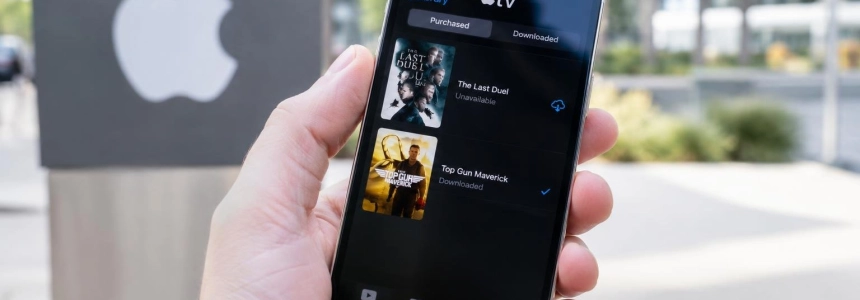
Apple itself acknowledges that purchased content usually remains available to download again or access, but warns that it may be removed from its services and become unavailable—for example, if it loses the rights granted by the provider. Its recommendation is to download purchases to a compatible device: once downloaded, the content can be viewed offline, and Apple says it cannot remove it from that device.
This distinction sets Apple’s case apart from a complete disappearance: access from the servers may change, while a download kept on a device lets users continue watching the file offline. But this solution requires planning ahead and having a compatible device of your own. A library that exists only in an account does not offer the same assurance as a locally stored copy.
UltraViolet: a shared locker left without a system
UltraViolet launched in 2011 as a shared digital locker for movies. The idea was to redeem a code included with a DVD or Blu-ray and access the rights through different services, such as Vudu, Flixster, or CinemaNow. In 2019, the service shut down after studios and companies withdrew their support. TechCrunch reported at the time that it had more than 30 million users and enabled playback of more than 300 million movies and shows.
The promise depended on a central database that allowed services to check which titles belonged to each user. When UltraViolet shut down, Flixster could no longer use that verification and also closed shortly afterward. Users had a limited window to transfer their collections; according to How-To Geek, the migration to Google Play or Vudu did not include every movie, particularly some independent films, foreign titles, and series from studios outside the consortium.
The lesson for platform designers is not that a shared database alone guarantees continuity. UltraViolet aimed for interoperability, but continuity still depended on company support and other services accepting the rights. If the central intermediary disappears and there is no complete transfer, migrating an account is not enough to preserve the entire collection.
Redbox: when the store closes
Redbox On Demand was an online store where customers could buy digital movies. When the parent company went from bankruptcy to full liquidation in July 2024, the digital store disappeared. How-To Geek says that no buyer took over the licensing obligations, so purchased movies were no longer available.
Unlike cases tied to a particular movie or region, the point of failure here was the store itself. Customers did not need to change countries, and a migration did not need to omit titles: when the service disappeared, so did the means of accessing the library. For a company, operating a digital store means that commitments to customers may outlast the business’s viability; if no one takes them over, continuity is left in limbo.
What the buy button really promises
The five cases do not describe a single mechanism. Licenses are central to PlayStation and Apple; Funimation involved a shutdown and a decision not to recognize codes; UltraViolet involved the end of shared infrastructure and an incomplete migration; Redbox involved the disappearance of the seller. “Purchase” does not mean the same thing when access depends on all those links in the chain.
For companies, these examples point to a practical responsibility: explain what happens to purchases if rights expire, a service merges with another, or a store closes, and define how users’ rights will be preserved or transferred. Legal terms may set the limits of an obligation, but they do not erase the gap between what a customer understands a purchase to mean and what the service can guarantee.
For users, Apple offers a concrete step: download purchased content to a compatible device before it becomes unavailable. This does not cover every platform or turn every purchase into ownership, but it does avoid relying on a future connection to the servers to play that file. Before clicking “buy,” the remaining question is what form of access you are paying for and where the movie will be stored.
Sources: How-To Geek, PlayStation, Apple Support, TechCrunch