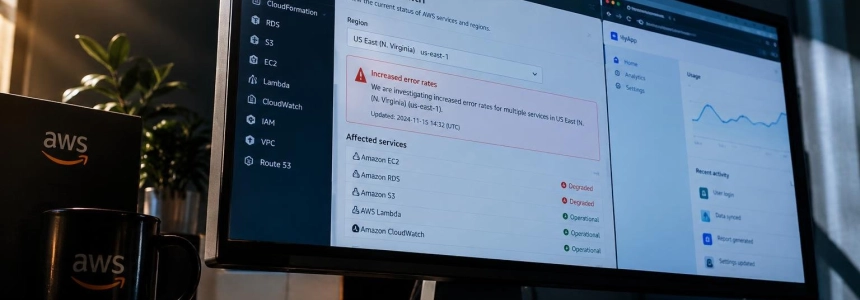
On November 15, AWS experienced problems with eleven services in us-east-1, including IAM Identity Center authentication and some of its Network Load Balancers. The outage lasted until 6:21 a.m. Pacific Time, but barely made headlines: it happened in the early hours on the U.S. West Coast and mainly affected people who administer systems, not necessarily those who use the applications.
The difference between a technical outage and a visible crisis is not just its duration. The time, the affected function, and who needs it also matter. In this case, some workloads may have remained active while some teams could not log in to manage them. And connectivity problems affecting a group of load balancers did not amount to a general failure across the entire region.
A real outage, with two recovery times
AWS detected registration, authentication, and connectivity errors in us-east-1 at 3:05 a.m. PST. Five minutes later, its engineers were already working on the incident, but the first public notice on the status page did not appear until 4:38, according to the timeline reconstructed by Control Plane. The resolution notice came at 6:53.
The incident did not have a single end time. Authentication recovered at 5:20; afterward, a more limited problem persisted with some of the Network Load Balancers in a cell in the use1-az1 availability zone. AWS gave 6:21 as the recovery time for that group. Its update also listed 6:10 as the end of the main incident window. That is why some accounts describe just over two hours of login failures, while others report more than three hours of connectivity problems.
Affected services included IAM Identity Center, AWS Sign Up, Amazon Connect, CloudWatch, NAT Gateway, OpenSearch Service, Step Functions, VPC Lattice, IoT Device Management, Kiro, and Elastic Load Balancing. AWS did not publish a root cause. Nor did it mention a cyberattack in its notices.
The system could be working and still be out of reach
IAM Identity Center was the entry point for administrators signing in through SSO. When that entry point stopped responding, teams could lose access to the console and to CLI sessions that depended on SSO credentials; credentials that had already been issued continued working until they expired, according to Control Plane. The infrastructure and access to manage it are distinct failure modes: a workload can continue processing work even if the on-call team cannot get in through its usual route.
That nuance changes how metrics should be read. UptimeRobot reported that its DynamoDB, S3, and SQS probes in several regions remained available during the period observed. This does not contradict the incident: those tests did not cover IAM Identity Center login or the specific group of affected load balancers. A green check does not represent every route used by customers and operators.
It also changes who notices the impact. AWS Support said there was no workaround for customers affected by the authentication errors. Five Nines noted that call centers using Amazon Connect with agents authenticated through Identity Center could lose access to their workstations. The failure did not have to take down a public website to block essential work inside a company.
“my app just broke; is it my crappy code or is there a global event going on?”
— The Register, opinion column
The question The Register raises about Downdetector sums up the role of these tools: users look for a way to distinguish a problem on their end from a widespread incident. But the AWS incident did not generate a comparable wave of consumer reports. Public silence did not measure the operational impact; it reflected that the failure was concentrated in administrative routes and components less visible to end users.
What changes depending on the affected layer
The second part of the incident was concentrated in a fraction of the NLBs in a cell in use1-az1. Control Plane explains that, by default, each Network Load Balancer node sends traffic to targets registered in its own availability zone; cross-zone load balancing is disabled by default. If an application's targets are only in the affected zone, having healthy instances in another zone does not guarantee they will receive that traffic.
AWS recommended creating a new NLB with targets distributed across multiple zones for those who needed an immediate workaround. That response, however, assumes that capacity is ready in other zones and that someone can make the change. Mitigation depends on an independent access route: that same morning, Identity Center problems could prevent administrators from signing in to carry out the change.
Architecture therefore needs to account for more than one dependency. Control Plane lists emergency access, distributing targets across zones, a second region that is already operational, and monitoring hosted outside the region being monitored as separate measures. They are not interchangeable: a regional replica does not by itself restore console access, and an alternative login method does not move traffic away from a degraded zone.
The cost of preparing for less visible failures
Control Plane outlines several options documented by AWS for maintaining an access path: direct federation with the identity provider to individual accounts, emergency roles or users, or replication of IAM Identity Center to another region. Replication requires a customer-managed KMS key and is not available with an Active Directory identity source, according to that analysis. Any alternative must be prepared and tested in advance: creating roles during the lockout may depend on the same console that is already unavailable.
For load balancers, the decision is not simply to enable every option. Registering targets in multiple zones and enabling cross-zone load balancing changes how traffic is distributed and must be evaluated for each workload. Control Plane also mentions zonal shift, which is disabled by default. Useful redundancy requires capacity and tested procedures, not just resources declared in a second zone or region.
The same logic applies to alerts. If the status dashboard, notifications, and recovery instructions depend on the region that fails, the team may lose both the service and the information it needs to respond. Control Plane proposes hosting them outside that region and maintaining recovery manuals that do not require SSO. Application availability and the ability to diagnose it are related but distinct goals.
Why AWS went unnoticed
The Register attributes the lack of attention to a specific combination of factors: it was before dawn on Sunday on the Pacific Coast, the authentication issue mainly affected professionals accessing AWS accounts, and other Microsoft 365 and air traffic outages had captured attention that day. The article also notes that Downdetector collects signals from users and that this incident did not produce the kind of public complaints that typically turn an outage into news.
The article raises a paradox: businesses increasingly depend on central providers that manage email and other services, but a localized failure can be mistaken for “the computers”, while a simultaneous outage affecting many organizations draws attention. Centralization can reduce the burden of operating systems in-house, but it also means that a shared problem can have cross-cutting consequences. In this case, however, the incident did not become an outage visible to everyone.
Monitoring data also does not tell a single story when it observes different components. UptimeRobot detected no problems with its storage and database probes; AWS did report authentication and connectivity failures in a group of load balancers. Visibility depends on what is measured: checking that an API responds does not prove that administrators can sign in, that every zone routes traffic, or that an application dependent on SSO accepts users.
What the incident allows us to conclude
The incident does not show that AWS applications stopped working across the board, nor has AWS linked it to the October 2025 us-east-1 outage. It does show that a limited outage can block business operations without generating a major public signal, and that a control-plane component—authentication—can be just as critical to the response as the service running the workload.
For technical teams, the practical takeaway is to check whether they can sign in and carry out their procedures when their normal access method fails, as well as verify that network targets and capacity in another zone or region are available. AWS has not explained the root cause of the November 15 incident. The final affected connectivity, in the NLBs in a cell in use1-az1, recovered at 6:21 a.m. PST.
Sources: theregister, Five Nines, Control Plane, UptimeRobot