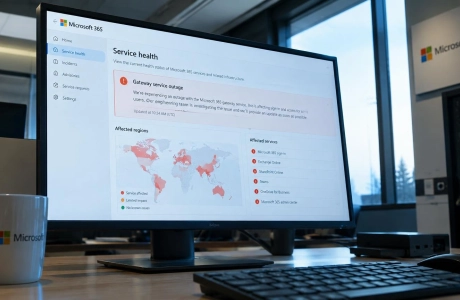
More than 80% of Microsoft 365 gateway servers became unresponsive during the global outage on November 12. Microsoft attributes the failure to a software defect introduced in July that remained latent for more than three months, until an increase in Teams traffic coincided with a reduction in available capacity.
The incident affected services such as Outlook, Exchange Online, and Teams, as well as SharePoint, Microsoft 365 Copilot, and other Office applications. Users had difficulty accessing, reading, or sending email; problems were also reported with some Teams features. The disruption affected organizations and users around the world.
An old defect compounded by two changes in load
In its preliminary report, published in the Microsoft 365 admin center, the company described three concurrent factors: an undetected software bug, increased traffic on the gateways, and reduced server capacity. The failure was in an update created specifically for Microsoft 365 network gateway servers and installed in July.
The update had worked for more than three months without causing visible problems, but it contained a lock contention defect in an internal Windows process. Under certain conditions, this contention exhausted CPU and memory resources until the server stopped responding. Charles Lamanna, Microsoft's executive vice president for Copilot, agents, and platform, summarized the problem on X: “A latent defect caused servers to become overloaded and stop responding under certain load conditions”.
Load testing did not reproduce the problem because, according to Microsoft, it focused on machines with fewer cores and less power than production servers. The company said that contention gets worse on newer hardware with more cores. BleepingComputer quotes this explanation from the preliminary report: “The contention issue worsens on machines with more cores and newer hardware; our load testing tended to focus on weaker hardware with fewer cores.”
The second factor was the automatic rerouting of Teams traffic to the network infrastructure that also serves Exchange Online. This change increased the load on the affected gateways. The Guardian explains that Microsoft usually has two network gateways, but one was not working for Teams, so traffic ended up concentrated on the primary gateway.
The third factor had already reduced available resources: an unrelated issue the previous day took nearly 14% of gateway server capacity out of service. Microsoft said the infrastructure could withstand that capacity loss on its own; it was the combination with increased traffic that triggered the defect. The load peak coincided with a high-traffic period in the United States, according to Lamanna's explanation reported by The Guardian.
The failure spread from server to server
When a gateway stopped responding, systems redirected requests to another server that still appeared to be operational. That server received more traffic, encountered the same defect, and also crashed. In less than two hours, the problem had spread across the fleet: at the lowest point, more than 80% of the affected servers were unresponsive, according to Microsoft.
The mechanisms intended to limit spread between regions also failed to prevent the outage from becoming global. BleepingComputer notes that these safeguards did not contain the cascading failure. The outage was no longer an isolated problem with one gateway and began affecting several services that depended on this shared infrastructure.
The first access issues were reported on Thursday, November 12. The timeline published by The Register and reported by TNW places the initial failure in Teams traffic rerouting at 01:07 UTC on November 12; the first support case arrived at 16:33 UTC. BleepingComputer, meanwhile, places the start of the incident at 11:20 a.m. ET that Thursday and confirmation of full recovery at 11:10 a.m. ET the following day.
The Microsoft incident page maintained by the University of Pennsylvania also lists a separate Teams incident, code TM1550488. It affected messaging features for users accessing services hosted or routed through the North American and South American regions, between 14:45 and 15:53 UTC on November 12. Microsoft attributed that episode to resource contention in the underlying infrastructure; the page does not establish whether it was related to the global outage.
Why email took longer to come back
At first, Microsoft tried restarting the affected servers. But when they came back online, they received the traffic that had built up and became overloaded again. Automatic recovery was not designed to handle a failure on this scale, the company explained, and the usual rollback options could not quickly undo a defect introduced months earlier.
Engineers prepared an update to restore the Windows code to its previous state and applied it in groups of servers. This allowed the infrastructure to be recovered in stages and stability to be validated before proceeding. Teams, OneDrive, SharePoint, and Office applications were able to move off the affected gateways and recover sooner; Exchange Online could not switch to alternative infrastructure for scale reasons, prolonging the Outlook disruption.
“Recovery took longer than usual because, when servers came back online, the waiting traffic immediately overloaded them and they stopped responding again.”
— Charles Lamanna, Microsoft's executive vice president for Copilot, agents, and platform
TNW places the start of the fix deployment at 07:20 UTC on November 13. Microsoft sent its final customer update at 04:15 UTC on November 14. BleepingComputer says the company confirmed the end of the active impact at 11:10 a.m. ET on November 13; PCWorld adds that Microsoft processed the emails that had been queued during the outage.
Impact beyond office applications
Downdetector recorded reports in 74 countries and territories, according to the Associated Press, cited by TNW and PCWorld. The Guardian reported that prisons were unable to release detainees, hospitals resorted to paper records, schools lost contact with families, and police departments could not receive crime reports.
The disruption also raised questions about dependence on shared services. Andrew Garbarino, chair of the House Homeland Security Committee, told Politico that he was seeking more information from Microsoft and CISA, the U.S. cybersecurity and infrastructure security agency. “We need to understand what happened and how to make these systems more resilient,” he said.
In another response, Matt Hull, NCC Group's vice president of cyber intelligence and response, told The Guardian: “This is a clear example of the importance of not only cyber resilience, but also business resilience.” He added that reports about hospitals, schools, and other essential services show how far-reaching a disruption can be, whatever its cause.
Microsoft ruled out a cyberattack or AI agents as the cause of the outage. In its apology on November 13, the company said it had broadly restored services and was continuing to recover the remaining customers and regions. It also explained that it had restored service in stages to check stability at each one.
The final report is expected on November 20
Microsoft said it increased capacity, improved monitoring, and added safeguards to prevent traffic redirection from causing similar cascading failures.
The incident followed another Google Cloud outage in its London region the previous month, which affected services such as Revolut, according to TNW. Microsoft has announced that the final report will include more information about the incident and measures to prevent similar disruptions.
Sources: TNW | Microsoft, BleepingComputer, PCWorld, the Guardian, University of Pennsylvania