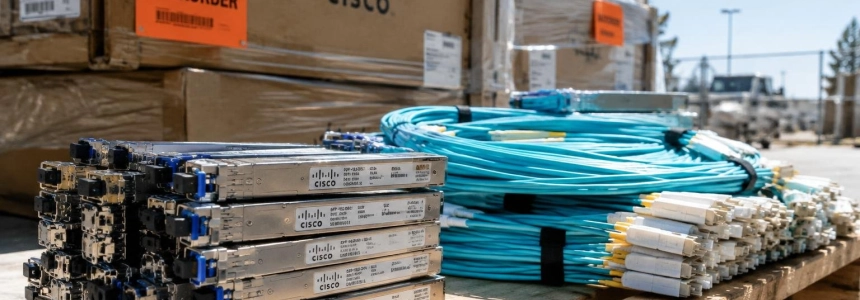
Network operators can expect to wait up to 18 months for optical equipment that used to arrive in about three, while prices have risen around 50% since the start of 2026. RETN attributes the bottleneck to direct competition with artificial intelligence data centers for chips, memory, and other components.
The problem is not just that there is more equipment to buy. AI expansion is shifting investment toward new data centers, and the infrastructure connecting them is competing for resources with telecommunications networks. For operators, businesses, and teams designing facilities, this makes connectivity an early decision about capacity and location, not a task to leave until the end of construction.
AI demand is reaching fiber, too
RETN describes a twofold squeeze: optical equipment prices have risen close to 50% in 2026, and lead times have stretched from three months to 12–15 months under normal conditions. Some orders take 18 months or more, according to the company. The warning, reported by The Register and MuyComputerPRO, is that there is no longer room to quickly resolve an expansion that has been left until the last minute.
Demand for AI memory and chips is part of the picture, but RETN also cites shortages of raw materials and skilled workers, energy constraints, geopolitical tensions, and logistical difficulties. The company adds a factor specific to the sector: some operators postponed network upgrades to cut costs and now have to carry them out when supply is under greater strain.
RETN compares the situation with the supply difficulties of the pandemic, when chip problems prevented suppliers from completing orders. This time, it argues, the pressure comes from demand for AI infrastructure outstripping available supply. The figures describe the sector as a whole; they are not broken down by country and cannot, on their own, determine the impact on any specific operation.
More private fiber, not necessarily more public traffic
The connectivity pattern also matters. RETN says that between 80% and 90% of its AI requests are for private point-to-point links, dark fiber, and dedicated interconnections used to move data between training clusters. Its interpretation is that AI growth is translating primarily into demand for high-capacity private connections, not an equivalent saturation of public internet traffic.
That difference changes what infrastructure is needed. An IP transit service does not automatically replace a dedicated link between facilities exchanging large volumes of data. For operators, pressure on optical routes and specific components is increasing; for those building data centers, it means including connections between clusters and other sites in the initial design.
Manufacturers' results cited by MuyComputerPRO reflect strong demand, although they do not detail the prices or delivery times their customers are facing. Ciena reported revenue of $1.67 billion in its fiscal third quarter, up 37% year over year, and raised its annual forecast to $6.42 billion. Lumentum reported $1.26 billion in its first quarter of fiscal 2027, compared with $533.8 million a year earlier; Coherent reached $2.37 billion, up 50%, and forecast between $2.55 billion and $2.75 billion for the following quarter.
Those figures show activity in the market, but they do not make it possible to attribute the price increases or delivery delays RETN estimates for the sector to any individual manufacturer. The shortage figure remains RETN's estimate, not a breakdown of orders by supplier. There is also no specific figure for Spain: MuyComputerPRO reports that RETN operates a point of presence in Barcelona, opened that year.
A remote site may need years of preparation
The race for land, energy, and cooling is pushing data centers toward locations far from major urban centers. RETN points to interest in the Nordic countries, where land is affordable, the climate is cooler, and renewable energy is available. But a location that is favorable for construction does not necessarily have enough fiber to connect to other data centers or customers.
For this reason, RETN suggests that projects outside established hubs involve network operators two to five years before opening, compared with one or two years previously. Connectivity planning needs to advance alongside energy, computing, and construction plans. If teams wait until the facility is nearly ready, current equipment lead times can turn connectivity into a barrier to opening.
At sites close to cities, developers usually fund the fiber and, according to RETN, this adds only a few percentage points to the project's total cost. At greater distances, the business case becomes more difficult: an operator may be reluctant to build a long-distance route to serve a single remote site. The Register reports that a major cloud provider is considering turning an abandoned factory in Central Europe into a large-scale server facility, despite the area having little fiber.
Redundancy requires physically distinct routes
Demand for resilience is also raising expectations for connectivity. RETN says some customers have moved from requesting two long-distance routes to requiring four or more redundant routes. But simply counting connections is not enough: if they share ducts or paths, a single physical fault can interrupt them all at once.
The cost can be significant. RETN estimates that a diverse circuit can cost €1,800 per month, compared with €600 for a conventional one. The difference pays for a route that avoids shared points of failure, not an abstract guarantee of continuity. Businesses must weigh the recurring cost of diversity against the impact an outage would have on critical services.
There is therefore a specific trade-off in the design: postponing additional routes reduces upfront spending, but can leave the data center dependent on shared infrastructure that is difficult to replace quickly. At the same time, ordering new routes at short notice means competing with other projects in a market where optical equipment and labor are scarce. Redundancy must be defined by physical routes, not just by the number of contracts or providers.
What changes for operators and businesses
For operators, the pressure combines postponed investment with new demand. RETN acknowledges that upgrades delayed to cut costs are now unavoidable, just as AI data centers are requesting private links and optical capacity. Businesses that depend on these networks may be affected by longer expansion schedules, although the specific impact will depend on the site and project.
For data center developers and businesses buying capacity, the practical consequence is to make decisions earlier: confirm routes, capacity, and diversity while the site is still being selected, rather than assuming fiber can be added at the end. RETN recommends treating the network as part of the AI supply chain, with the same level of planning as energy, computing, and space.
The pressure does not mean that every AI application will experience network delays or that the public internet is on the verge of saturation. RETN describes a specific mismatch between the pace of new projects, component availability, and the readiness of private routes, especially far from existing hubs. It remains to be seen how lead times will evolve and which projects will be able to fund new long-distance connections.
“The AI race is often described as a race for compute, chips, power, and data. But it is the networks that bring all of these together.”
— Tony O'Sullivan, CEO of RETN
For projects still choosing a location, the question is not only how much energy they will be able to secure, but whether they can secure a fiber route and optical equipment in time to open.
Sources: theregister, RETN, RETN, MuyComputerPRO