Google Search Profiles is now appearing beyond its announced markets, and now lets users manually add LinkedIn to a claimed profile. Creators and SEO professionals reported access from Spain, Australia, Singapore, the United Arab Emirates and Japan; Google has not officially announced a global rollout.
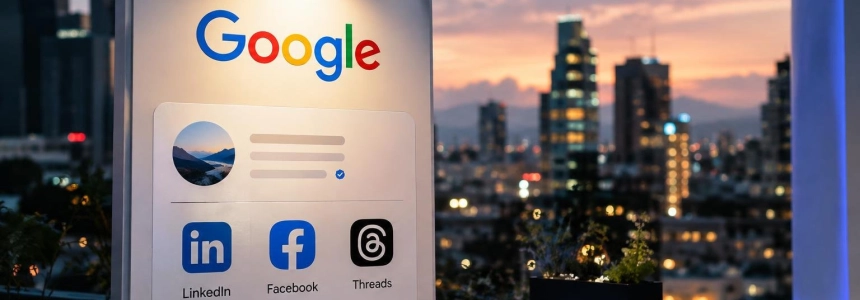
Damien Andell spotted the LinkedIn change and posted on X: «You can now manually add LinkedIn to your search profile if it's already claimed». According to Search Engine Roundtable, Google had already been adding LinkedIn automatically to some profiles, but the new development is that users can now try to add it themselves.
Profiles can be claimed from more countries
On November 22, Search Engine Roundtable reported that users outside the United States, Canada and India could access the page to claim a profile. Clara Soteras said she was able to do so from Spain: «Search Profiles seem to be rolling out to new regions! Today they showed up in Spain. Until now they were only available in the USA and Canada.»
Search Profiles seem to be rolling out to new regions! Today they showed up in Spain. Until now they were only available in the USA and Canada.
— Clara Soteras, SEO
Gagan Ghotra also noted on X that the option appeared in Google accounts configured for Australia, Singapore and Dubai. The Search Post added Japan to the countries where creators had reported being able to claim a profile, citing a Japanese blog that said applications opened in mid-November. These are signs of availability, not an announcement from Google.
Until now, the company had announced availability in the United States, Canada and India. The Search Post notes that Google launched profiles in the United States on June 4, 2026. On October 6, Robby Stein, Vice President of Product for Search, announced on X that they were also available to creators and publishers in Canada and India, and that Brazil would follow. No date has been confirmed for that country.
Official availability remains difficult to determine from Google's pages. The Search Post found on November 22 that the help page for creating a profile no longer listed any countries. However, an archived copy from November 13 and another from October 29 did list Canada, India and the United States. The page for claiming profiles still lists those three countries.
Google's pages don't agree
The main Google for Creators page still mentions the United States, Canada and India and says that expansion to other countries is planned for later in the year. Six country-specific versions of that page—for Japan, Spain, France, Germany, Italy and Australia—still describe availability as limited to the United States. In total, The Search Post compared eight Google pages and found three different answers.
The discrepancy does not make removing the list of countries an official confirmation. But it aligns with reports from users who managed to open the claim page from new regions. Search Engine Roundtable notes that, before these reports, some people outside supported markets resorted to using a VPN to appear to be in one of them.
Anyone who wants to check whether they can access it can visit profile.google.com/claim and sign in with the Google account that manages their creator activity. Google's official help page sets out the same eligibility requirements: be at least 18, comply with Google's content policies and have 10,000 subscribers or followers on at least one supported platform: YouTube, Instagram, X or TikTok.
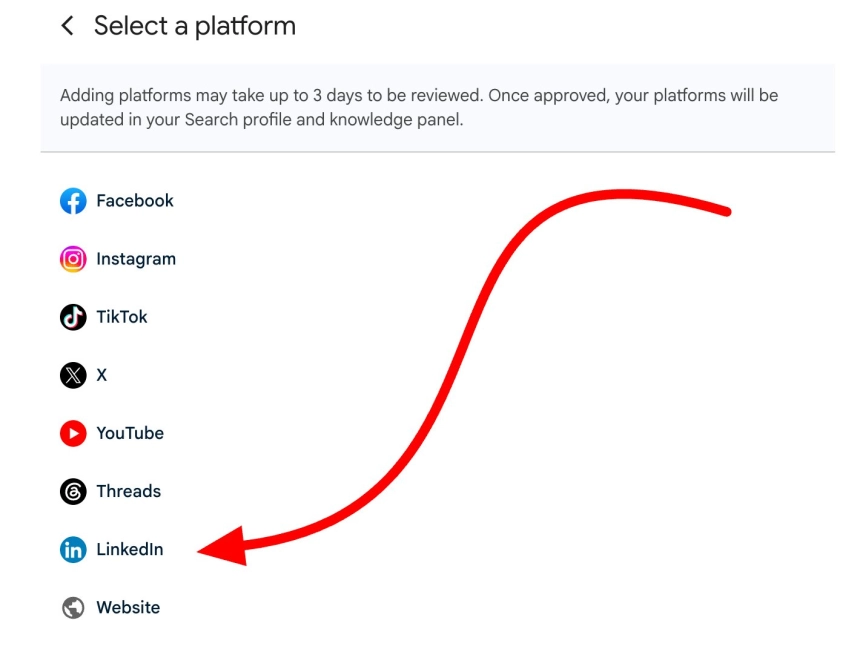
LinkedIn can be added, even though it isn't listed among the supported platforms
Google's help page lists four platforms that count toward the follower threshold: YouTube, Instagram, X and TikTok. Search Engine Roundtable's coverage distinguishes between these supported networks and other options that can be added manually: Facebook, Threads, LinkedIn and a website. Therefore, LinkedIn does not count as one of the four platforms for reaching 10,000 followers.
The profile brings together recent posts, videos and articles from linked platforms, as well as elements such as an image, a bio and links. Google presents it as a space where publishers and creators can bring together their presence across Search and Discover. Users can reach it from a knowledge panel, from the author's name shown in Discover or through a direct link.
When a platform is linked, new content is added automatically. Google says it usually appears in the profile within 24 hours; its profile management help page also warns that it can take 24 to 48 hours, depending on indexing and the platform's API. Changes to the name, bio and social links require Google's review and remain pending until approved.
A profile does not directly change a piece of content's position in search results, according to Google's help page. The company does explain that people who follow a creator from their profile may see more of their posts in Discover. In addition, the profile can show information and links in the knowledge panel and appear as an entry point for viewing the creator's recent posts.
A 10,000-follower threshold and up to ten profiles
Google says an account can manage up to ten Search profiles for different brands or identities. Its help page gives examples such as a personal brand and a podcast; each profile must correspond to a distinct identity. It also allows users to claim a profile for someone under 18, provided they use a Google account owned by an adult.
The current threshold is lower than the one in place at launch. The Search Post says Google lowered it to 10,000 followers on September 16. Third-party reports about the June launch had put the initial requirement at 100,000 followers on YouTube, Instagram or X. Google's current list adds TikTok as an eligible platform and sets the threshold at 10,000 for each of the four.
After signing in to an eligible account, Google may offer an existing profile that has not yet been claimed. The help page recommends reviewing the other linked accounts before claiming it. If the creator has a YouTube channel, it suggests using the same Google account; it also explains that the profile handle is assigned based on the linked account with the most followers, though it can be edited later.
A bug allows arbitrary URLs to be entered
Andell also spotted a possible issue in the source preferences: he found that arbitrary URLs could be added, including a YouTube URL, even though the field should accept a domain. According to his post, the behavior worked with any URL.
Google's official profile management page does allow users to request content platforms via a link, but clarifies that new additions require approval. It also distinguishes web links from platform content: the former can appear in the profile, but the posts shown come from linked platforms, not web links. Google may reject an account that is not relevant to the brand, even if the user manages to authenticate it.
The profile feature was introduced in June for publishers and creators with a sizable audience. Google explained at the time that claiming one could create a knowledge panel for eligible profiles or update an existing one with an image, recent content and a direct link. The company said it was starting in the United States and would consider expanding to more countries and adding features.
For now, the international expansion is based on user reports of being able to claim profiles and the removal of a country list from a help page. Google has not confirmed whether this is a full global rollout or a broader test. The claim page will show whether access is enabled for each account and region.
Sources: Search Engine Roundtable, Search Engine Roundtable, The Search Post, Google Search Help, Google Search Help, Google