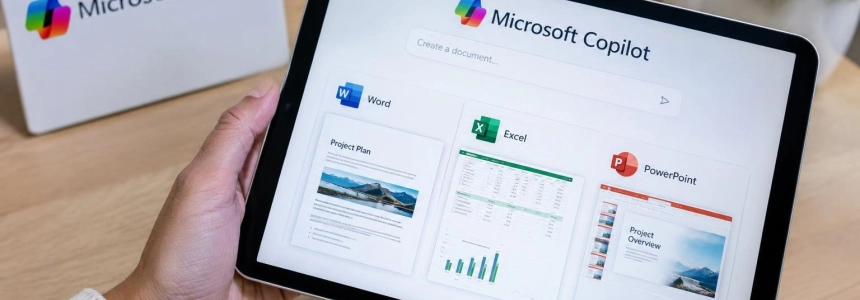
Word, Excel, and PowerPoint are now available within Copilot: users can create documents, spreadsheets, and presentations from the assistant and continue editing them in the Office applications. Satya Nadella introduced the change at Ignite 2026 as a shift in how people work with Microsoft tools: instead of starting with an application, the starting point will be Copilot.
The change reverses the approach Microsoft had promoted until now. Copilot was added to Word or Excel as an assistant for working within each program; with the proposal announced at Ignite, agents can organize work and open the applications they need, drawing on the context of company emails, meetings, calendars, chats, and files.
“This is the only AI-powered instrument that lets you create PowerPoint presentations or Excel spreadsheets without consuming credits: all that value is already included in your Copilot subscription license.”
— Jared Spataro, chief marketing officer
Copilot shifts from assistant to workspace
Office integration makes it possible to go from an idea to a finished file in Copilot, then refine it in Word, Excel, or PowerPoint. Microsoft says files retain Microsoft 365 permissions, sensitivity labels, and the compliance controls associated with the organization from the outset.
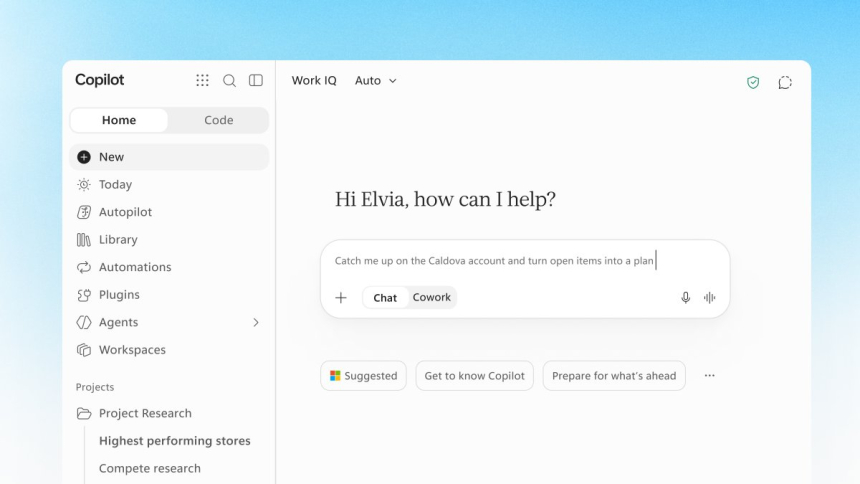
The company is also presenting Home as the new entry point to Copilot. Chat and Cowork are available there: the former is for queries, while the latter is for delegating more complex workflows. A single input box, powered by Auto, decides which models and level of effort to use; employees can also manually choose OpenAI or Anthropic models, subject to their organization’s policies.
Within Home, the Today experience brings together email, calendars, conversations, and Teams meetings, as well as tasks. It can surface pending items and prepare drafts, schedule changes, or follow-ups for users to review. Today remains in private preview in the Copilot app and Outlook, so it is not part of the general availability of Office in Copilot.
Microsoft says work context is central to this strategy. Work IQ analyzes business information and relationships between people to help agents understand what is relevant to a task. The Microsoft IQ platform, which includes Work IQ, was announced as generally available; companies decide which data agents can access.
Microsoft puts the volume this context must manage at more than 19.5 exabytes of Microsoft 365 data. The company also says that 90 billion emails, 15 billion Teams messages, and 10 billion new files are added each week. Its argument is that granting access to this data is not enough: the system must identify what matters for each assignment.
Autopilot works across email, meetings, and documents
The most ambitious new feature alongside Office is Copilot Autopilot, a persistent agent that runs in the cloud and can be given ongoing responsibilities. Microsoft says it will be able to monitor Teams channels, follow up on emails, perform recurring tasks, and manage projects, even without waiting for the user to message it each time.
The agent can appear where the team already works—such as Teams, Outlook, chats, channels, and documents—and be mentioned like a colleague. Microsoft gives the example of organizing a vendor review: Autopilot could prepare the schedule and work plan, coordinate meetings and follow-ups, and request updates from the people involved.
Autopilot is beginning to roll out to Frontier customers, Microsoft’s early-access program. It will be billed based on usage through Copilot credits, but the company has not yet announced final pricing for general availability. The company describes a hybrid model: a per-user subscription for included capabilities and usage-based billing for tasks that require more resources.
The rollout schedule also varies by feature: Microsoft says Autopilot is beginning to reach Frontier, while Word, Excel, and PowerPoint within Copilot are already generally available. Copilot Workspaces, a space for people and agents to collaborate on a shared goal, is available in Frontier. Microsoft expects users will eventually be able to bring their Autopilot agents there.
Agents have their own identities and boundaries
Nadella acknowledged that understanding how models work internally and getting them to behave in line with human goals remains difficult. Microsoft’s proposed response is to separate AI capabilities from the permissions it receives: each Autopilot will have its own identity and owner, and administrators will be able to limit its access or block it.
According to Microsoft, each agent will have a Microsoft Entra Agent ID. Its access and actions will be logged under its own name so security teams can review them; it will also be able to ask the user before taking certain actions. Access will be governed by the organization’s existing permissions and the rules set by the IT department.
The company is also expanding Agent 365, its platform for monitoring and managing agents. Announced features include identity and access management, controls for tools such as MCP servers, plugins, and skills, and visibility into agents across multiple platforms and tenants. Microsoft is adding tools to review spending and relate it to the work performed.
Agent 365 Business Analytics, which is beginning to roll out in Frontier Public, aims to measure value based on work completed, not just tokens consumed. The tool analyzes tasks, how long they would normally take a person, and the portion completed by Cowork. Agent 365 Cost Management gives IT a view of usage by users, services, agents, and models, along with policies, limits, and alerts.
More integrations for business teams
Microsoft is expanding Copilot with plugins and skills for business functions. In Dynamics 365, it announced updated plugins for Sales, Service, and Finance and Operations, with more than 100 predefined skills for activities such as preparing account plans, sales presentations, customer meetings, vendor management, and account reconciliation.
For sales, the company describes features for prioritizing opportunities, preparing for meetings, and following up, along with 44 skills for repeatable tasks such as researching prospective customers. In customer service, 13 skills can help classify cases, gather background information, draft responses, and prepare escalations; case updates remain pending review before they are confirmed.
It also announced a Salesforce plugin with more than 38 sales skills, bringing account, opportunity, and pipeline context into the tools employees already use. In finance, Microsoft proposes using Excel and ERP systems from Copilot, with 30 skills to analyze and edit workbooks or delegate multistep tasks to Cowork. For legal work, it announced more than 20 skills focused on drafting and negotiating agreements, tracking obligations, and turning research into guidance.
The initiative extends to collaboration between employees and agents. Workspaces lets users share context to move a project forward, review drafts, and assign tasks. Microsoft presents it as an evolution of Copilot Notebooks and says collaboration can also continue in Microsoft Teams.
Microsoft’s case: control and measurable value
In its presentation, Microsoft positioned these features within a broader strategy to turn Copilot into a work environment, not just a chatbot people consult from time to time. The company says nearly 80% of Fortune 500 companies use Cowork. As an example, it said more than 5,000 Lilly employees use Copilot Cowork each month for multistep research and analysis tasks.
Microsoft’s blog also cites Bayer, Honda, Mastercard, and Michelin as companies using Copilot. BNY, for its part, explained that integrating account, service, and customer information allows its teams to coordinate without switching applications. These are examples presented by Microsoft and its customers; comparable productivity metrics for each organization are not provided.
Microsoft says corporate spending on AI doubled in one year and that more than 80% of it is outside enterprise IT budgets. To address this situation, it proposes usage controls and measurement that links usage to completed tasks. The company itself acknowledges that deploying agents raises a practical question for businesses: who can do what, and how is the cost controlled?
At the close of his keynote, Nadella also referred to the previous week’s global outage, which affected access to Exchange Online and Teams. He acknowledged that more work remains to be done and linked the incident to dependence on digital services. Microsoft wants Copilot to be the gateway to work; for now, Office is already available there, while Autopilot and other capabilities are rolling out in stages.
Sources: DDay.it, Digital Trends, Microsoft Copilot Blog, Source, TechRadar