Spotify now lets all its artists review what music appears under their name with Artist Profile Protection, a feature that exited its testing phase on November 17 after eight months of work with thousands of musicians. The control addresses incorrect attributions caused by impersonation, metadata errors or shared names; it does not detect whether a recording was generated with artificial intelligence.
The company announced the feature on November 17, 2026, after testing it for eight months with selected artists. Spotify says it worked with thousands of musicians to fine-tune the system and ensure that protecting a profile does not interfere with release schedules. The general rollout does not change the basic principle: the tool controls attribution on the profile; it does not analyze the audio or prevent the track from remaining available elsewhere.
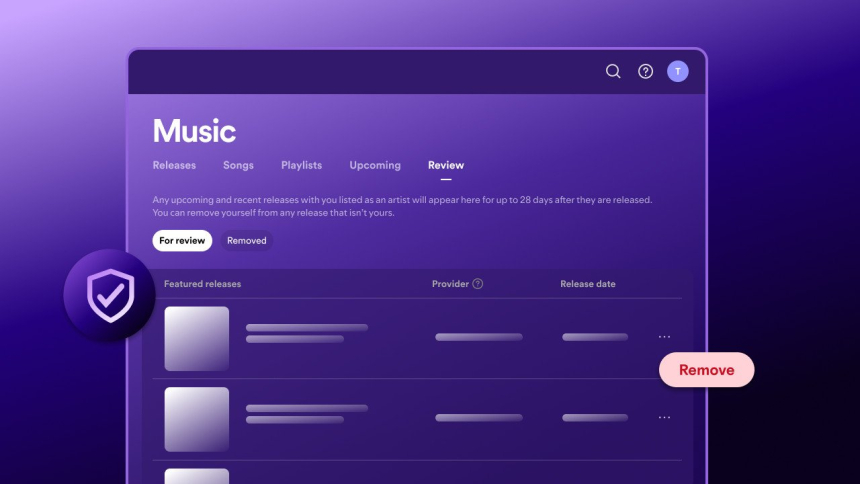
Artist Profile Protection is managed through Spotify for Artists and notifies the team when music associated with the artist's name is delivered. If the release does not belong to them, they can remove their association before it appears on the profile. In the default setting, called “Review releases,” the alert does not pause publication: if no one intervenes, the track is released as scheduled and added to the artist's statistics and recommendations.
“Artists should never have to go and find someone else’s music under their name.”
— Sam Duboff, Spotify’s global head of marketing and policy
Two modes: review or block
The standard mode, “Review releases,” lets the release proceed unless the artist removes their association with it. The team can act before the release date or during the 28 days after publication. If the association is removed in time, the release no longer appears on that profile and does not count toward the artist's statistics or recommendations to their listeners.
The alternative, “Block releases,” holds the release until the artist approves it. Spotify says approval can take up to 24 hours. The option is still being tested with a limited group, and the company considers it especially suitable for musicians with common names or who frequently experience incorrect attributions. If the artist does not approve a legitimate release in time, it may be delayed or not come out as scheduled.
| Mode | What happens to the release | Availability and timelines |
|---|---|---|
| Review releases | It is published on schedule if the artist does not remove their association with it. | It is the default setting; action can be taken up to 28 days after release. |
| Block releases | Approval is required for it to appear with the artist associated. | Available to a limited group; approval can take up to 24 hours. |
Administrators and editors on the artist's team can activate and manage protection. Spotify explains that it can be set up from the artist settings menu in the desktop version or from the music tab in the mobile app. To review releases, the company's help page gives the path “Music > Review” on desktop or in the app; there, users can find releases awaiting review and those that have already been removed.
Protection does not remove the song from other platforms
Removing the name only changes what happens on Spotify: the release may continue to show the artist on other streaming services. The company advises musicians to contact their label or distributor if necessary. In addition, some deliveries from certain providers cannot be reviewed or removed using this tool, and artist keys do not work with all of them.
Artists who use blocking can give an artist key to trusted distributors. That key allows their legitimate deliveries to reach the protected profile pre-approved, without going through manual approval. Spotify warns that it should not be published or shared with untrusted distributors; if an unauthorized person obtains it, the artist should request a new one.
The tool also accounts for credits other than that of the primary artist: deliveries can associate someone as a featured artist, remixer, composer, orchestra or conductor in classical music, or actor. For featured artists and remixers, Spotify says they must approve the delivery to appear linked to it; without that approval, it may be published without their name. If the primary artist has enabled blocking, they must approve the release for it to be published on Spotify with the associated artists.
A response to errors and impersonation
Spotify describes the problem as a consequence of music being distributed simultaneously to numerous digital services and stores. Open distribution channels have made it easier for independent artists to release their work, collaborate and switch distributors, but they also leave room for errors and abuse. A shared name or incorrect metadata can send a track to the wrong profile; someone may also deliberately attach their music to another person's profile.
The company maintains that these mix-ups can affect catalogs, statistics, Release Radar and how followers discover music. In its announcement, it says protecting artists' identities is one of its priorities for 2026 and that the ability to review releases responds to a recurring request from musicians over the past year. The feature is optional, but has been open to everyone since November 17.
The expansion comes amid growing discussion about AI-generated music and impersonation. Digital Trends notes that Spotify banned unauthorized AI voice impersonation in September 2025, announced it would support DDEX AI credits and said it had removed more than 75 million spam tracks during the previous year. These are distinct measures: credits describe information about a work; profile protection lets artists manage which releases are associated with them.
There have also been cases that brought the problem into focus. The BBC reported that an AI-made song appeared on the verified profile of Blaze Foley, who died in 1989. The Guardian reported that The Velvet Sundown, an AI project, had surpassed one million Spotify streams before its nature was revealed. Neither example makes the new feature a detector: its purpose is to let artists challenge an attribution on their page.
More music, more pressure on platforms
TechCrunch reported that Billboard had said the previous month that Sony Music had requested the removal of more than 260,000 deepfake songs from digital platforms, nearly double the figure the record label had reported in March. Deezer, for its part, said AI-generated tracks accounted for 44% of its daily uploads, according to Digital Trends. These figures describe the industry context, not the number of fake releases detected by Spotify's tool.
Other services have also adopted measures, though of different kinds. Digital Trends notes that YouTube Music began making it easier to identify AI tracks and that Australian charts banned AI-generated songs. On Spotify, the company presents Artist Profile Protection as a solution to the mismatch between content and profile; Sam Duboff told TechCrunch he hopes it will set a new standard for streaming platforms.
The practical impact now depends on which mode each artist enables and whether they review their notifications: in the default mode, ignoring an alert does not stop publication. Blocking offers a safeguard in advance, but is not yet available to everyone and can delay legitimate releases. And although removing an association keeps a track from appearing on an artist's Spotify profile, it does not resolve its attribution on other services.
Sources: Digital Trends, WWWhat's new, TechCrunch, Spotify for Artists, Spotify