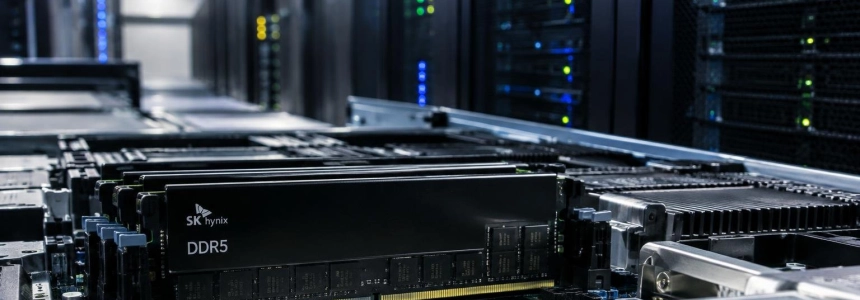
Conventional DRAM contract prices could stop rising in the second half of 2027 and fall during 2028, according to TrendForce’s base-case scenario. The forecast depends on server growth moderating and production continuing to increase; it does not specify when memory purchased by consumers will become cheaper.
The distinction matters: TrendForce is discussing conventional DRAM contract prices, not retail prices for memory modules, laptops, or prebuilt PCs. Its projections also exclude HBM memory, according to Hardware Busters. A potential decline in contract prices would be a signal for the rest of the supply chain, but it does not mean immediate discounts in stores.
Two scenarios, two timelines
TrendForce presents a base-case forecast and a more pessimistic one. In the first, contract price increases narrow progressively throughout 2027, prices could stabilize in the second half of the year, and declines would begin in 2028. In the second, a downward revision to demand would lead server manufacturers to cut purchases; prices would start falling as early as the fourth quarter of 2027.
| Scenario | Conventional DRAM prices | Stated condition |
|---|---|---|
| Base case | Stabilize in the second half of 2027; decline from the first quarter of 2028. | Server shipment growth moderates and supply increases. |
| Pessimistic | Start falling in the fourth quarter of 2027; declines deepen in 2028. | Server manufacturers cut purchases further and inventories are liquidated. |
The difference is not just a matter of timing. In the base-case scenario, normalization comes after months of increasingly smaller price increases. In the pessimistic scenario, server manufacturers would cut their purchases further, and inventory reductions would occur across the supply chain. TrendForce does not assign probabilities to the two scenarios in its announcement.
Demand is starting to set limits
The forecast is based primarily on signs that purchases are cooling. TrendForce says consumer electronics manufacturers are finding it difficult to pass on further price increases to their products and have little room to absorb them. If that pressure reduces sales, it also limits how much they can pay for memory without affecting demand for their devices.
In China, cloud service providers (CSPs) began reducing their orders for server DRAM at the start of the fourth quarter of 2026. TrendForce says North American CSPs have largely absorbed the available supply. That shift cushions the initial impact, but it does not guarantee that total demand will continue growing at the same pace.
There are also questions about the pace of data center construction in the United States. TrendForce notes that the outcome of the midterm elections could encourage a more cautious stance toward these projects, and that power supply constraints could affect construction planned for 2028. The consultancy presents these factors as risks to future demand, not as projects that have already been canceled.
Another factor is a possible change in Nvidia’s financing for neocloud providers, companies that offer cloud computing capacity. If that support were reduced, server purchases could cool indirectly, along with the associated demand for DRAM. TrendForce also mentions the possibility of reduced investment and consolidation among these providers in its pessimistic scenario.
More capacity, less certain orders
On the supply side, TrendForce expects global DRAM bit supply to grow sharply between 2026 and 2028. The expansion would be driven both by new production capacity and by the transition to more advanced manufacturing processes. If server orders slow while production increases, the imbalance that has been supporting prices could ease.
Trade restrictions add uncertainty to that equation. TrendForce cites new rules from the U.S. Bureau of Industry and Security (BIS), the agency responsible for export controls, that limit access to advanced AI chips for data centers providing substantial computing resources to Chinese companies. Foundries also need BIS approval to manufacture advanced-node chips for Chinese designers.
The consultancy believes these measures could weigh on DRAM demand growth in Asia. In its most adverse scenario, stricter export controls and a contraction in neocloud investment would add to cuts in server purchases. There is no estimate of how much each factor would reduce demand, so they cannot be translated into a percentage decline in prices.
Capacity expansion also has a downside for manufacturers: if new production lines come online after customers have already cut their orders, the additional supply could accelerate the adjustment. TrendForce does not present factory expansion as a guarantee of low prices; it considers it alongside demand that, in its view, is becoming increasingly difficult to predict.
A forecast at odds with manufacturers’ message
TrendForce lays out a shorter timeline than the warnings attributed to memory manufacturers. Profesional Review reports that SK hynix executives have put the shortage through 2030, while Micron’s CEO has warned that it will worsen during 2027 and 2028. Tom’s Hardware summarizes those outlooks as pointing to tight supply that could last until 2029 or 2030. This is no minor disagreement: the market is debating whether relief will arrive in a few years or whether tight supply will persist almost until the end of the decade.
Acer Chairman and CEO Jason Chen had taken a position similar to TrendForce’s in urging caution about claims of a shortage:
“memory manufacturers are just exaggerating the shortage to protect their margins.”
— Jason Chen, Chairman and CEO of Acer
Chen’s statement is an opinion, not a conclusion proven by TrendForce’s forecasts. The consultancy bases its scenarios on changes in purchasing, production plans, and risks to data centers; it does not claim that manufacturers have coordinated a shortage or that price manipulation is taking place.
What this means for memory buyers
For PC manufacturers and companies buying servers, a potential change in the trend affects cost and inventory planning. If the base-case scenario plays out, pressure on contracts would stop increasing during 2027, but declines would come later. If the pessimistic scenario materializes, the reversal would come sooner and be accompanied by broader cuts to purchases and inventories.
For anyone waiting to upgrade their RAM, the signal is less direct. Profesional Review notes that it is still unclear when the cost of consumer DDR5 kits will fall. Hardware Busters adds that contract price cuts can take months to reach modules and systems. Therefore, TrendForce’s timeline does not make it possible to say for certain that a particular kit will be cheaper by a specific date.
The most cautious interpretation is that 2027 could mark the peak, not the discount. TrendForce’s first forecast decline applies to contracts and, in the base-case scenario, is expected in 2028; retail prices will depend on how that change filters through the supply chain. The open question is whether data center orders will cool soon enough to bring the reversal forward to the final quarter of 2027.
Sources: Profesional Review, Tom's Hardware, TrendForce, Hardware Busters