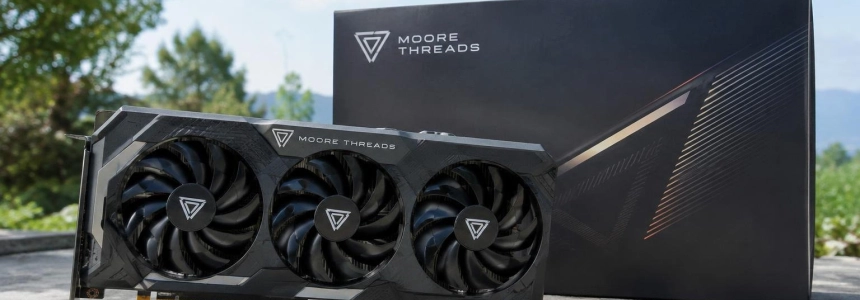
Lushan could reach 64 GB of VRAM, twice the memory of the GeForce RTX 5090, but Moore Threads has yet to confirm that figure. The Chinese company is preparing this desktop graphics card for gaming and local execution of artificial intelligence models, and plans to unveil it on December 29.
The unveiling is scheduled for the MUSA Developer Conference 2026. Wccftech traces the announcement to a November 18 post from Moore Threads MTT S80, shared by its product lead, AIR_FORCE. Tom’s Hardware also links the card to a conference poster showing a graphics card covered by a cloth and the name Lushan.
Where the 64 GB figure comes from
The figure has not been presented as a finalized official specification. Moore Threads had promised that its next GPU would offer four times the memory of the MTT S80, which has 16 GB. Multiplying that capacity by four gives 64 GB; Tom’s Hardware presents this amount as a possible high-end configuration, while TechPowerUp cautions that it remains an inference.
The company has described the product as a card with the largest video memory capacity in a consumer GPU. That wording points to surpassing the GeForce RTX 5090’s 32 GB, but does not, by itself, specify an exact amount. For now, 64 GB is the most straightforward interpretation of the earlier promise, not a figure confirmed by Moore Threads.
| GPU | Stated memory | Status of figure |
|---|---|---|
| Moore Threads MTT S80 | 16 GB | Capacity cited as a basis for comparison |
| NVIDIA GeForce RTX 5090 | 32 GB | Current reference cited by Tom’s Hardware |
| Moore Threads Lushan | Up to 64 GB, according to the estimate | Not confirmed by Moore Threads |
The three figures do not have the same degree of certainty: the MTT S80’s 16 GB and the RTX 5090’s 32 GB serve as reference points, but Lushan’s capacity remains unconfirmed. December 29 is the announced date for learning more about the card.
Gaming and local AI models
Moore Threads is positioning Lushan for PC gaming and local AI computing. Wccftech notes that the card could also appeal to people who run language models locally, a task that can consume a considerable portion of the GPU’s available memory.
As an example, Wccftech cites Qwen3.8-27B: according to the outlet, its 8-bit quantized versions require between 27 and 30 GB of video memory. Therefore, 64 GB of capacity—if confirmed—could leave more room for larger models or other parts of the workload. Memory alone, however, does not describe overall performance: Wccftech also points to bandwidth as a factor in processing instructions and generating tokens.
In gaming, extra capacity does not automatically translate into greater speed. Wccftech observes that memory usage rises especially when increasing resolution to 8K, and adds that even an RTX 5090 needs extreme upscaling to reach playable frame rates at that resolution. The proposal combines two distinct uses: gaming and having enough memory for local inference.
More than just a memory upgrade
Moore Threads’ preview is not limited to capacity. According to Wccftech’s translation of the promotional message, the company is announcing a 64-fold improvement in AI computing performance, as well as a new rendering architecture called UNITE and a next-generation hardware ray tracing engine.
The same message mentions support for AI-powered generative rendering technology. Moore Threads has not provided benchmark results, comparison conditions, or gaming performance figures in that preview.
The MTT S80 and MTT S90 are the previous desktop models used for comparison. Wccftech says the MTT S90 outperformed the GeForce RTX 4060 in a series of tests following driver optimizations, and that those optimizations enabled the MTT S80 to double its graphics performance a year after its launch. This background provides context for the new promises, but cannot, on its own, predict how Lushan will perform.
What remains to be verified
The card is being presented as a product for the consumer market, but its exact memory capacity remains unconfirmed: Moore Threads has not specified the figure. Wccftech suggests that the capacity could exceed that of the RTX 5090; Tom’s Hardware estimates it could reach 64 GB based on the promise to quadruple the MTT S80’s 16 GB.
The architecture and AI computing figures also need a specific comparison before they can be evaluated against other cards. Moore Threads has announced a 64-fold improvement in AI computing, but the preview does not specify the basis for that comparison. Lushan will be unveiled on December 29 at the MUSA Developer Conference 2026.
Sources: TechPowerUp, Wccftech, Tom's Hardware