Samsung Electronics has nearly committed most of its memory capacity for 2027-2029, and some customers are seeking contracts that guarantee supply through 2031. The pressure stems from the boom in artificial intelligence infrastructure, which consumes memory for accelerators and data centers and is pushing companies across several sectors to reserve production years in advance.
Information about commitments through 2029 comes from industry sources cited by Economy Tribune. Customers are requesting additional volumes beyond those already agreed and, in some cases, are exploring extending the contract terms. Samsung has not announced that all of its production has been sold: the published description is that most of its capacity is secured through agreements.
Long-term contracts to secure capacity
Samsung confirmed at its third-quarter 2026 earnings presentation that it had signed long-term supply agreements with 10 major customers and was negotiating with another 10. Its stated goal is to allocate between 60% and 70% of its memory production capacity to multi-year contracts before 2030. According to the company, this model provides greater revenue visibility and secures supply for key partners.
The company is already close to that target: Samsung Electronics said at its earnings conference that it was moving toward allocating 60%-70% of its total capacity to long-term contracts by 2030. In its official earnings announcement, the company also linked its strategy to a more stable sales base and the timely preparation of new products for AI applications.
The negotiations could include upfront payments and pricing mechanisms agreed between supplier and buyer. Economy Tribune reports that both parties are keeping open the option of contracts with upper and lower price limits; Samsung explained that the agreements already signed include a price floor. No specific terms or the identities of customers seeking supply through 2031 have been disclosed.
“Expanding LTAs will greatly help establish a stable, contract-based business model.”
— Samsung Electronics, during its earnings conference
Demand for these agreements is no longer limited to AI companies. Korea JoongAng Daily reported in early November that it is also spreading to companies in the mobile, automotive, and networking sectors. Under these contracts, suppliers and customers set the period, volumes, pricing mechanisms, and deposits in advance, according to the outlet.
HBM and DRAM compete for manufacturing resources
The shortage affects not only high-bandwidth memory (HBM), which is used in AI accelerators and data centers. Samsung had already confirmed that its entire HBM supply for 2027 was sold out; Economy Tribune adds that conventional DRAM wafer capacity for that year was also reportedly almost entirely sold out.
Manufacturing HBM requires a considerable amount of DRAM wafer production capacity. As a result, when manufacturers increase the proportion of HBM, there is less room to rapidly increase conventional DRAM production. This effect persists even as companies expand investment: manufacturing these complex products and the time needed to bring new facilities online delay the arrival of additional capacity.
Industry sources cited by Economy Tribune estimate that major manufacturers are meeting only between 60% and 70% of current demand, and expect the supply shortage to worsen in 2027. For DRAM, the annual growth rate in bit supply would be limited to a maximum of 20%-25%, according to the same outlet.
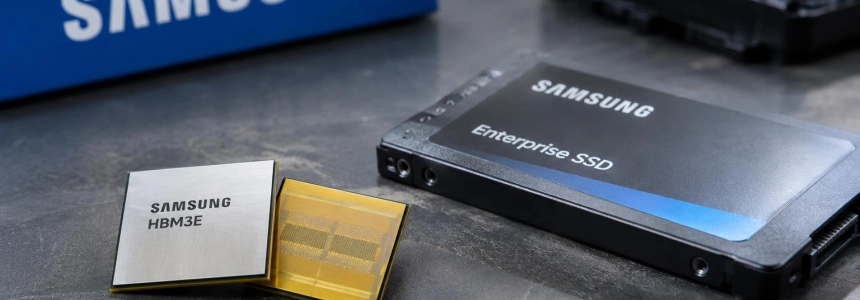
The squeeze is also affecting enterprise NAND and SSDs for data centers. An industry representative cited by Economy Tribune said inquiries about NAND had increased and demand was growing in the contract market, even though the spot market was behaving differently. Japan's Kioxia, which specializes in NAND memory, reportedly raised its demand forecast for 2027, according to the same source.
The difference between segments is pronounced: Economy Tribune puts coverage of consumer NAND demand at 70%, while that of enterprise SSDs exceeds 50%. The figures show that the product and customer type matter: capacity is not equally available across all memory categories.
Samsung expects even greater AI demand in 2027
In its official third-quarter results, Samsung said memory demand had driven record quarterly revenue and profit for its memory business despite capacity constraints. The Device Solutions division recorded revenue of 147.1 trillion won and operating profit of 106.5 trillion won. The company highlighted the importance of AI products and increased sales of HBM4 and server SSDs.
Samsung expects investment in AI infrastructure to reach an all-time high in 2027 and AI-driven demand growth to far outpace industry supply growth compared with 2026. To respond, it plans to strengthen sales of HBM, server DRAM, and SSDs, as well as increase the supply of high-speed DDR5 for servers and QLC SSDs.
The company also expects competition for AI leadership to sustain infrastructure investment in the fourth quarter of 2026. It forecasts that memory demand will be supported by new products linked to CPU and GPU platforms, as well as QLC SSDs associated with the expansion of personal AI agent services.
Investment will not open the floodgates immediately
Samsung warned that higher capital expenditure does not immediately translate into higher production. Building factories and acquiring equipment takes time; in addition, the manufacturing stages for next-generation HBM constrain how much supply can grow. On an earnings call, the company said capital expenditure would increase significantly in 2027, but that several factors would prevent this spending from raising bit production by a corresponding amount in 2028.
In the third quarter, Samsung spent 29 trillion won on capital investment, including 27.2 trillion won for its Device Solutions division. The total for January through September reached 56.9 trillion won, and the company estimated that full-year 2026 spending would be around 84.4 trillion won. It said it would direct investment toward new factories and infrastructure to meet demand for AI and high-performance computing.
The outlook for NAND, however, is not uniform. Wccftech cites a recent TrendForce forecast pointing to a possible decline in NAND contract prices starting in the first quarter of 2027, due to lower enterprise SSD orders from Chinese cloud providers and increased production. That expectation contrasts with the enterprise NAND shortage described by Economy Tribune and does not imply the same trend for HBM or DRAM.
The outlook also includes the risk that supply will increase later: Korea JoongAng Daily noted that new factories could significantly boost DRAM supply around 2028, according to market research firms such as TrendForce. Samsung, for its part, said supply and demand would likely remain tight even in 2028, due to construction and equipment lead times and the complexity of HBM. Contracts through 2031 are still under negotiation; for now, the concrete fact is that most of Samsung's capacity for 2027-2029 has already been reserved.
Sources: Computer Hoy, Wccftech, 이코노미트리뷴, koreajoongangdaily, Samsung Global Newsroom, Samsung global