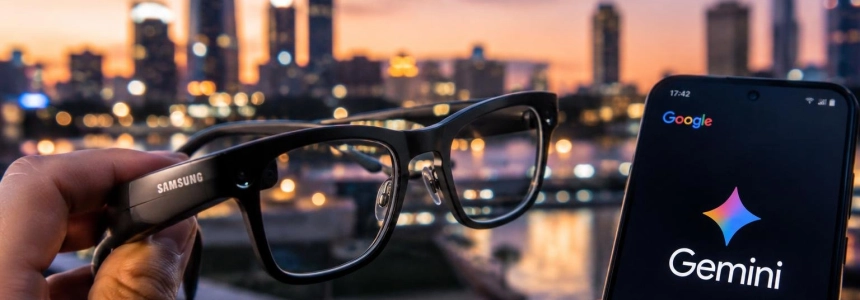
Samsung and Google’s Intelligent Eyewear will arrive on December 10, 2026, with prices starting at $395 for Warby Parker designs. Gentle Monster models will start at $449, according to Hipertextual; the offering combines Gemini, Android XR, and frames created with both eyewear brands.
The project brings together Samsung, Google, and two eyewear brands: South Korea’s Gentle Monster and U.S.-based Warby Parker. Samsung contributes its mobile hardware expertise, while Google provides its Android XR platform and Gemini. The companies offered a first look at the device at Google I/O 2026 in May, and Samsung showed it again in July during Galaxy Unpacked.
The timeline has taken shape in several stages. In May, Google said the audio glasses would arrive «later this fall» and that display glasses were also in development. In July, Samsung was still describing the launch as planned for the fall and had not announced prices. Yonhap reported on November 9 that preorders would begin that week and that the official launch was expected in December; Hipertextual now puts availability at December 10.
Two brands, two frame styles
Google previewed two collections with distinct design approaches. Gentle Monster will offer more striking frames, while Warby Parker will focus on classic styles. Hipertextual reports that the Gentle Monster collection will include six models in different colors, with clear, photochromic, or tinted lenses. The Warby Parker designs draw inspiration from popular models by the brand.
In its July preview, the TechRadar journalist described square, round, and cat-eye frames in amber, green, and black, with clear or photochromic lenses. They also noted that the arms were somewhat thicker than those of conventional glasses.
The offering includes two types of glasses: audio glasses, which provide spoken assistance, and display glasses, which can show information. Google said in May that the audio glasses would arrive first. For now, the date and prices reported by Hipertextual refer to the availability of Intelligent Eyewear, without a breakdown by device type.
| Brand | Design or collection | Starting price |
|---|---|---|
| Warby Parker | Classic styles | $395 |
| Gentle Monster | Six models, with different lens options | $449 |
Gemini offers help without taking out your phone
The glasses are designed as an accessory for your phone, not a replacement. Google explained that they pair with both Android phones and iPhones; Samsung highlighted integration with the Galaxy ecosystem. Gemini can be accessed by voice or with a tap on the arm. Google said in May that users could simply say «Hey Google» or tap the side of the frame; Hipertextual, however, mentions «Hey Gemini» as the wake phrase.
Among the uses described by Google are asking about what the user sees, checking reviews for a nearby restaurant, and deciphering parking signs. The glasses can provide turn-by-turn directions based on the user’s location and the direction they are facing. Gemini can also add stops to a route or suggest restaurants based on the user’s preferences.
Assistance includes voice and text translation: translated audio can preserve the speaker’s tone and voice, while menu and sign text can be translated by looking at it. Hipertextual puts the number of languages available for real-time translation at more than 70. Google also described message summaries, call management, and sending texts without touching the phone.
Google also shared examples of connected tasks and apps. Gemini can prepare a coffee order in DoorDash, with the user responsible for the final confirmation. The glasses can also use phone apps to order a ride with Uber or practice languages with Mondly.
For image capture, the device can take photos and videos using a button or a voice command. Google mentioned editing with Nano Banana, including removing distracting elements from the background. Hipertextual attributes a 12-megapixel ultra-wide-angle camera, image stabilization, HDR processing, and spatial audio recording to the glasses. It also cites open-ear speakers and playback from Spotify, YouTube Music, Apple Music, and Audible audiobooks.
Battery life, privacy, and design limitations
According to Hipertextual, the glasses weigh around 41 grams and last up to nine hours on a charge. The case can recharge them up to seven times. The same publication says the camera and microphones can be completely turned off so the device can be used as ordinary glasses. This option is complemented by a front-facing indicator light: in July, TechRadar observed an LED next to the camera to indicate when photos or videos are being taken.
TechRadar also identified stereo speakers, microphone openings, and a metal switch on one of the arms. The outlet was able to examine the frames, but Samsung did not allow the journalist to try them on or use them. The publication also reported that the Bixby assistant will coexist with Gemini, attributing tasks such as controlling volume or accessing phone apps to Bixby.
Privacy was one of the issues raised during that presentation. James Choi, executive vice president and head of Samsung’s XR R&D team, said public acceptance takes time and noted that concerns can vary across societies. He also explained that the arms contain technology and sensors, which limits how much they can be adjusted like those of ordinary glasses.
“If, because of that, we stop innovation, we don’t go anywhere.”
— James Choi, head of Samsung’s XR R&D team
Choi explained that AI processing still requires keeping the phone in the equation: the glasses are not intended to replace it. Samsung wants to shift some of the intensive AI use that currently falls to the phone onto this accessory. Regarding the display version, he said the company is working on technology it considers superior to what is available on the market, while acknowledging the challenges of maintaining a discreet form factor and adequate battery life for everyday use.
Yonhap described the launch as an attempt by Samsung and Google to expand their presence in the AI glasses market, where Meta dominates. The agency cited industry data according to which Meta accounts for more than 80% of global shipments of artificial intelligence glasses. Hipertextual does not specify a launch in Spain or Latin America, so availability in those markets remains unannounced.
Sources: Hipertextual, Samsung Mobile Press, Google, Yonhap News Agency, TechRadar